
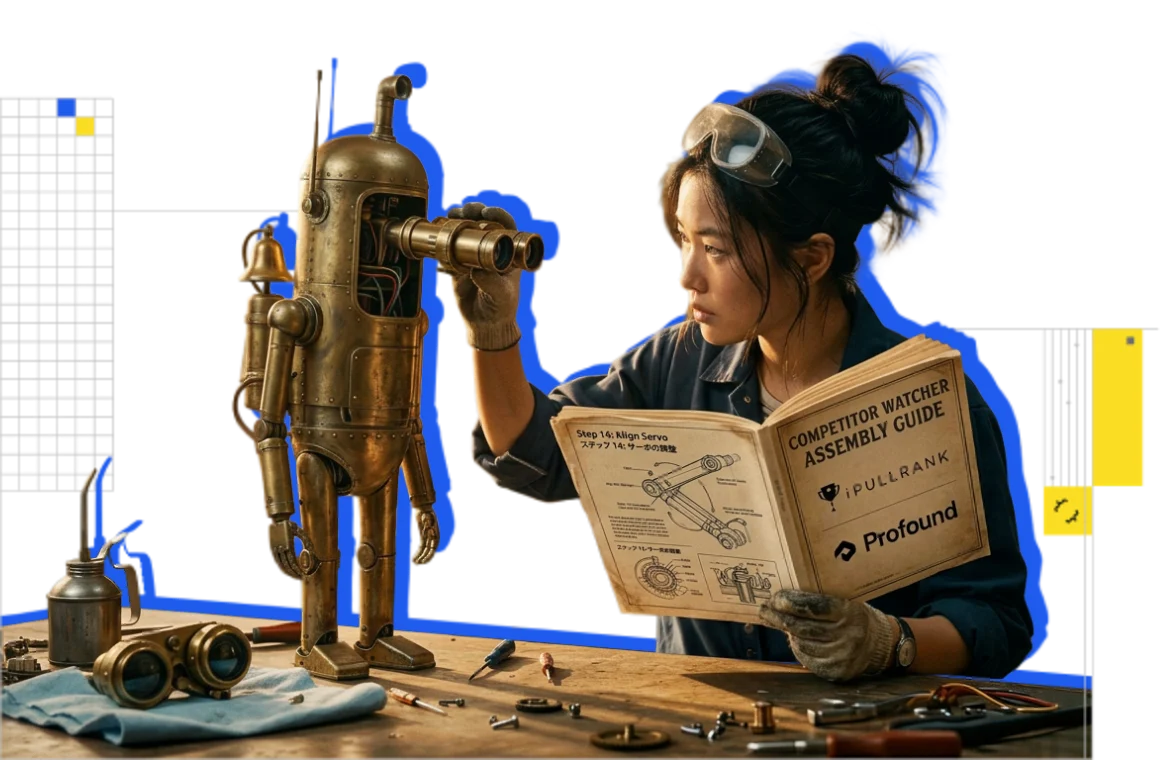
Your team sets the direction. AI agents connect the repeatable work across research, content, commerce, outreach, and measurement.
We design, build, and operate agents around your data and workflows. Your people make the decisions that shape your brand and your customers’ experience.
Useful signals are spread across dashboards, customer conversations, content tools, and teams. Acting on them takes time.
We help you connect those signals to the next task, the right person, and a clear measure of success.

We tailor every agent to your business and train it on your internal knowledge graph.
Here are a few ways your team could put them to work:
Watch competitors, spot demand emerging in communities, and test where your brand appears across simulated buyer journeys.

Flag lost AI citations, investigate why they changed, and draft page refreshes, briefs, and product FAQs.

Find shopping prompts where your products are missing, then support product descriptions, video metadata, and localization at scale.

Connect organic visits to subscribers or accounts, and turn questions from sales calls into topics to track.

Find relevant publications and draft pitches for your PR team to review and send.

Prepare visibility digests and bring rankings, citations, and subscriber growth into a clearer view of organic value.

Check schema and indexing, verify fixes, and flag conflicting brand facts across your site and other sources.
Agents can run on a schedule or respond to a signal. A recurring buyer question, for example, can trigger research into how your brand answers it. An agent can draft a brief and route it to your content team. A drop in AI citations can prompt an investigation and a proposed page update.
Your team decides what starts each workflow and approves what gets published, sent, or changed.
Each agent has a purpose, approved data sources, an owner,
and a way to measure whether it helps.

1. Review goals and workflow
2. Map agent opportunities
3. Agentic Operations Plan
4. Build the knowledge layer
5. Build the agent library
6. Evaluate and QA
7. Deploy and train
8. Agent Ops
We can connect tools such as Profound and AirOps with your data, CMS, Slack, and existing processes. When your needs call for it, we build custom agents and knowledge layers. The agents live in your workspace and belong to your team.
Marketing needs to reach people wherever they discover you and give them a reason to care. We bring Relevance Engineering and Resonance Design into each workflow, then evaluate agents for accuracy, relevance, brand voice, and usefulness to your team.
Explore The AI Search Manual and our work on agentic retrieval pipelines.

Your team sets the permissions. Agents can research, monitor, and report within those boundaries. Publishing, outreach, and changes to your site wait for a person. Evaluation thresholds, audit logs, and regular retesting help you manage quality as tools and models change.

Proof
//.proof_card_001
+++
175%
YoY GROWTH
in revenue
RELATED CONTENT AND SEARCH WORK: For a global eCommerce marketplace, AI-assisted category content and a repeatable testing workflow helped drive $290M+ in revenue and 175% year-over-year revenue growth.

Agentic solutions can also extend an existing iPullRank program.
3 Months
4–8 Agents
Build and deploy 4–8 AI agents to automate workflows across monitoring, research, content, and reporting. Establish a connected system with platform integrations, quality controls, and governance to support your marketing operations.
Download the one-sheet No. We can build around your current tools or develop a custom approach.
You do. We build them in your workspace and train your team to run them.
We test each agent against the standards for its task before launch and on a regular schedule.
They can monitor, research, and report within the permissions you set. A person approves publishing, outreach, and site changes.
Agent Ops includes retesting and updating affected agents.

Bring us a recurring task or a signal your team wants to act on sooner. We’ll explore what a useful first agent could do in a working session.
