

Your buyers are turning to AI Search to compare options, form opinions, and decide which brands to trust. When your visibility breaks down somewhere in that process, it’s easy to lose them before they ever reach you.
We can help you see exactly where that’s happening so you can figure out what to fix first, then translate that into a customized strategy your team can put into action.














AI Search has become a powerful brand and growth channel. Its value extends beyond rankings and traffic, shaping how buyers understand your business and whether your brand earns consideration.
Unlike traditional SEO, success requires the right teams to work as one. The more complex your organization, the more important it is to break down silos and build a holistic marketing program leadership can prioritize, measure, and grow.
Your brand’s AI Search presence is shaped everywhere it shows up, from owned experiences to the conversations happening around it. AI Search platforms use that broader footprint to understand and represent your business.
A comprehensive program brings it all into focus while creating work that earns attention and matters to the people you want to reach.

Relevance Engineering aligns your content strategy, technical foundation, user experience, PR, distribution, and off-site authority. It makes your brand easier for search engines and AI platforms to access, interpret, verify, and confidently include in answers throughout the buyer journey.

Resonance Design turns that foundation into content that earns attention. It combines audience insight, narrative, design, format, and creative execution to produce work that stops the scroll, speaks to people as people, and gives them a reason to trust, remember, and choose your brand.

Relevance helps your brand appear in the right contexts. Resonance makes that appearance matter. Together, they connect machine understanding with human response to build an AI Search presence that is visible, credible, and memorable.
We start with your goals, current visibility, internal resources, and ability to execute. Then we recommend the program mix that helps you make progress now and build the capability to keep improving.


Define where to compete, what to prioritize, and how search, audience, and AI visibility insights translate into measurable growth.

Build a content system that audits, plans, creates, optimizes, and promotes assets for measurable visibility across search, AI-led, and other digital channels.

Strengthen technical visibility through audits, implementation, measurement, and custom Relevance Engineering solutions that help platforms find and use your data.

Drive visibility through promotion, Digital PR, and community engagement. Build links, earn mentions, and position your brand inside the conversations that shape discovery.

Create content across media and channels, rooted in brand, search, and audience insight, so every asset can earn attention, build trust, and drive action.
When you are thinking about AI search, you need a strategy, and we've got the road map. We've got the deliverables. We've got everything you need to make sure that your brand is showing up in search. So when it comes to iPullRank, I'm joined today by Mike King, the founder and chief relevance engineer at the agency. We're crushing it. We're putting a ton of stuff out here, and he's gonna walk you through exactly what you get when you sign up for one of our engagements with our AI search strategy program. So, Mike, can you kind of kick it off and tell us, like, what these deliverables are, the value, and why they matter? Look. Your SEO agency is telling you that it's just SEO. I mean, there is some overlap, but that's not enough. Right? Like, if you just do SEO, you are not gonna get improvements to visibility in AI search in the way that you want. So what we do is our AI search pilot. We offer it in two different flavors, but this is the full flavor where we're doing the whole thing. So we do an AI search audit where we're looking at the site from a technical perspective, highlighting the key technical aspects that are stopping you from having visibility in these AI search platforms. We also do a keyword portfolio, which includes what we call our keyword matrix. Because these platforms aren't just using the query or the prompt that the user types in, they're extrapolating to a series of what are called synthetic queries in the background. So we identify those queries for you and then map them to the seed queries and show you where your gaps are. Because this is more about the content ecosystem than just your website, so things like social media, your earned media, your other owned properties, and so on. We're doing omni media content audits wherein we're reviewing everything in your content ecosystem and showing you again where the gaps are and helping you develop a plan for how you fix what you've already got. Then we expand further into our Omnimedia Content Plan where we talk about here's how we expand this beyond what you already have. What sort of videos do we want to make? We know that YouTube is the second most cited source in AI search. Another really important thing here is how do we measure all this? Measurement is a bit different in this environment. We do a measurement plan, we show you how to set up the right data pipelines and tooling that you need and dashboards so you can know what's actually happening here. The last thing is that we roll up all these insights on the executive level in our AI strategic roadmap. Everything that we've learned through the course of this engagement, we then give you in a strategic format that's going to work with your executive leadership so we can actually get things done. The different flavors are that we will do all of that or we will do that without the AI search roadmap or excuse me, strategic roadmap and the AI search audit. But most people want the whole thing and so that's what we've been doing and we've been getting great results for our clients on the back of it. So there you go. There there's, like, the nuts and bolts of what we're actually doing. So if you are an executive or you are on an SEO team and you know you wanna kinda level up to also get that sort of expertise, you know, kind of like consulting perspective with the strategy of like, what do you do? We are taking engagements. You can find the link and sign up, have a consultation, have a discovery, learn about the right fit. And if if it makes sense for you. We're doing this for, enterprises, mid markets. So check it out, and let's do something amazing together. Like, reach out and and talk to us because we're excited to help everyone show up without, like, the BS that you're hearing in the industry right now. Like, this is the real stuff. And remember, as Mike King always says, it's not just SEO.
Find the topics, questions, and buyer moments that deserve investment, then connect them to content priorities.
Okay. So where do you start with an AI search strategy? For us, it's all about the keyword portfolio. I'm here with Mike King, the founder and chief relevance engineer at iPullRank to talk you through, like, the specifics of how this deliverable works. Mike, what do you got? Our keyword portfolio has always been a pretty substantial deliverable because in most cases, when people do keyword research, it's just to list in keywords and search volumes. We've never felt like that's enough to be strategic about anything. We already were giving you, like, twenty two data points per keyword. Now we've added what we call the keyword matrix, where we're identifying the different synthetic queries that are being used as part of the query fan out. So in that, what we're doing is we're identifying, you know, what are your landing pages for those synthetic queries? What are your rankings for the synthetic queries? And then how do you score from a relevance perspective for different passages in those pages. So it's gonna give you a sense of where there might be semantic gaps where and why your competitors are outperforming you because if those scores are quite low, that's gonna be an indication that you're not gonna be chosen as part of that synthesis pipeline that these AI search platforms are using. We want to give clarity on what these systems are seeing so that you can use your qualitative understanding of what actual people want and combine that with the machine understanding and then make improvements to that content. So when you get the keyword portfolio, that's what you're getting. We walk you through it and answer any questions you have so you have this document to start building and mapping all that content. I wouldn't even call it a document. It's more like a tool, right? Like it's it's set up for slicing and dicing of data and targeting opportunities based on what is a priority for the business at the time. One the dimensions that we're looking at things on is going to be personas and need states and jobs to be done, things like that, so that you can say, okay. Well, for these business goals that we have going on, let me just toggle these data points, and now I have a subset of queries to go after. And to that point, it's even more critical as AI search becomes even more personalized. You can't just go top of the funnel everything to everyone anymore. You have to get into the personas. So if you're interested in this, you check it out. And, you know, as Mike King always says It's not just SEO.
See how your content performs across formats and channels, where authority breaks down, and which gaps matter most.
When you are planning out your AI search strategy, the first thing you're doing is you're getting all of your keywords and prompts through the AI keyword portfolio. But what do you do next? You need an Omnimedia content audit. I'm joined with Mike King, the founder and chief relevance engineer at iPullRank to walk you through this deliverable, why it matters, and why you should get it. So with AI search, it's not just about your website. It's about your content ecosystem. So you've got to consider what's going on in your shared, owned, earned properties. And what we do is we audit all of that because the whole goal here is that we want to have a stronger signal to these machines of the messages that we want out there. We're going to review everything that you have out there. We're going to review video content. We're going to review the site itself. We're going to review things that are happening on Reddit as it relates to the target keywords that we have identified in that keyword portfolio. And so we're gonna say like, here's the semantic gaps in that existing content, and then here are the recommendations on how to make improvements so that you and your team can go out and make adjustments to content, or you can work with us on doing that as well. So there you go. When it comes to what your strategy should be, this is already happening, and this is a way to kind of future proof your content strategy knowing that we're gonna see more and more multi modal content show up in AI search, seeing all those different content formats. So it's complex, but we know what we're doing. That's why, you know, as Mike King always says It's not just SEO.
Turn audit findings into a clear production, optimization, governance, and measurement roadmap.
When it comes to your AI search strategy, you've already looked at your website, you looked at all the other channels in terms of the omnichannel approach and audited those, But then you need to know, like, what do you do next? And that's where we kind of walk you through this next deliverable, which is the Omnimedia Content Plan. I'm here with Mike King, the founder and chief relevance engineer at iPullRank. He's gonna tell you what it is and why it matters. Mike? So AI search is a is very much about that content ecosystem. It's not just about what's on your website. So you gotta think about what's my plan gonna be to get more signal out there beyond my website. So yes, it does cover content that you should create for your website as the source of truth, but then it talks about like how do we do more YouTube videos effectively? How do we do UGC and make it work for us? How do we do digital PR effectively? Do we have other own media channels? How do we make all this work together so that that signal to the AI search platforms is very clear? So we're gonna map content opportunities to different audiences, their stages in the user journey. We're going to lay out content models for multi different formats because multimodal really matters here. And then we're also going build out workflows and governance models so this can actually happen. So we're building you a content system. We're not just saying like, hey, here's some ideas, execute on them. We're gonna figure out the best way to actually scale this for your organization. And whenever you get it, we walk you through it. And the other big thing when you, like, partner with us on this is to Mike's point with everything being omni channel, we can help you break down the silos within your organization to leverage all these other channels because it's it's not just about your page and you know as Mike King always says. It's not just SEO.
Define the visibility, citation, execution, and business metrics your team will use to track progress.
Okay. So you're walking through all of the different aspects of AI search strategy, but one of the biggest things, especially for the c suite executives, is is how do you report on this? It is so messy right now, and that's why we've put together such a comprehensive approach to AI search measurement. And one of the core deliverables of this strategy is the measurement plan. I'm joined by Mike King, the founder and chief relevance engineer at iPullRank, and he's gonna explain exactly what this is and why it matters for your business. Mike, what do you got? Yeah. So classic search measurement is really about performance, but AI search channels are more branding channels. So you've gotta really think about performance differently. And the way we do is we stratify it into three different buckets. So you've got your performance measures, you have your channel measures, and then you have your input measures. So the measurement plan is all about that. Like, how do we set up the right data pipeline so we can get the right data sets? How do we have the right tooling in place so that we can get the right data that we need? And then also, do we set up the right dashboard so you can log in at any point and see how things are going? And, you know, the data pipelining is a big component of that because a lot of this data is in disparate places. And so we've got to work with organizations to get them into one place so that we can have the level of dashboarding that we want. And what's wild too is with all of the different SEO and AI search tools out there, they are coming to us for feedback on how to improve it. So we know firsthand what metrics you really should be looking at even creating our own proprietary metrics in some cases. Because when it comes down to it, Mike, what do you always say? It's not just SEO.
Identify the technical, retrieval, entity, and passage-level barriers limiting visibility in AI answers.
Okay. When it comes to your AI search strategy, is your website actually accessible to all of the different bots out there? What are all the different technical and complex aspects that might be impacting your visibility? One of the core deliverables that we offer is a comprehensive AI search audit. I'm joined by Mike King, the founder and chief relevance engineer at iPullRank. He's gonna explain what this deliverable is, why it's so valuable, and what why you need it. Mike, what do you got? So the AI search audit is a comprehensive review of your visibility and performance in the AI driven conversational search experience. And so we're looking at it from a perspective of like, what does it take to get into these platforms, specifically that's unique from classic SEO? There's some overlapping things as well because when you talk about things like JavaScript rendering, that's really important because most of these platforms don't do rendering. But we're parsing this deliverable between the retrieval chain optimization, so things like fetching, indexing, ranking, passage selection, so on. We're also looking at citation architecture and trust signals. We're looking at schema machine interpretability, all those certain really specific things that you need to solve technically in order to have that visibility in AI search. So that's why it's so important going forward, and not enough brands are actually doing this. And this is when you're looking and seeing whether you're showing up and being recommended compared to your competitors is a big reason why you may not be. And another reason that Mike always says, it's not just SEO.
Bring priorities, owners, timing, and dependencies into one plan leadership & delivery teams can act on.
When you are looking at your AI search strategy, you've done all these deliverables with us, and you need to bring it all together. Like, what is next? Where do you go from here? That's why our final deliverable to send you off, and it's really key for the executive c suite, is your AI search strategic road map. I'm joined by Mike King, the founder and chief relevance engineer at iPullRank. He's going to break down what this deliverable is and why it matters to your org. Mike? Yeah. I mean, you do all this work for any sort of search environment. It's really technical. It's really in the weeds. You've got to level it up so that you can have the right conversations with your c level executives. And so it's really a top level executive summary of everything that we've indicated in the different documents. We talk about the current state, the key insights, we give the strategic objectives, the prioritization criteria, we give a business impact analysis, then we give timelines and milestones, we talk about resourcing and budget considerations, and then what does the ongoing governance framework look like as well. So at that point, you have everything you need in a very sleek, succinct deck on how to move forward with this. And what we find is that the C level reacts very well to that because it gives them just the information that they need. And that's why when you hire iPullRank, you are getting the most mature, responsible, comprehensive, and innovative approach to AI search strategy going forward. It's why all of these top enterprise Fortune five hundred brands and mid markets hire us and why you should actually start a conversation today. Because ultimately, when it comes down to it, Mike, what do you always say? It's not just SEO.
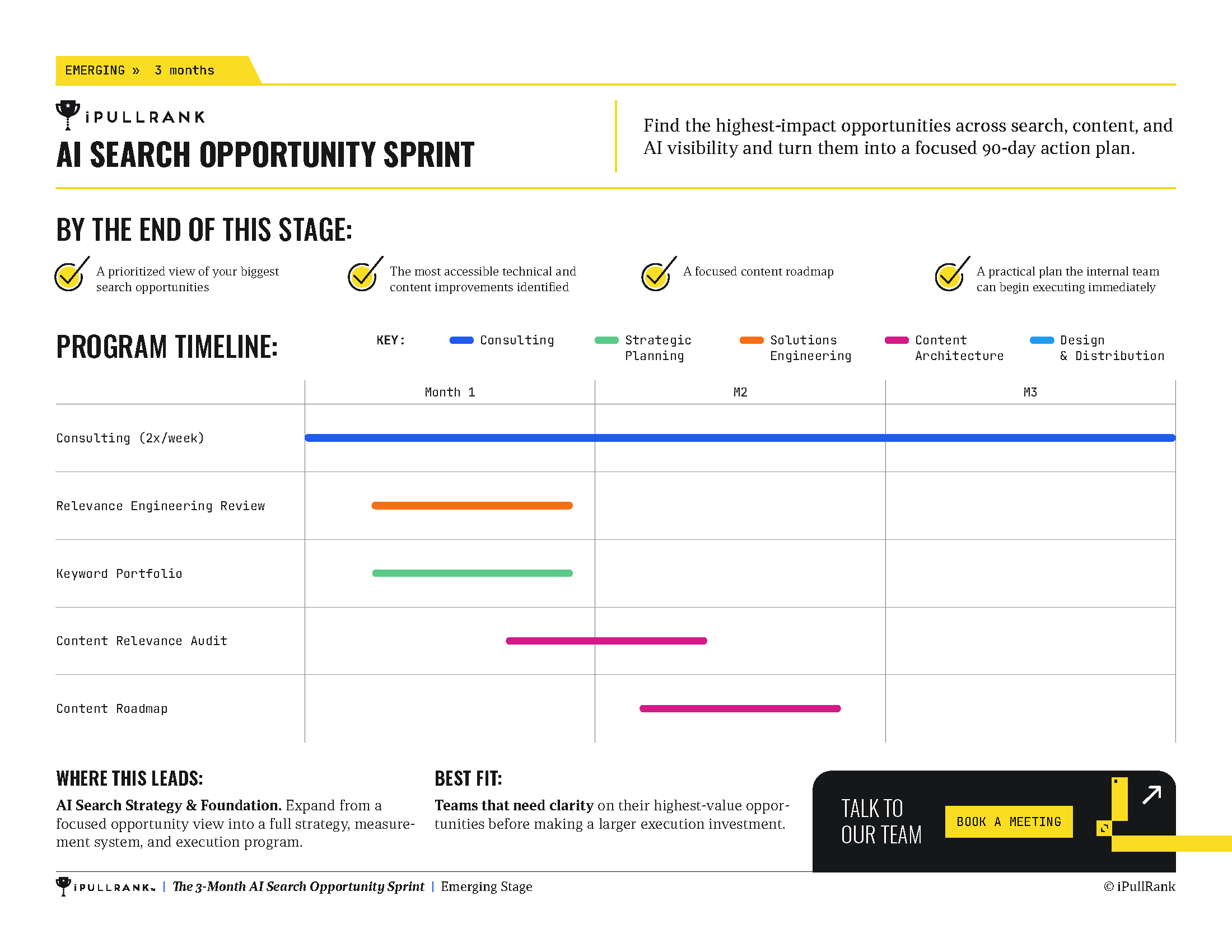
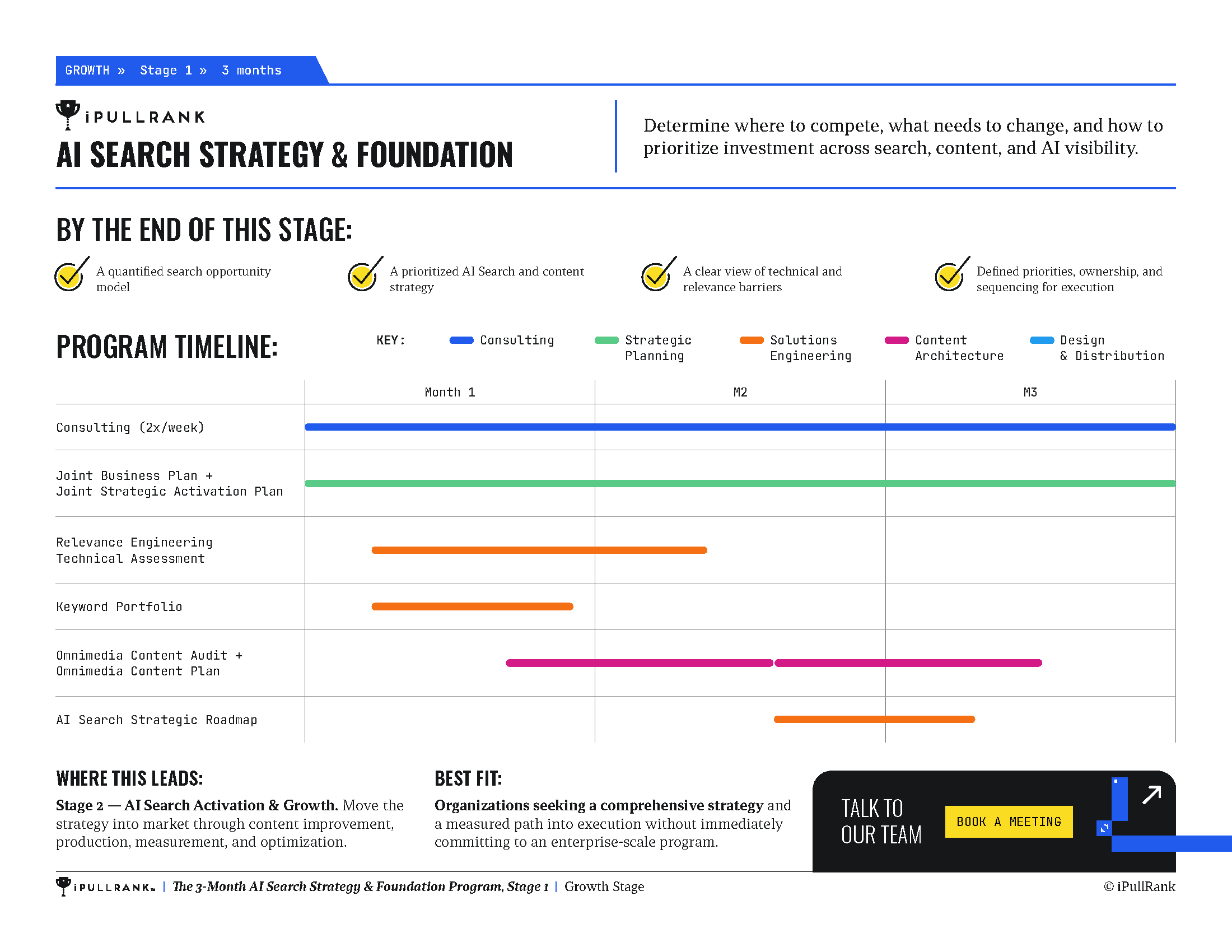
A focused 3-month engagement for teams that need clarity before scale. Identify the highest-impact search, content, and technical opportunities, then turn them into a practical 90-day action plan.
Program Timeline — EMERGING, 3 months
Hover or tap any bar, dot, or legend item for details. Timing shown is directional and adjusts based on kickoff date and scope.
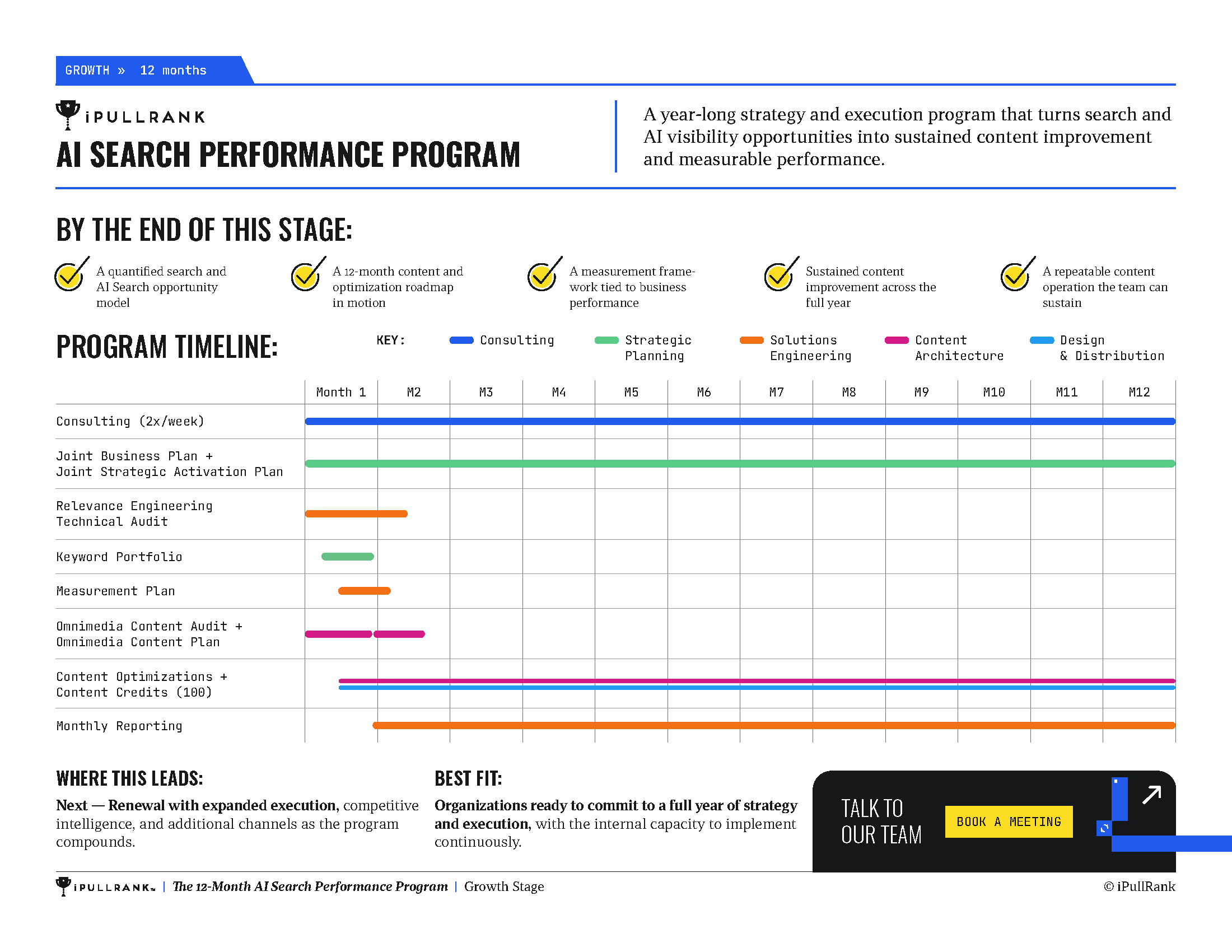
A full-year program for teams ready to connect strategy, technical work, content, authority, execution, and measurement in one continuous cycle. The program builds momentum across the year while adapting to what the data shows.
Program Timeline — GROWTH, 12 months
Hover or tap any bar, dot, or legend item for details. Timing shown is directional and adjusts based on kickoff date and scope.
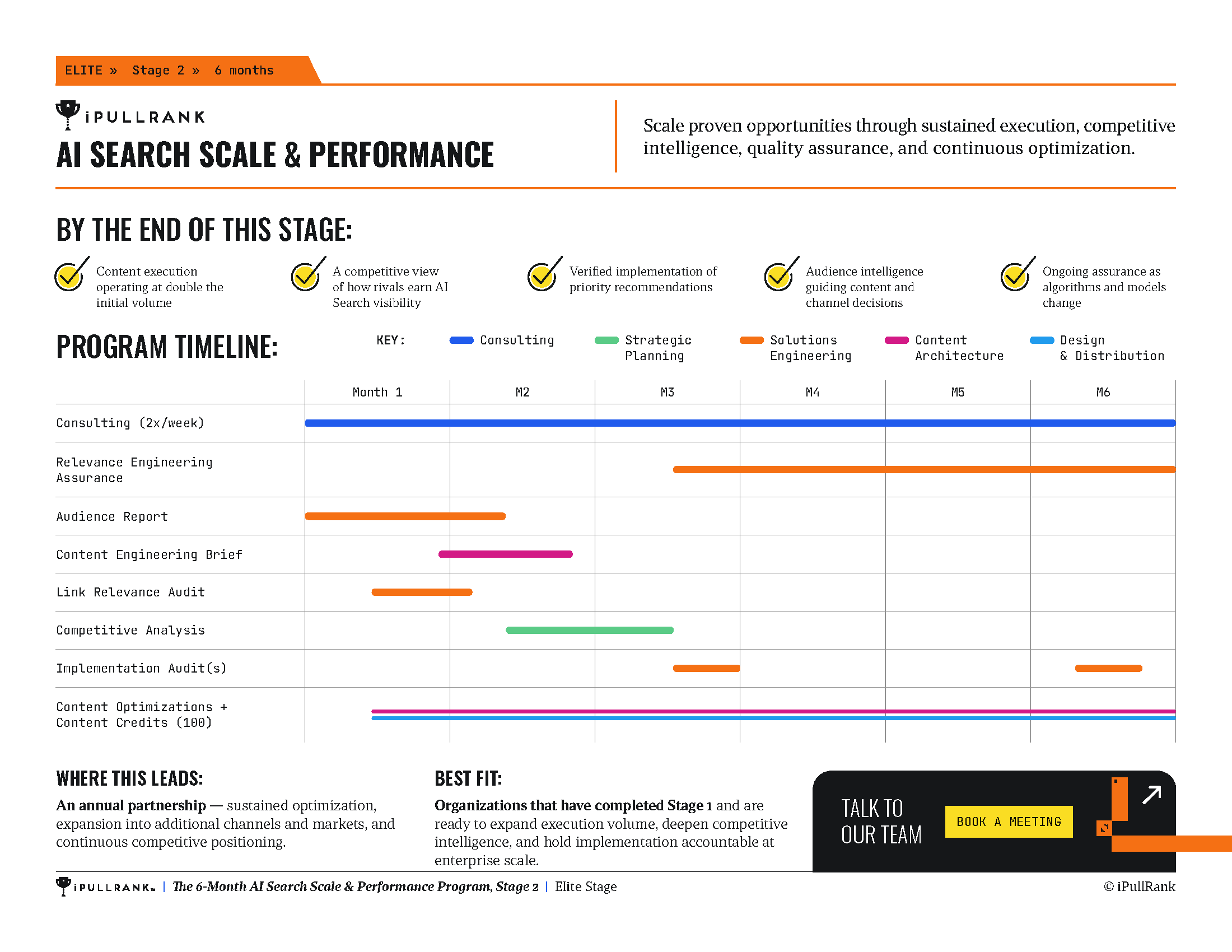
A full-year enterprise program for organizations that need cross-functional alignment, scaled technical and content execution, executive measurement, governance, and continuous assurance as AI platforms change.
Program Timeline — ELITE, 12 months
Hover or tap any bar, dot, or legend item for details. Timing shown is directional and adjusts based on kickoff date and scope.
+AI Search is evolving too quickly for anyone to claim a finished formula. The results below show how more than a decade of solving Organic Search challenges can be applied to a more complex visibility problem, with measurement guiding each next move.

Michael’s focus: AI Search strategy, Relevance Engineering, and executive consulting.

Fajr’s focus: content strategy, content systems, and scalable execution.

Zach’s focus: search strategy, analytics, measurement, and performance reporting.

Patrick’s focus: technical SEO, automation, passage analysis, and measurable implementation.
You do not need to choose a program before you book. Our team will learn what leadership is asking, where your team is getting stuck, and what you can realistically execute. We will bring the right specialists into the next step and recommend a scope tied to your goals.
Prefer to share context first?
Request a Program Recommendation.
The AI Search Readiness Quiz helps you assess leadership urgency, technical health, content capacity, measurement maturity, authority, and ability to execute. You will get a recommended starting point in a few minutes.
Now let’s get started and build a mature AI Search strategy for your brand.After you submit the form, we’ll review your details and follow up to schedule a conversation. We want to understand your business, identify the right opportunities, and see where iPullRank can help you win across classic search and AI Search.
Find your highest-impact opportunities across search, content, and AI visibility, then turn them into a focused 90-day action plan.
Connect a full year of AI Search strategy, content execution, measurement, and reporting to sustained improvement and measurable performance.
Clarify where to compete, what must change, and how to prioritize investment across search, content, and AI visibility.
Move a validated strategy into sustained execution through content improvement, production, measurement, and ongoing optimization.

Extend a validated strategy through deeper content execution, competitive intelligence, link analysis, and ongoing performance measurement.
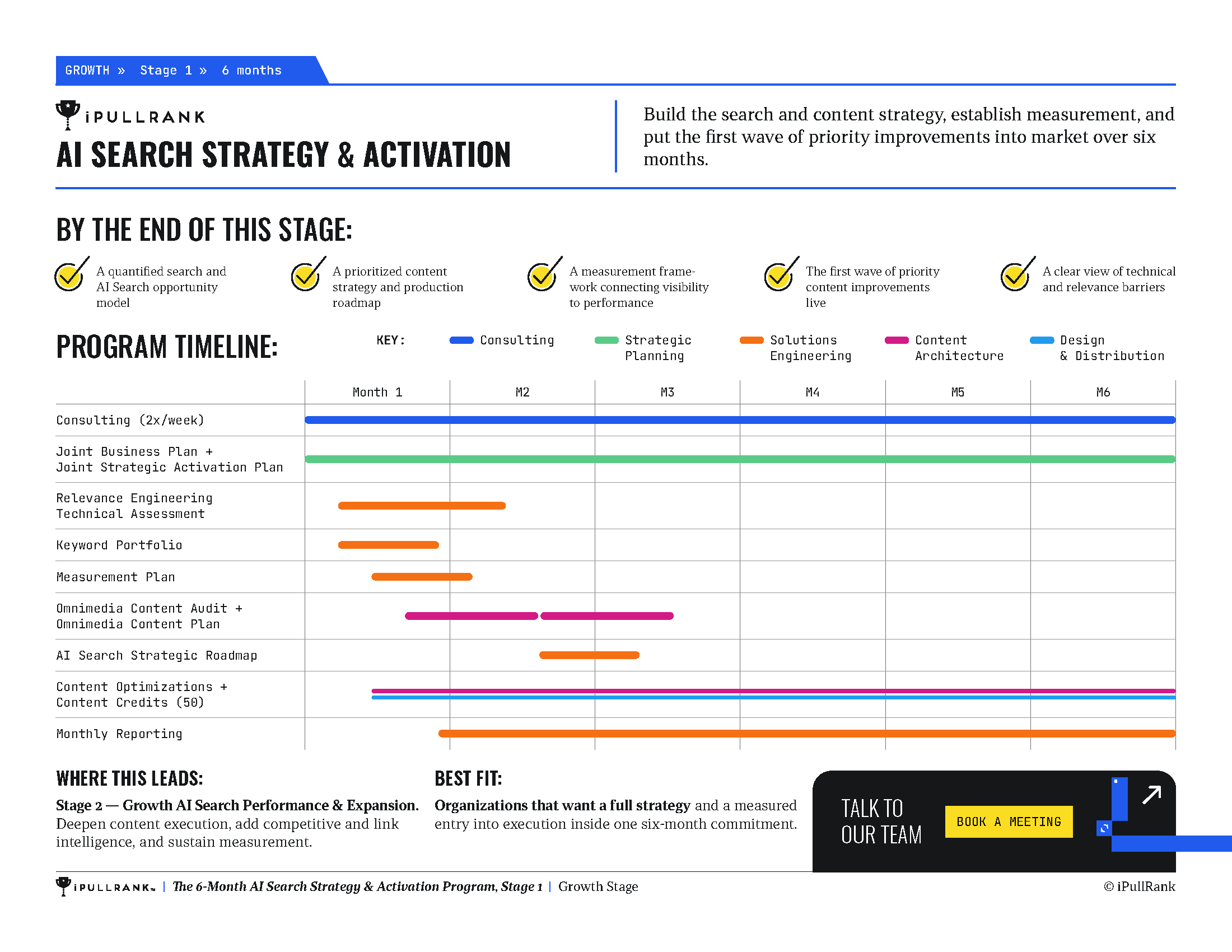
Extend a validated strategy through deeper content execution, competitive intelligence, link analysis, and ongoing performance measurement.

Coordinate enterprise AI Search strategy, content, competitive intelligence, implementation, and measurement through one year-long performance program.
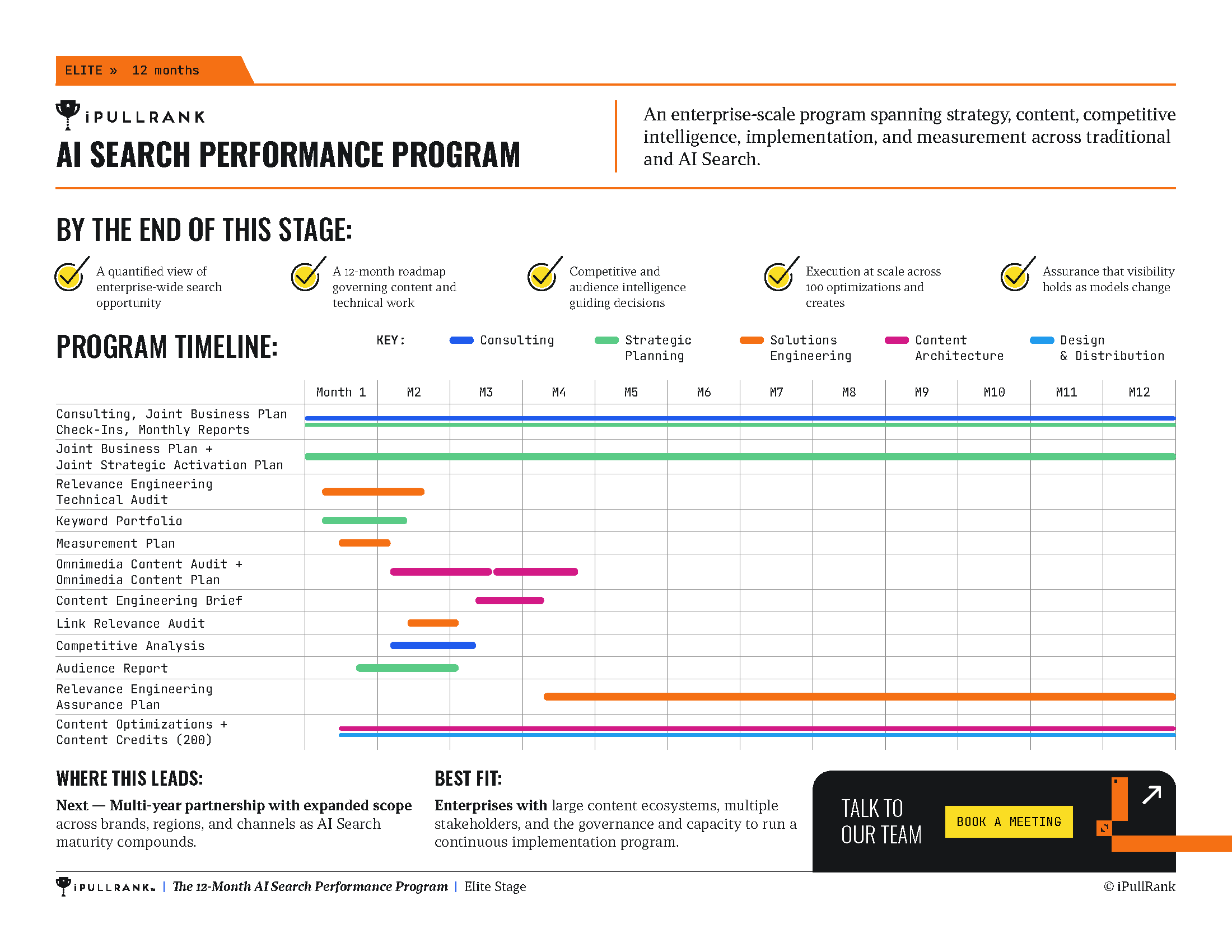
Build enterprise AI Search strategy, establish measurement, and launch the first wave of priority improvements over six months.
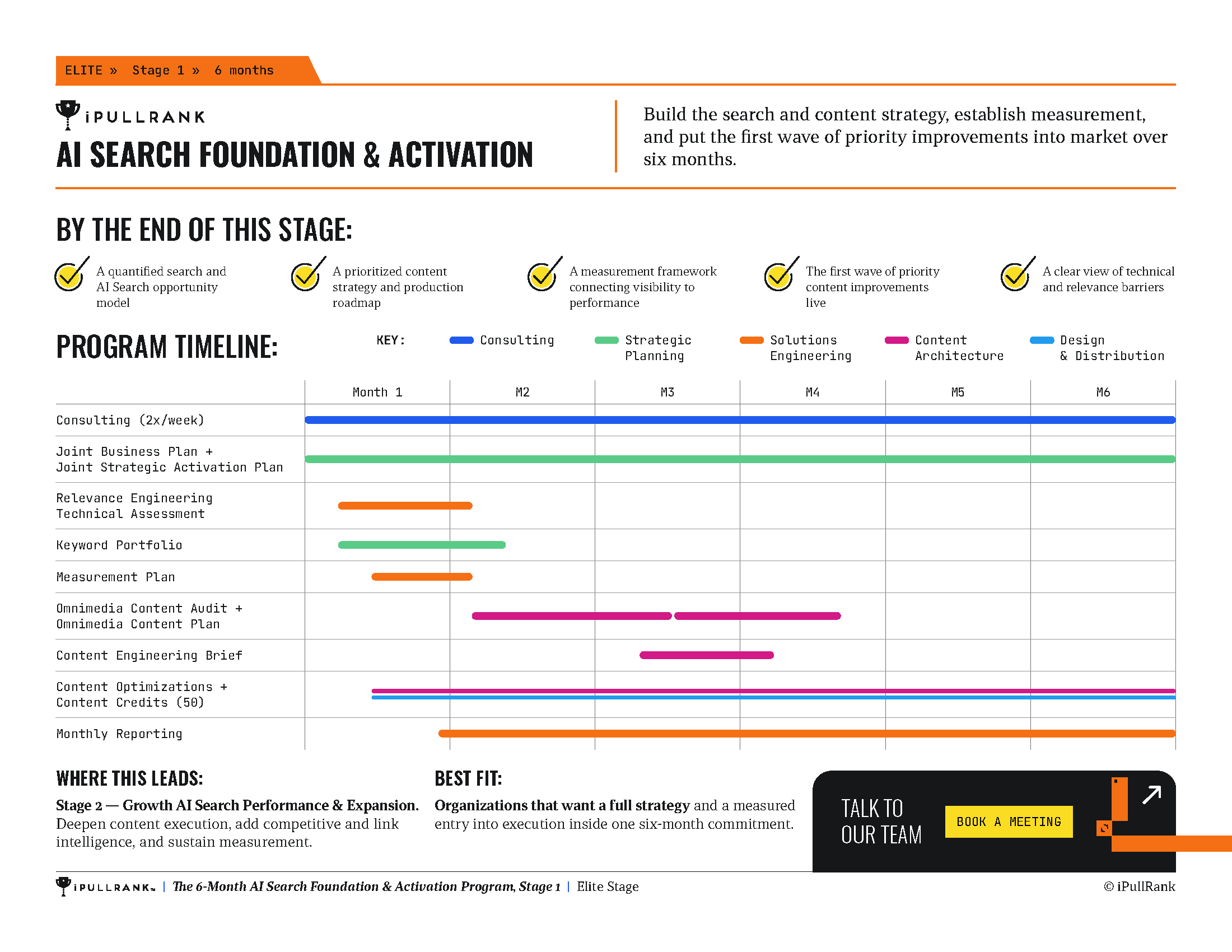
Scale proven opportunities through sustained execution, competitive intelligence, quality assurance, and continuous optimization at enterprise scale.