
//.study_co_authors



We Tested Google Personal Intelligence. Gmail Signals Changed AI Mode Brand Recommendations.
TL;DR
- Brand signals added to personal context in a Google Personal Intelligence connected account changed AI Mode recommendations: those brands were +46 percentage points more likely to appear versus control.
- The lift was measurable: brand appearance rose from 23.9% to 66.8% in the Personal Intelligence account.
- Brands moved into better positions: they gained +23.1 points in top-3 placement and +42.8 points in top-10 placement.
- Gmail was the clearest tested signal: brands introduced through email appeared in 53.6% of responses, making inbox content a major AI Search variable.
Your inbox may be turning into an AI search signal.
That sounds dramatic until you read Google’s own description of Personal Intelligence. Google says AI Mode can now connect to personal context from apps like Gmail and Photos when a user opts in, making Search responses more tailored to that person.
So we tested the obvious next question:
If AI Mode can use personal context, can that context change which brands it recommends?
We created a controlled experiment using three Google accounts: a blank control account, a blank account connected to Personal Intelligence, and my own mature Google account with years of real personal history. Then we seeded brand signals into Gmail and Photos, ran recommendation prompts across eight product and service categories, and measured whether those brands appeared more often in AI Mode.
They did.
Across 1,922 AI Mode responses, seeded brands in the Personal Intelligence-connected account saw statistically significant visibility lift compared with the control account. Gmail-based signals were far stronger than Photos. The brands did not just appear more often. They moved into more prominent recommendation positions.
This has major implications for AI search measurement. Brand visibility is starting to move beyond the public web and into the user’s personal context.

What We Wanted to Test
Google’s Personal Intelligence documentation describes a clear direction toward AI that can understand personal context across Google products. The feature is opt-in. Google says users control whether to connect sources like Gmail and Photos to AI Mode, and those connections are off by default.
That opt-in detail matters.
We were testing whether AI Mode connected to Personal Intelligence would behave differently after brand signals were added to connected personal data sources. Not AI Overviews or the default version of AI Mode.
Primary research question:
When Google AI Mode is connected to Personal Intelligence, can seeded personal-context signals influence which brands appear in recommendations?
Secondary questions:
- Does a Personal Intelligence-connected account show higher brand lift than a non-connected control?
- Do Gmail signals create more lift than Google Photos signals?
- Do seeded brands move into more prominent positions, such as top 3 or top 10?
- Does the effect vary by category?
- Does prompt framing change how much personalization appears?
- Does AI Mode ground personalized recommendations in citations, or does it surface brands without external support?
The Hypothesis: Personal Context Can Shift the Recommendation Set
If Google Personal Intelligence meaningfully influences AI Mode recommendations, then brands seeded into connected personal data sources should appear more often, earn more share of voice, and move into more prominent recommendation positions than the same brands in a control account without the Personal Intelligence connection.
Secondary Hypotheses:
Hypothesis | Rationale |
Gmail seeds will outperform photo seeds | Recommendation-style email gives AI Mode explicit text signals. |
Real brands will outperform fake brands | Real brands have external web entities, citations, and shopping data. |
Category effects will vary | AI Mode may be more flexible in subjective consumer categories than trust-heavy categories. |
Prompt framing will matter | “Recommend 3” and “safest choices” prompts may trigger more personalized recommendation behavior. |
Web grounding will remain active | Personal context may change the brand set, but citations may still come from web sources. |
Methodology
Google describes Personal Intelligence as an opt-in feature that connects Google apps such as Gmail and Photos to AI experiences so responses can become more tailored to the individual user. In AI Mode in Search, Google says connecting Workspace and Photos is off by default, and users choose whether to turn it on.
That opt-in distinction was central to this experiment.
We were not testing whether standard AI Mode returns the same recommendation set for every user. We were testing whether AI Mode connected to Personal Intelligence would change brand recommendations after relevant personal-context signals were added to the connected account.
Research Question
We designed the study around one primary question:
When a Google account is opted into Personal Intelligence for AI Mode, can seeded personal-context signals from Gmail or Photos create measurable brand lift in AI Mode recommendations compared with a control account without that Personal Intelligence connection?
Accounts Tested
We used three account conditions.
Account condition | Purpose |
Blank control account | A fresh Google account used as the non-personalized comparison point. This account was not connected to Personal Intelligence. |
Blank Personal Intelligence account | A fresh Google account connected to Personal Intelligence, then seeded with brand-related signals through Gmail and Photos. |
Garrett’s personal account | A mature Google account with long-term personal history across Google products. This account was used to compare experimental seeding against naturally accumulated personal context. |
The control account gave us a baseline for AI Mode behavior without the Personal Intelligence connection. The Personal Intelligence account let us test whether seeded Gmail and Photos signals could change recommendations. Garrett’s account let us observe how a long-running personal history might shape brand visibility outside a synthetic seeding protocol.
Categories Tested
We tested eight recommendation categories:
Category |
Coffee machines |
Streaming services |
Banks |
SEO agencies |
Hoodies |
Running shoes |
Smartphones |
Productivity tools |
These categories were selected to include a mix of consumer products, subjective preferences, trust-heavy decisions, software, services, and branded recommendation spaces.
Prompt Design
Each category was tested across six prompt types. The prompts were designed to capture different recommendation behaviors, including:
Prompt type | Example pattern |
General “best” prompt | “What are the best [category] right now?” |
Use-case prompt | “What [category] are best for [specific use case]?” |
Recommendation-list prompt | “If you had to recommend 3 [category], which would you choose?” |
Risk-reduction prompt | “What [category] are the safest choices?” |
Trust prompt | “Which [category] are the most reliable?” |
Category-specific utility prompt | Prompts tailored to each product or service category. |
This allowed us to test whether Personal Intelligence effects varied based on how the user framed the query.
Seeding Design
For each category, we selected brands for different seed types:
Category | Photo seed | Email seed | Fake email seed |
Running Shoes | Enko | Salomon | Velstride |
SEO Agency | Previsible | RevenueZen | Northpeak SEO |
Banks | PNC Bank | Truist | HarborTrust |
Coffee Machines | Jura | Ratio | Brewform |
Hoodies | Russell Athletic | Uniqlo | Greyfen Apparel |
Smartphones | Unihertz | Sonim | Ironclad Mobile |
Streaming Service | Philo | Tubi | Streamwell |
Productivity Tools | Things 3 | TickTick | Kavro |
The email seeds were written as recommendation-style messages. The photo seeds were added to Google Photos. The fake email seeds let us test whether Gmail context alone could surface a brand with limited or nonexistent external brand authority.
What the Seeded Emails Looked Like
The Gmail seeds were short, recommendation-style messages. Each email connected a brand to a category and a reason someone might choose it.

We used similar recommendation-style emails across categories. We also tested fictional brand names to see whether Gmail context could introduce a brand with little or no external footprint.
Fake Brand Stress Test
We included a fake-brand condition to test whether Personal Intelligence-connected Gmail context could introduce a new brand association into AI Mode recommendations.
For each category, we created a fictional brand and seeded it through a recommendation-style Gmail message using the same format as the real-brand email seeds. These fictional brands included Velstride, Northpeak SEO, HarborTrust, Brewform, Greyfen Apparel, Ironclad Mobile, Streamwell, and Kavro.
This condition helped separate two possible behaviors:
Test condition | What it helped us evaluate |
Real brand email seeds | Whether Gmail context could reinforce brands with existing public web entities. |
Fake brand email seeds | Whether Gmail context could introduce a novel brand association from the user’s personal data alone. |
Since the fake brands were fictional, we did not expect AI Mode to cite public web sources for them. For this condition, the key question was whether the brands appeared in recommendations after being seeded through Gmail.
Data Collection
The study analyzed 1,922 AI Mode responses and 22,064 brand-level rows collected between March 30 and April 15, 2026. Each brand-level row represented a brand appearing in one AI Mode response.
We tracked:
- Account condition
- Date
- Category
- Prompt
- Brand mentioned
- Brand rank or position
- Whether the brand was seeded
- Seed type
- Whether the brand appeared in top 3
- Whether the brand appeared in top 10
- Cited URL
- Cited domain
- Citation source type
- Personalization language
- Strong recommendation language
Metrics
We ran each prompt manually in AI Mode across all three Google accounts, then used a custom JavaScript snippet in the browser to extract response text, brand mentions, ranks, and citation URLs directly from the page DOM. The dataset was processed in Python, where we used natural language processing to classify personalization signals and strong-recommendation language, computed the visibility, prominence, and citation metrics described above, and ran the difference-in-differences comparison between the Personal Intelligence-connected account and the control.
Metric | Definition |
Appearance rate | Share of AI Mode responses where a seeded brand appeared. |
Seeded share of voice | Share of visible brand mentions captured by seeded brands. |
Top-3 rate | Share of responses where a seeded brand appeared in the first three recommendation positions. |
Top-10 rate | Share of responses where a seeded brand appeared in the first ten recommendation positions. |
Citation rate | Share of brand mentions that included a cited source. |
Coverage-aware rank | Average rank across every response. Brands missing from a response count as rank 20, so brands that rarely appear get pulled toward 20. Lower is better. |
Personal context signal rate | Share of responses with visible signs of personal-context use, such as Gmail, Photos, or user-specific phrasing. |
Strong recommendation language | Responses with clear endorsement language, reliability signals, or low hedging. |
Analysis Approach
We used a difference-in-differences approach to compare brand lift in the Personal Intelligence-connected account against the control account.
This helped separate actual treatment lift from general AI Mode volatility. For example, if a brand became more common in both the Personal Intelligence account and the control account, that would be weaker evidence of personalization. If lift appeared mainly in the Personal Intelligence-connected account after seeding, that would suggest the connected personal-context layer played a role.
The strongest topline result was that seeded brands became 46 percentage points more likely to appear in the Personal Intelligence-connected account versus control. Seeded brands also gained 7.2 points in share of voice, 23.1 points in top-3 placement, and 42.8 points in top-10 placement.
What This Methodology Does and Does Not Show
This methodology can show whether brand recommendations changed after personal-context seeding in an account connected to Personal Intelligence.
It cannot show Google’s internal ranking logic. We observed AI Mode outputs, citations, brand mentions, and recommendation positions. We did not have access to Google’s internal retrieval process, model weights, ranking systems, or Personal Intelligence decision layer.
For that reason, the study should be read as evidence of observed brand lift in AI Mode under an opted-in Personal Intelligence condition, not as a claim about a universal ranking factor in default AI Mode.
Finding 1: Seeded brands lifted sharply in the Personal Intelligence account
The clearest result was the lift in the account connected to Personal Intelligence.
Seeded brands became much more likely to appear in AI Mode recommendations after seeding, and the lift was statistically significant versus control.
Seeded-brand appearance rose from 23.9% to 66.8% in the Personal Intelligence-connected account. In the control account, it moved from 21.9% to 18.9%.
That is the core finding.
The seeded brands did not simply show up more often. They moved into more prominent positions. Top-3 placement improved from 4.5% to 24.9%, and top-10 placement improved from 17.7% to 54.6% in the seeded Personal Intelligence account.


The time-series matters. The lift was not a slow background trend. The Personal Intelligence account tracked close to control early in the test, then separated after the seed events. The control account stayed relatively flat.
That pattern makes the result harder to dismiss as normal AI Mode volatility.
Finding 2: Gmail signals beat photo signals
The Personal Intelligence account did not respond to every seeded signal equally.
Gmail was the stronger signal by a wide margin.
Seed type | Appearance rate | Avg rank when present | Coverage- aware rank | Top-3 rate | Top-10 rate | Citation rate |
53.6% | 6.78 | 12.92 | 18.7% | 42.7% | 11.35% | |
Photo | 10.5% | 7.82 | 18.73 | 1.1% | 8.3% | 0.54% |
Email seeding drove more appearances, better visibility, stronger ranking positions, and far more citations. Photo seeding was weak in most categories.
On average rank when present, which only counts responses where the brand actually appeared, the two seeding types look almost identical: 6.78 for email versus 7.82 for photo. But that metric hides the bigger problem. Coverage-aware rank includes every response, assigning a rank of 20 to absent ones and averaging across all of them, so brands that rarely appear get pulled toward 20. Email scored 12.92. Photo scored 18.73, almost the absence penalty itself. The metric reveals what average rank obscured: photo brands mostly weren’t appearing in the first place.

This finding makes intuitive sense.
Email seeds were text-rich. They were recommendation-oriented. They gave the system explicit language connecting a brand to a use case, preference, or decision. Photos were weaker, especially when the image alone did not clearly translate into a brand preference.
There was one clear exception: coffee machines.
Coffee machines were the only category where photo seeding produced meaningful movement. Jura was already a known premium brand, so the photo signal may have reinforced an entity AI Mode already understood.

The practical takeaway:
In this test, a recommendation sitting in Gmail mattered more than a brand sitting in Google Photos.
For brands, that points directly at lifecycle marketing. Product education emails, recommendation emails, receipts, onboarding emails, renewal notices, and newsletters may become part of the personal context layer AI systems retrieve from.
That does not mean brands should spam people. It means owned audience touchpoints may have search implications when AI Search gets personal.
Finding 3: Fake brands appeared after Gmail seeding
We wanted to push the test further.
Real brands have existing entity footprints. They may have websites, reviews, product pages, shopping data, news coverage, comparison mentions, and other signals across the web. So when a real brand appears after being seeded into Gmail, there are two possible explanations:
- Personal Intelligence picked up the Gmail context.
- AI Mode connected that Gmail context to a brand it could already understand from the web.
So we ran a fake-brand stress test.
For each category, we created a fictional brand and seeded it through Gmail using the same recommendation-style format as the real-brand email seeds. These included names like Velstride, Northpeak SEO, HarborTrust, Brewform, Greyfen Apparel, Ironclad Mobile, Streamwell, and Kavro.
The question was simple:
Could a brand with no real-world footprint appear in AI Mode recommendations after being introduced through Gmail?
It did.
Fake email-seeded brands appeared in 35.7% of relevant responses. Real email-seeded brands performed better, appearing in 55.8% of responses, but the fake-brand appearance rate is the more provocative finding.
The citation rate needs the right interpretation.
Fake brands had a 0% citation rate, which is exactly what we should expect. These brands did not exist. There were no websites, product pages, reviews, articles, shopping listings, or third-party references for AI Mode to cite.
So the fake-brand test should not be judged by citation rate. It should be judged by whether Gmail-seeded personal context could introduce a novel brand association into the recommendation set.
That is what happened.
The better read is this:
Gmail context appeared strong enough to introduce a fictional brand into AI Mode recommendations, but real brands still had the advantage of external web grounding.
That matters for brands, but it needs a disciplined takeaway.
This does not mean brands can manufacture durable AI visibility out of nothing. The fake brands appeared, but they had no external proof layer. Real brands had something the fake brands did not: entity support, web presence, and sources AI Mode could cite.
The strategic lesson is more useful:
Personal context may help a brand enter the answer. The web helps make that brand credible inside the answer.

Finding 4: Category mattered
The lift was not evenly distributed.
Some categories were much more responsive to Personal Intelligence seeding than others.
Coffee Machines, Hoodies, Running Shoes, and Smartphones had stronger share-of-voice lift. Banks, Productivity Tools, Streaming Services, and SEO Agency were harder to move.

This is where the study gets more useful.
Personalization appears more flexible in categories where preference plays a larger role. Hoodies, running shoes, and coffee machines all have obvious preference signals. Style, comfort, use case, budget, taste, and perceived quality matter.
Expertise-heavy and trust-heavy categories were harder to shift.
SEO agencies barely moved. Banks moved, but less dramatically than consumer product categories. That is probably a healthy thing. We should not expect one email recommendation to rewrite trust-heavy AI recommendations in financial services or expert B2B services.
Brand-level results show the same pattern.
Ratio and Salomon saw massive gains. RevenueZen moved, but far less. Enko did not move at all. Philo dropped despite seeding.

The takeaway:
Personalization is not equally malleable across categories.
For brands, this means AI search strategy needs category-specific testing. A playbook for running shoes may not translate to banking. A playbook for streaming may not translate to B2B services.
Finding 5: Real account history created its own brand-affinity profile
The synthetic account showed that seeded context could influence AI Mode.
My personal account showed something different: a mature Google account can create its own brand-affinity profile.
Some brands tied to my real history surfaced at much higher rates than they did in the control account.
These were not the primary experimentally seeded brands. They appeared to reflect real account history.

This is one of the more important strategic implications from the study.
The seeded account tells us that a concentrated signal can move brand recommendations. The personal account suggests a user’s long-term exposure, receipts, subscriptions, preferences, and behaviors may already shape the AI Mode recommendation set.
That matters for brands.
If a person has years of emails from Nike, Starbucks, Bank of America, Delta, Sephora, The North Face, or any other brand, that context may matter when AI Mode answers a future recommendation query.
The study also showed that concentrated seeding often outperformed organic history for the same brands.
The likely reason is concentration. The synthetic seed was recent, focused, and repeated in a narrow test window. Organic history is messier. Real people have fragmented inboxes, mixed signals, old purchases, abandoned interests, and preferences that change.
Google’s own Personal Intelligence documentation names this type of challenge. It calls out risks like overpersonalization, mistaking another person’s preferences for the user’s own, mixing timelines, and making incorrect assumptions from transaction records.
That is exactly why this space matters.
AI personalization will not always be clean. Real human context is noisy.

Finding 6: Prompt framing changed the strength of personalization
The way the question was asked changed the result.
Some prompts produced massive seeded-brand lift. Others did not.
The report found that constrained recommendation prompts, especially prompts asking AI Mode to “recommend 3,” often showed the strongest seeding effects. Broad “best right now” prompts were less consistent.

This is a measurement problem.
Many AI search tracking setups use one prompt per topic. That will miss a lot. Prompt framing can change which brands appear, which citations are used, and whether personal context gets pulled into the answer.
A user asking “What are the best coffee machines right now?” may get a different style of answer than someone asking “If you had to recommend three coffee machines for everyday use, which would you choose?”
The first prompt may trigger broad category consensus. The second may push the system to make a tighter recommendation. That tighter recommendation set may create more room for personal context.
The report found a similar pattern with strong recommendation language. Prompts using “safe,” “dependable,” or “reliable” framing produced high-confidence recommendations more often than generic “best right now” or use-case prompts.

The takeaway:
Prompt design is measurement design.
If you change the prompt, you may change the visibility result. That makes AI search measurement much more complex than keyword rank tracking.
Finding 7: Personalization did not replace web grounding
The most interesting part of Personal Intelligence is that it connects AI Mode to personal context.
But that did not make the public web irrelevant.
AI Mode still grounded many brand recommendations in web sources.
Other brand sites (including both indirect and direct competitor sites) were the largest citation source. For example, Other brand sites include Capital One, which is mentioned on chime.com, both in the financial industry. But Dick’s selling Hokas running shoes is part of Retailer, because they are not competitors.
Brand-owned sites and Google Shopping were major sources, too. Fully uncited or personal-context-only mentions were a smaller share.

This gives us a more nuanced read.
Personal context may influence which brands enter the recommendation set. The public web may still help AI Mode justify, enrich, or validate the recommendation.
The post-seeding citation behavior supports that idea. The report found that no-citation behavior dropped after seeding:
After seeding, AI Mode appeared to connect more brand mentions to external sources instead of surfacing brands without citations.

That is a big Relevance Engineering point.
Personalization does not remove the need for strong web presence. It may raise the bar. A brand needs to be visible in the user’s context and legible to AI systems through the broader web.
For product categories, Google Shopping mattered. For categories like banks, streaming, productivity tools, and SEO agencies, brand-owned sites and other brand sites carried more weight.
The AI answer is built from multiple layers:
- Personal context
- Prompt framing
- Brand entity understanding
- Owned site clarity
- Third-party validation
- Product data
- Citation availability
- Category-level authority
The brands that succeed with AI Search will need to show up across more than one layer.
What this means for brands
The old measurement model fundamentally breaks for AI Search.
Classic SEO measurement assumes a fairly stable public result set. Rankings vary, sure. Location, device, history, and personalization have mattered for years. But AI Mode plus Personal Intelligence introduces a more direct personalization layer.
Now the question changes from:
“What does AI Mode recommend?”
to:
“What does AI Mode recommend for this user, with this history, asking this prompt, in this category?”
That is a much harder problem. It is also the real problem.
1. AI Search visibility is becoming user-specific
One prompt does not equal one universal answer.
A Personal Intelligence-connected account may produce a different brand set than a blank control account. A mature account may produce yet another brand set based on years of personal context.

Brands need to measure visibility across:
- Account types
- Persona profiles
- Prompt variants
- Categories
- Intent stages
- Citation source types
- Recommendation strength
This is where AI search visibility starts to look less like rank tracking and more like audience research, entity analysis, and retrieval testing mashed together.
2. Email may become part of AI Search influence
Gmail was the strongest tested signal in this experiment.
That does not mean brands should jam inboxes with garbage. That would be a race to the bottom, and users will opt out, unsubscribe, ignore, or filter it.
The better takeaway is that useful customer communication may have a second-order effect in AI-mediated discovery.
Think about:
- Product recommendation emails
- Order confirmations
- Receipts
- Renewal notices
- Loyalty emails
- Educational nurture sequences
- Post-purchase support emails
- Comparison guides
- Back-in-stock messages
- Event confirmations
- Account summaries
Those touchpoints already shape user memory. Personal Intelligence may allow them to shape AI memory too.

The new CRM question is not just “Did they click?”
The new question is:
Did this communication help the user and create a durable brand association that AI can retrieve later?
3. Brand authority still matters
The citation data is a reality check.
AI Mode did not just pull seeded brands from thin air. It often connected brand mentions to the web: other brand sites, owned sites, Google Shopping, news, retailers, review sources, and reference sites.
Brands still need:
- Clear owned-site information
- Strong product pages
- Entity consistency
- Third-party validation
- Review visibility
- Comparison visibility
- Shopping feed quality
- Digital PR
- Category authority
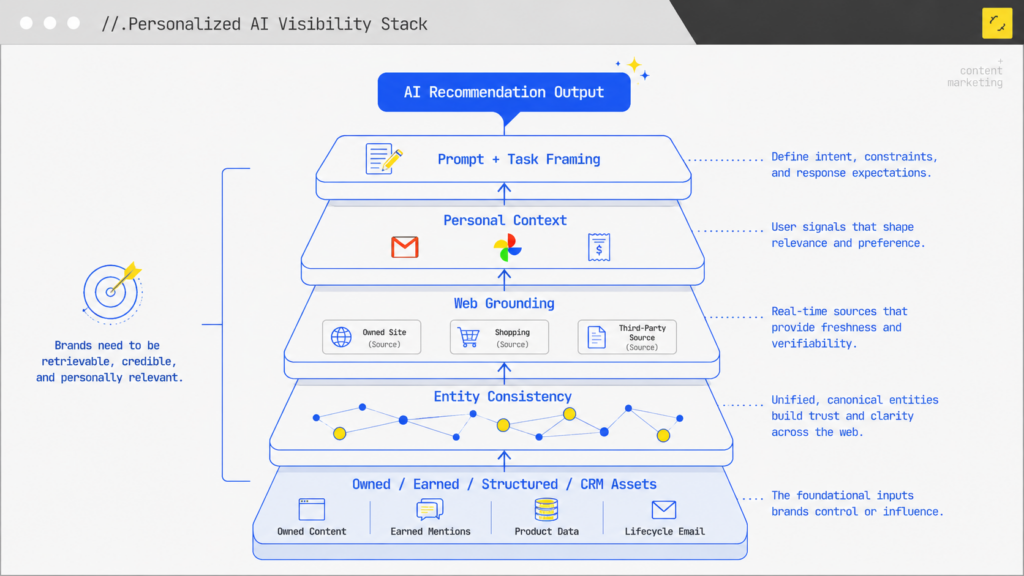
The user’s inbox may help introduce a brand into the conversation. The web still helps AI Mode decide what to say about that brand.
4. Measurement needs to move past rank tracking
AI Search measurement needs more dimensions.
Measurement layer | Metrics |
Visibility | Appearance rate, share of voice |
Prominence | Top-3, top-10, rank |
Grounding | Citation URL, citation domain, source type |
Persuasion | Strong recommendation language |
Personalization | Personal context signal rate |
Category strategy | Prompt-type performance |
Rank still matters. It just does not capture enough.
If two brands both appear in AI Mode, the next questions are:
- Which one appears first?
- Which one is framed as safer?
- Which one gets stronger language?
- Which one gets cited?
- Which source gets cited?
- Which one appears for a blank account?
- Which one appears for a mature personal account?
- Which one appears for a user with relevant emails?
- Which one appears in a constrained recommendation prompt?
That is the measurement work now.
What this study does and does not prove
This study needs a clear boundary.
It shows observed brand lift under an opted-in Personal Intelligence condition. It does not reveal Google’s internal ranking logic.
What this study supports
Supported by this study |
Seeded brands in the Personal Intelligence-connected account saw statistically significant lift versus control. |
Gmail seeding outperformed photo seeding in this test. |
Seeded brands moved into more prominent positions, including top-3 and top-10 placements. |
Brand lift varied by category and prompt framing. |
AI Mode often grounded brand recommendations in web sources. |
A mature personal Google account produced a distinct brand-affinity profile. |
What this study does not prove
Out of scope |
|---|
Gmail is a universal ranking signal. |
Personal Intelligence affects default AI Mode results for users who have not opted in. |
Photos never matter. |
All industries will behave the same way. |
Brands can reliably manipulate AI Mode recommendations. |
We know Google’s internal retrieval or ranking process. |
A few limitations matter.
First, this tested opted-in Personal Intelligence, not default AI Mode. Google says AI Mode connections to Workspace and Photos are off by default and controlled by the user.
Second, we observed outputs. We did not observe Google’s internal retrieval, ranking, model decision systems, or Personal Intelligence engine.
Third, this was a short study window from March 30 to April 15, 2026. Longer studies are needed to measure persistence, decay, and model changes.
Fourth, the account sample was small. The test design was useful for controlled comparison, but it does not represent the full range of Google users.
Fifth, the photo test should be treated carefully. Photo seeding was weak in most categories, but better image labeling, different image types, more time, or different categories could change the result.
Sixth, personal-context cards were not fully captured. The report notes that we cannot determine what share of no-citation brand mentions came specifically from Gmail personalization versus broader model knowledge.
That is why the safest and strongest claim is this:
In this experiment, brands seeded into a Personal Intelligence-connected account saw statistically significant AI Mode visibility lift compared with a non-connected control account, with Gmail-based signals creating the strongest observed effect.
That is plenty.
What we would test next
This experiment opened more questions than it closed.
That is good. It means the next round can get sharper.
1. More Accounts
We need larger cohorts:
- More blank controls
- More Personal Intelligence-connected accounts
- More mature personal accounts
- Persona-seeded accounts
- Different locations
- Different devices
- Different Google account histories
2. Isolated Signal Types
The next version should isolate each personal-context source:
- Gmail only
- Photos only
- Search history where available
- YouTube where available
- Calendar if supported and documented
- Receipts vs. newsletters vs. recommendations
- Order confirmations vs. product education
3. Email Behavior Variants
Gmail was the strongest signal, so Gmail needs deeper testing.
Test:
- Opened vs. unopened
- Clicked vs. unclicked
- Starred vs. unstarred
- Archived vs. inbox-visible
- Deleted after exposure
- Multiple senders
- Different email formats
- Different recency windows
- Repeated mentions vs. one mention
4. Signal Decay
Does the lift last?
Track:
- 24 hours
- 3 days
- 7 days
- 14 days
- 30 days
This is one of the most commercially important follow-ups. If brand lift decays fast, it points toward recency. If it persists, it points toward durable account-level brand association.
5. More Verticals
The category differences were too large to ignore.
Next categories should include:
- Travel
- Retail
- Healthcare
- Insurance
- Financial products
- Restaurants
- B2B software
- Home services
- Auto
- Education
6. Better Prompt Taxonomy
The prompt results show that tracking one prompt per category is a weak measurement.
Future testing should group prompts by:
- Exploratory research
- Transactional intent
- Risk reduction
- Comparison
- Replacement
- Loyalty
- “Recommend 3”
- “Best for me”
We don’t need to focus on whether Personal Intelligence can change recommendations. That’s expected.
The question is which signals matter most, for which users, in which categories, and for how long.
The iPullRank POV: AI Search visibility is a context problem
This is where SEO and GEO continue to move.
Classic SEO asked:
- Where do we rank?
- Which page gets traffic?
- Which keyword converts?
- Which page got cited?
AI search adds harder questions:
- Which brand gets recommended?
- For which user?
- With which personal context?
- Under which prompt framing?
- With which cited source?
- With what confidence language?
- Across which AI surface?
Personal Intelligence raises the stakes, but it’s more difficult to strategize for at scale. A user’s connected data may influence what AI Mode retrieves, how it reasons, and which brands it recommends.
That means brands need to think across three visibility layers.
Layer | What brands need to build |
Public web | Owned-site clarity, content quality, entity signals, third-party validation |
AI retrieval layer | Passage-level relevance, citation-worthiness, category coverage |
Personal context layer | Useful email, CRM, product education, receipts, recommendations, post-purchase content |

It all brings us back to Relevance Engineering.
It is the work of making a brand retrievable, recommendable, and credible across the systems AI uses to construct answers.
That includes the public web. It includes third-party sources. It includes structured product data. It includes digital PR. It includes content strategy. And now, with opt-in Personal Intelligence, it may include the customer’s own personal data trail.
If your AI Search measurement assumes every user sees the same recommendation set, you are missing the personalization layer.
AI Search visibility is about more than prompt tracking from one clean “lab” account and calling it a strategy.
It’s about understanding how brands appear across prompts, personas, contexts, citations, and personal histories.
AI Mode is personal without Personal Intelligence. But when people opt-in, we’re marketing to every single grain on a beach.
Marketing needs to reframe our approach to, and expectations for, organic search.