The C-suite team at your organization only wants to know one thing: what’s the ROI?
The use of metrics in marketing enables you to track progress, measure success, and address failures. Traditionally, this was a deterministic process: “We rank #3, therefore we get X traffic.” Thanks to AI Search, it has become probabilistic. People enter more conversational queries into AI systems that synthesize data and generate query fan-outs to provide answers.
If your brand isn’t cited in those answers for that persona, you don’t exist. Measurement now requires a three-tier reporting model: Input Metrics (what you produce), Channel Metrics (AI citations and visibility), and Performance Metrics (conversions and revenue).

Having well-developed customer personas is great, but they need to be fully based on data to ensure you aren’t making educated guesses. To understand the customer journey accurately and create effective targeted communications your customers require, you need to create both the persona and the journey maps based on real insights. These should showcase individual customer experiences from beginning to end with omnimedia measurements that provide person-level insights.
Traditional metrics still matter, but they’re no longer enough.
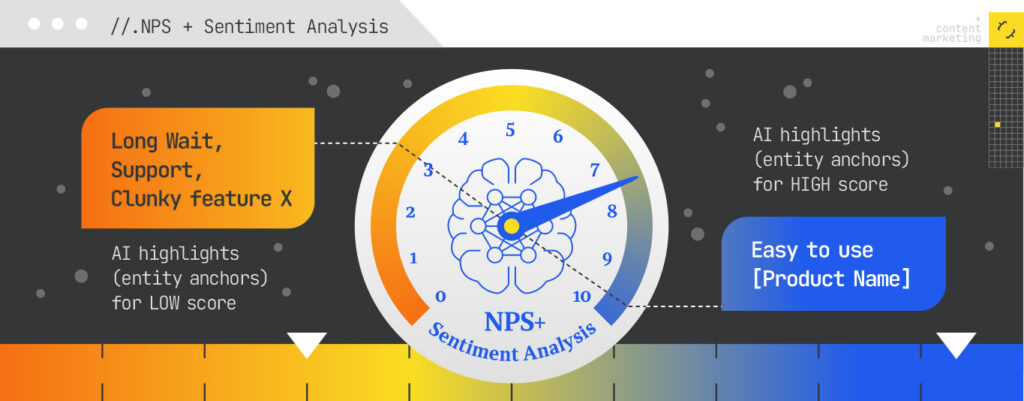
Net Promoter Score (NPS) and Customer Satisfaction (CSAT) remain foundational, but AI has added a layer of Sentiment Analysis.
Developed in 2003 by Bain and Company, the NPS is used by millions of businesses to track how their customers view them. NPS measures the loyalty of customers to the brand, using responses to just one question:
“How likely is it that you would recommend [Company X] to a friend or colleague?”
Respondents answer by giving a rating between 0 (negative) and 10 (positive) and are grouped into one of three categories based on their rating:
The customer satisfaction score is similar to NPS, except it measures the buyer’s satisfaction with the product or service purchased. The question used for CSAT is something similar to:
“How would you rate your overall satisfaction with the [goods/service] you received?”
Respondents use a scale of 1 to 5 to rate their purchase, with 5 being the most positive. Only responses of 4 and 5 are considered satisfied and used to predict customer retention. The score is expressed as a percentage of the total. CSAT provides insight into the customer’s mindset at the time of the survey but doesn’t go far toward measuring their overall relationship with the company. The NPS measurement, however, provides a broader view of the brand or product and focuses on the customer’s intention, rather than overall satisfaction.
While we still ask “How likely are you to recommend us,” AI now analyzes the qualitative comments to identify Knowledge Graph anchors, which are specific entities (people, places, things) associated with your brand.
Also, we now measure Explanatory Efficiency. If a customer has to wade through narrative bloat to find an answer, their satisfaction drops. AI rewards concise, fact-dense information over fluffy prose. So, yes, being clear is now a ranking factor.
To accurately track if your persona-based content is reaching its target, you must monitor these seven AI-specific key metrics:
These aren’t vanity metrics; they’re how AI evaluates your content.

To collect and understand the insights available from personas and the user journey accurately, you’ll need to use some sort of data analytics platform that can deliver omnimedia measurements. Given the importance of measuring the customer journey and the investment in resources it can involve, it’s vital to do it efficiently. Some ways to do this are:
With a well-developed persona and tools in place to follow your customer through their journey, you should be able to identify how your user’s needs will change over time. Armed with this information, you can adjust your content and overall messaging to meet the customer where they are in their journey. Keep the same messaging throughout and you run the risk of becoming irrelevant to your customer or having them outgrow your product or service.
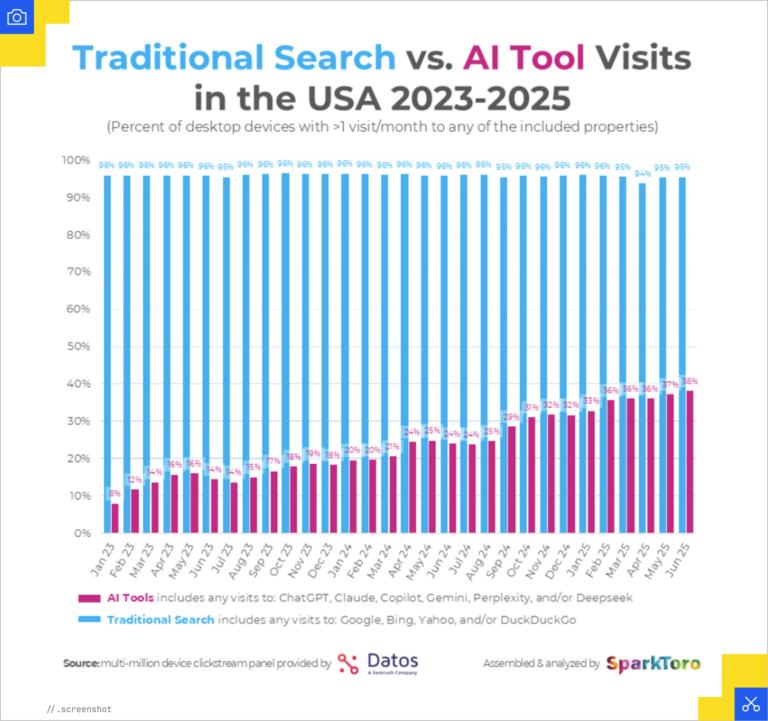
The primary KPI for the Awareness stage is now the AI Citation Rate. Research by SparkToro shows that traditional rank is still the great gatekeeper with 95% of Americans still using Google for search. It’s also been found that if your brand is in the top 10 organic results, it’s more likely to be cited by an AI. If your persona’s research journey doesn’t include your brand in the AI summary, you have an authority gap.
Customers are pressed for time, and they don’t want to spend it providing feedback to you. The quicker and easier your feedback process is, the more likely you are to get it. One way to make it quick and easy for customers is to use channels they access often, so it’s no effort for them to provide it. This might be social media, email, a review site, or a Reddit forum. Make sure your outreach happens at the most important moment and is hassle-free for the customer to provide it.
Instead of surveys, you can also use AI to analyze the user experience. If a user spends time on your page and stops searching for that topic, the Information Gain is high.
Remember that although feedback can be incredibly useful, it doesn’t replace the user’s actual behavior, which is a far superior tool for segmentation and persona-building.
Your customers don’t all behave the same, nor do they have the same impact on your revenue. It’s important to make sure your measurement activities focus on the most valuable of your customers. With customer journey analytics, you can do things like:
This allows you to use your customer journey analytics to highlight behavioral segments that have the highest profitability and growth potential.
If you’re using a customer journey analytics tool, you’ll have access to custom dashboards that can help you monitor what’s happening at both journey level and overall level in real-time. This gives you a status check on critical insights, as well as discovering the high-impact micro-journeys that might be happening.
The customer journey analytics you collect will help you to identify the most important metrics to follow. Once you’ve analyzed your customers’ behavior, you might discover there are certain questions you can’t answer because you aren’t capturing the metrics. At the same time, you’ll be able to tell whether the money and time you’re spending on measuring, analyzing, and reporting is delivering worthwhile results.
Marketers can then use the insights to create precise maps that identify positive and negative experiences across the customer journey. These journey maps also help to connect customer experience with the behaviors and expectations of individual consumers. Finally, they highlight areas across the customer journey where marketers can optimize their efforts.
When you collect and analyze customer journey data, you gather insights that can help you deliver a more personalized experience, improve your product or service to meet customer needs better, and enhance your processes for stronger customer service. For example, if the data shows customers with a common question don’t return for a second purchase, it could be because they had difficulty understanding the product’s use the first time.
Once you collect this data, don’t just report it. Run experiments based on your persona segments. Here are a few you can try:
By working with AI programs, the act of measuring success becomes much easier than it used to be. AI also plays a part in personalization and interpretation of personas, which we’ll look at in the next chapter.
If your brand isn’t being retrieved, synthesized, and cited in AI Overviews, AI Mode, ChatGPT, or Perplexity, you’re missing from the decisions that matter. Relevance Engineering structures content for clarity, optimizes for retrieval, and measures real impact. Content Resonance turns that visibility into lasting connection.
Schedule a call with iPullRank to own the conversations that drive your market.