

“A segment is essentially a persona, but not all segments are designed for the same reasons,” said Farrah Bostic.
As a marketer, you might have a segmentation study that is designed for media targeting and buying, or one that’s for creative development, she explained. There’s also segmentation that’s designed for new product development or new service offerings.
Put them all together and what do you get?
Hopefully your ideal customer.
Before you can build customer personas that are an accurate representation of your market segments, you need to know what those segments are. This requires figuring out which segmentation variables are most appropriate for your industry, your target audience, and the goals of your business. These variables then serve as context that allows LLMs and search assistants to generate relevant, high-conversion experiences.
There are many different segmentation methods to choose from. Use one or use them all! It all depends on your business. Here are five of the most well-known methods of segmentation:
Segmenting an audience based on demographics is the most obvious and most commonly used method. It’s based on factual, statistical data such as:
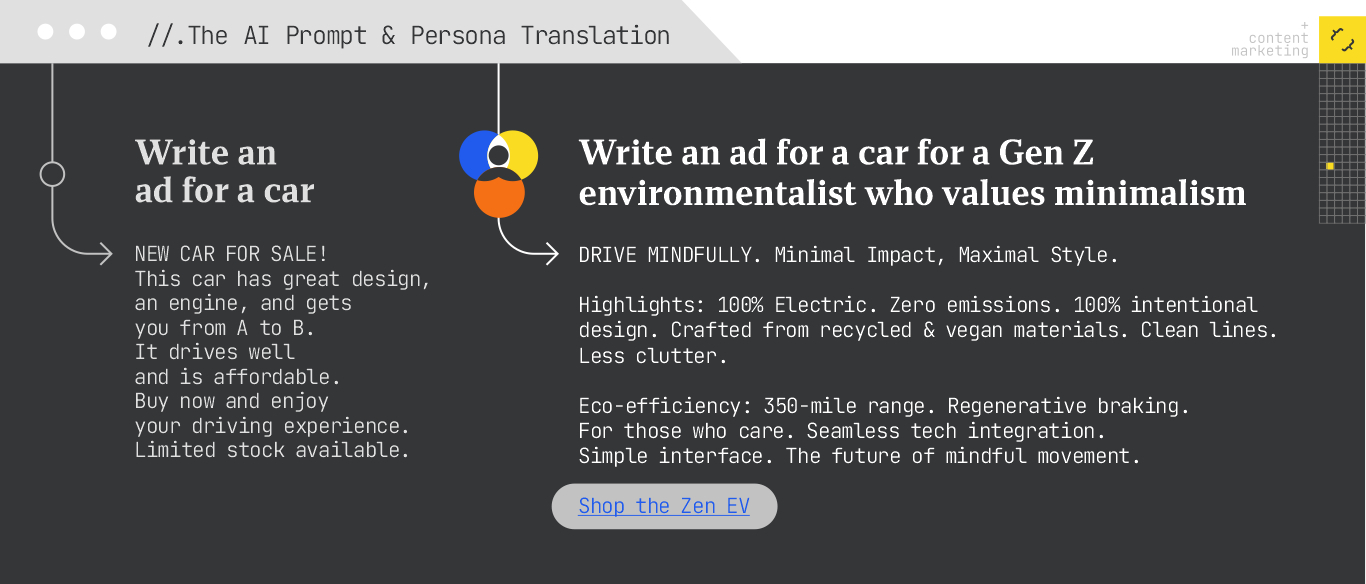
In an AI Search context, demographics help refine the intent behind a query. For instance, a search for “best investment strategies” requires a vastly different AI response for a Gen Z student (Ages 18-24) than for a High-Net-Worth individual (Income $250k+) nearing retirement.
One way to pull demographics is by viewing the breakdown of the audience that visits your website via Google Analytics. Today, you can export this demographic data and feed it into an LLM as a prompt to ensure the AI’s persona-based content maintains the correct level of sophistication and cultural relevance.
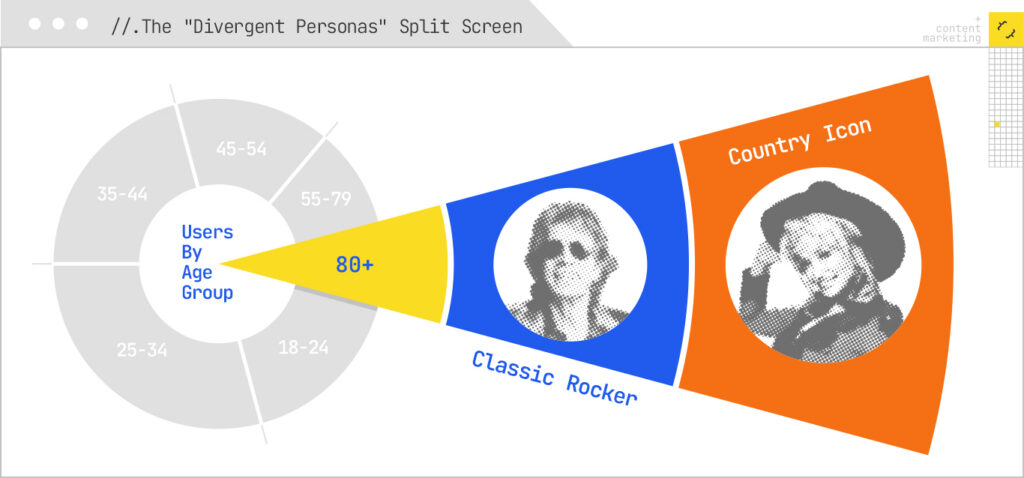
Even potential customers within each age demographic could be vastly different. Consider these performers from each generation. They might be in the same age group, but their personalities and the type of music they provide greatly differ:
This is why it’s important to go deeper into smaller groupings and segments.
This is the process of dividing the total marketplace into smaller, homogeneous groups based on the buying behavior of the people in the groups. In AI Search, behavioral signals are the primary way AI assistants decide which citations to provide. If a user frequently clicks on technical documentation, a search assistant will prioritize those sources.
Attitudinal segmentation groups people by beliefs, interests, and opinions. This is arguably the most valuable input for AI. By feeding an LLM a persona’s fears or values, you can prompt it to:
This method works most effectively when it’s combined with one of the other primary methods, such as demographic, behavioral, or lifestyle segmentation.
This is when a business divides its target audience on the basis of geography. It’s used when people living in an area have similar problems and buying preferences as a result of their location. This kind of segmentation works well for businesses targeting a local audience (like a company that sells surfing equipment targeting coastal towns). It can be broken down into countries, cities, towns, regions, urban, suburban, and rural areas.
Firmographics are attributes that apply to business customers such as companies, non-profits, government departments, or any type of firm or organization. The data is to business organizations what demographic data is to individual consumers. By grouping business customers in terms of their shared needs and preferences, you can improve the insights upon which your B2B marketing, advertising, and sales are based. This will ultimately lead to more focused and effective campaigns.
Aside from these more popular segmentation methods, there are countless others that are even more specific like media-based segmentation or pricing segmentation.
Data-driven segmentation can also create customized solutions for customers with the use of clustering and the leveraging of pre-built segments.
Clustering is a mathematical way to discover similar groups of customers based on identifying the smallest variations among the customers in each group. It identifies the relationship between different data points from a statistical viewpoint.
Using machine learning algorithms for cluster analysis based on buying behavior can help you discover new segments of customer archetypes, such as:

A key factor in cluster analysis is defining what we mean by similar or different traits. It’s often necessary to split the data into segments that are analyzed independently to develop segment-specific insights.
There are three main benefits of a data-driven segmentation approach using cluster analysis:
The advantage of using clusters along with segmentation to create your personas is that each persona tells a different customer story. This gives you the means to target each customer grouping very specifically with personalized content and communications.
Segmentation can be complex and highly challenging to perform, but it’s so valuable marketers can’t afford to be without it. According to McKinsey, 71 percent of consumers expect companies to deliver personalized interactions and can even become frustrated when they don’t. Pre-built segments offer a viable solution to this, particularly in email marketing.
A pre-built segment is when you use data to develop criteria for grouping the customers. Typical pre-built segments might appear to be superficial groupings. If you aren’t using any other form of segmentation, however, they still give you a basic platform to start from.
Establish the five primary strategic segments right from the outset. Depending on the type of business you have, these could be:
You can also choose other relevant criteria to create groupings or categories for your customers and use these as pre-built segments.

Pre-built segments enable you to hyper-personalize your marketing by making use of the behavioral data they show to discover customers’ consumption habits. By combining these pre-built segments with clusters and other segmentation methods, you can whittle your marketing down to a very specific set of persona identities.
By combining these segments with behavioral data, you can move toward hyper-individualization and use these segments as synthetic users. As we mentioned earlier, by inputting a segmented persona into an AI, you can chat with a simulation of your customer to test how they might react to a new journey map before you go live.
With the amount of data you can now gather about your customers, you can use technology such as scoring tools to identify high-value or high-potential customers. You can also find out other information, such as which clients are the most likely to buy from you or to move to another supplier, and customize your communications accordingly. This is the benefit of hyper-personalization: the ability to target individual customers (or groups of individuals) with a specific message based on your knowledge about their activities and intent.
By combining your existing customer and transactional data, you can pinpoint the mix of common characteristics and product purchases that make up the best, most profitable customer relationships. You can retrace those customer journeys and discover how their relationship with you evolved to this point and use the data to define exactly what your target personas should look like. Based on this, you can determine how best to merge the segments with your marketing activities to make sure you’re delivering the right message to the right persona at the right time.
The goal of segmentation isn’t just to know who the visitor is, but to understand the person behind the visit. Are they a 35-year-old male from the west coast who loves to surf? Or are they Dolly Parton shopping for a new pair of heels?
If your brand isn’t being retrieved, synthesized, and cited in AI Overviews, AI Mode, ChatGPT, or Perplexity, you’re missing from the decisions that matter. Relevance Engineering structures content for clarity, optimizes for retrieval, and measures real impact. Content Resonance turns that visibility into lasting connection.
Schedule a call with iPullRank to own the conversations that drive your market.