

Has a product post on social media ever stopped your scroll and hit you so hard in the feels that you placed an order immediately?
That’s not an accident.
Getting your audience to feel something is at the core of market segmentation and the entire reason buyer personas exist in the first place.
Your persona now has two bosses: the human it represents and the AI that interprets them. Humans are still providing the strategy and guidance behind the personas while the machine synthesizes. This means psychology and bias play a role in the perception of the ideal customer and why they make a purchase, so we need to focus on where buying decisions are taking place these days.
“Now optimization is everywhere because the buying decision is no longer happening on the website,” adds Talia Wolf, CEO of Getuplift. “They go off the website and they’re on Reddit, on LinkedIn, Quora, YouTube, Discord. They’re having conversations. That’s where trust lives.”
In other words: your funnel is no longer yours.
A persona is also now a model of how attitudes manifest as AI-interpretable digital footprints like dwell time and search intent.
Emotion may be the driving force behind a large part of all customer purchase decisions, but data should still be used to understand a consumer’s behavior. Salsify’s 2026 Consumer Research report states that 68% of customers will pay more for products from brands they trust, requiring a new understanding of how shoppers approach decision-making.
However, AI systems now sit between your brand and your buyer interpreting search intent, surfacing recommendations, and curating experiences before a human ever engages with your messaging. So if your persona is built only on human psychology, even if it’s beautifully researched, it’s incomplete. Segmentation can help you to create custom marketing options for each consumer group, based on their specific attributes. Within the broader concept of segmentation, you can use micro-segmentation to break down your audience into smaller groups, and in those groups, you can personalize your communications to reach customers who have specific needs and wants.

A persona is a fictional character that reflects your ideal customer, who they are, what they look like, and what they need or want. While the persona is portrayed as a particular person, it isn’t a real individual, but a combination of all the qualities your ideal client would have. Personas aren’t written in stone; they need to be reviewed periodically. If you find the data supports it, you can edit personas to match the newest information.
Given the expanded role of personas in AI Search today, the definition of a persona should be broadened to add a second dimension: a persona is also a model of how shared attitudes manifest as observable, AI-interpretable behaviors across digital touchpoints. When building a persona, marketers should ask not only “What does this person want?” but also “How does what this person wants show up in data?”
This also reinforces one existing principle of persona work that now carries even more weight: personas must be reviewed periodically. AI systems continuously update their models of consumer intent, which means the behavioral signatures associated with any given persona can shift faster than the underlying human psychology does. The data pool driving those revisions is simply broader now and some of it reflects not just what your customers think and feel, but what the machines mediating their experience have concluded about them.


I like the specificity [of a persona] because I think it makes the abstract real. Of course it’s not perfectly representative, but it gives you a bull’s eye to throw your darts at.
Sr. Director of Global Growth & Paid, HubSpot
It can be argued that the concept of the persona was first developed by Carl Jung when he formed the 12 archetypes. Jung believed that every person should fall into one of the archetypes based on their overarching life goal and what they do to bring this desire of theirs to fruition. The idea of using these archetypes in marketing is that if a customer can connect with a brand because they are a part of the same archetype, then the customer should trust the brand and its messaging, and want to listen to what you have to say.
Later, in 1998, Alan Cooper published a book called “The Inmates are Running the Asylum,” which spoke to the idea of UX personas. When he was designing a project management software program (which eventually formed the base of Microsoft Project), Cooper interviewed several potential users for their input. Extensive conversations with a woman named Kathy led to making her the typical user for the program, his first UX persona personality.

Cooper writes in his journal how he then applied the same method to other programs he developed. At one point, he became frustrated with trying to identify the most important features of a program for users and asked to meet the customers. After a few interviews with users, clear patterns emerged that led to the creation of his Chuck, Cynthia, and Rob personas.
In marketing speak, we often use the terms segments, cohorts, and personas interchangeably, but in reality, they have different meanings. While all three are abstract concepts describing people, they apply to different levels of identity:
This is a grouping of people with similar attributes based on any set of rules. Marketers use segments to distinguish between different groupings of customers, which allows them to target their communications at the needs and wants of each group. When developing customer segments, it’s helpful to have data about what motivates prospects and customers, and how best to reach them, although this may be a struggle if, for instance, a segment of your audience is those who walk into your store on a rainy day.
“A segment is essentially a persona,” said Farrah Bostic, founder of The Difference Engine. “But not all segments are designed for the same reasons.”
Cohorts are about when and why something happened.
A cohort in the marketing space applies to a group of customers who share a particular experience or event. The group is typically made up of several different personas, many of whom might have other qualities that overlap various market segments, but they are targeted as a single group because of shared criteria. For example, men between the ages of 34 and 55 are a broad demographic grouping. Those men in the group who online shop for big and tall during the same timeframe because their favorite brick and mortar stores don’t carry their sizing would represent a cohort.
The definition of personas is a character profile that represents groups of customers who share similar attitudes, values, and desires regarding a specific product or service. They provide a deeper understanding of the profile’s needs, wants, behaviors, attitudes, and motivations. When personas are set up correctly, they can cut across segments and unify them into fewer target groups. This makes marketing easier to personalize.
Segments, cohorts, and personas are all helpful marketing tools, but they’re used differently and at different stages of marketing. Segments come into play early in the process, while personas are usually subsets of segments. Cohorts are very precise groupings used in cases where extreme “drilling down” is warranted.
Essentially, personas often cut across multiple segments and cohorts to unify them into something actionable.

Personas force you to think about real people and not just metrics.
It’s important to know who you are marketing to (duh, right?), so you need to get your message heard and reach your target audience in an effective way. Using personas gives marketers a very specific idea of exactly who they are talking to when they create items of content. Some of the reasons why using personas works include:
The use of personas offers a far more reliable and scientific method of marketing than the “guess-and-check” option. That might have worked fine for solving math problems in school, but in marketing, it can be expensive if your first few guesses turn out to be wrong (and will anger a lot of executives at your organization).
It’s important to base your development of personas on data, not assumptions, to get the most accurate results.
“You can look at your current client roster, look at their user behavior, look at how they came into your funnel, look at when they dumped out of it, and start to develop some hypotheses about who’s an easy adopter, who’s a hard adopter, and who’s a reluctant adopter,” said Farrah.
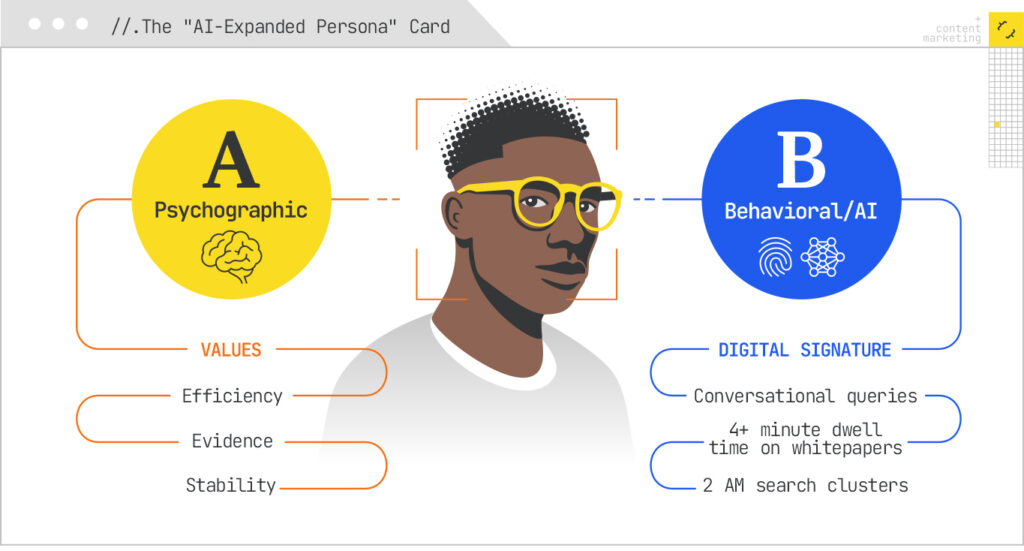
A modern persona must operate at two levels simultaneously. At the human level, it retains everything that has always made personas valuable: the emotional drivers, the values, the pain points, the goals. But now you must also define what that person’s inner world looks like as data, because that is the version of your customer that AI systems actually encounter.
Consider a persona like “Pragmatic Pete,” a mid-career professional researching enterprise software. The traditional persona captures Pete’s frustration with inefficient workflows and his preference for evidence-based decisions. An AI-expanded version also captures what his intent looks like in practice: the search queries he uses late in his research cycle, the content he lingers on versus skims, the comparison behaviors that signal an approaching purchase decision. These behavioral signatures are what AI systems use to determine whether your content reaches Pete at all.
Understanding Pete’s emotional state still tells you what to say. Understanding his behavioral signals now tells you whether AI systems will deliver it to him in the first place.
According to iPullRank’s Director of Content Sherri Eisenberg, useful personas focus on decision behavior and not just demographics.
The most useful personas typically include:

When marketers have access to this information, they can tailor conversations around the customer’s priorities instead of pushing generic pitches that aren’t as likely to resonate.
Director of Content, iPullRank
Once you’ve created personas, don’t just forget about them. Keep them current and relevant to your business. Look at them at least once a year to ensure they’re up to date.
As Sherri suggests, keep an eye on these changes to update your personas:
Amanda Natividad, Chief Evangelist/VP Marketing at SparkToro, added that you should revisit your personas a couple times a year.
“Not starting from scratch again,” she said, “rather, testing assumptions, and determining whether there are additional data points you should include in it.”
Creating personas forces you to segment your audience, because each persona reflects one or more of the interests, demographics, challenges, personalities, and objectives of your market. Segmentation targeting using personas helps to predict the demand for a product or service, which allows you to create marketing campaigns that speak to their pain points and hit them right in the feels.
If your brand isn’t being retrieved, synthesized, and cited in AI Overviews, AI Mode, ChatGPT, or Perplexity, you’re missing from the decisions that matter. Relevance Engineering structures content for clarity, optimizes for retrieval, and measures real impact. Content Resonance turns that visibility into lasting connection.
Schedule a call with iPullRank to own the conversations that drive your market.

Sign up for the Rank Report — the weekly iPullRank newsletter. We unpack industry news, updates, and best practices in the world of SEO, content, and generative AI.

iPullRank is a pioneering content marketing and enterprise SEO agency leading the way in Relevance Engineering, Audience-Focused SEO, and Content Strategy. People-first in our approach, we’ve delivered $4B+ in organic search results for our clients.


