Three studies dropped in the same week, and they all arrived at the same verdict. Marie Haynes looked at 12 months of GA4 data across 100 sites and found that ChatGPT sent 0.62% of the traffic Google organic did. SEO Works found that organic delivered 39 times the traffic of AI assistants and roughly 30 times the conversions. Kevin Indig ran 632 tests across 12 sites and couldn’t establish a reliable link between AI visibility and subsequent branded search or direct traffic. Rand Fishkin bundled them together, and the conclusion that spread was that GEO is a distraction and you should get back to the work that sends clicks.

I’m not going to argue with the numbers. The methodologies are reasonable, the people behind them are serious, and if you measure AI Search as a performance channel, that is exactly what you’ll find. It sends very little traffic, and it probably always will.
The problem is the conclusion, because every one of these studies grades a brand channel with a traffic ruler. It’s the equivalent of judging a Super Bowl spot by its click-through rate and deciding television is a distraction. The numbers are right. The category is wrong.
Getting the category right matters because of what’s being written off. ChatGPT now reaches 1.2 billion people every week, up from 900 million in February. Google’s AI Mode has crossed a billion monthly users, AI Overviews reach 2.5 billion, and the Gemini app is closing in on a billion of its own. No information environment in history has reached this many people this fast, and the advice making the rounds this week is to ignore it because it doesn’t show up in your referral report. That is exactly the kind of thinking that keeps SEO in the basement of the business.
What changed is not whether these systems send traffic. What changed is the exchange between you and the machine, the mental model of the person on the other side of it, and the yardstick nobody bothered to update.
What they actually argue, and where we agree
It’s worth being precise about what these three pieces claim, because the strongest version of their argument is not the one that got amplified.
Marie’s position is that GEO, meaning the bag of tactics that promise to get you into ChatGPT answers, is a distraction from the surface that is actually sending visitors to your business, which is Google. Her advice is to spend the time preparing for the agentic web instead: UCP, Universal Cart, WebMCP, intelligent eyewear and whatever comes next. SEO Works makes the narrower point that AI assistants deliver a small fraction of organic’s traffic and conversions, even though the visitors who do arrive convert better. Kevin’s piece is the most careful of the three. He went looking for the brand effect everyone claims exists, the idea that AI visibility shows up later as branded search and direct traffic, and across the brands he tested he couldn’t find it reliably.

Source: The SEO Works, AI Referral Traffic Benchmark
I agree with more of this than you’d expect. GEO as a tactical discipline, the schema hacks and the llms.txt files and the “write for the robots” advice, is a distraction, and I’ve said so. Google is still the surface sending the most visitors, and anyone telling you to abandon it is selling something. And Kevin is right that the brand effect has not been demonstrated at scale with analytics data, because it hasn’t.
Where we part ways is the conclusion. The question these studies answer is whether AI search is a good performance channel, and the answer is no. The question that matters for anyone allocating budget is whether a channel that over a billion people a week use to ask questions, compare options and form opinions deserves strategy, measurement and investment as a brand channel right now. That is a different question, and nothing in the referral data speaks to it.
Part of the problem is the name
We call it AI Search because the machine is searching. The person is not. The person is having a conversation, and that distinction explains most of what the traffic studies found.
We saw this a year ago when we ran the first UX study of AI Mode with Farrah Bostic. We put real people in front of it with real tasks, from comparing credit card loyalty programs to finding shoes under $75, and watched what they did. The clearest finding was that nobody treated it like search. They treated it like a research companion. They asked a question, read what came back, asked a follow-up, and formed an opinion, and the ten blue links they would have clicked through in a classic session mostly went unclicked because the system had already done that work for them.
That is what query fan-out is. When I walked through how AI Mode and AI Overviews actually work based on Google’s patents, the point I kept coming back to is that the query is no longer the unit of work. It’s the spark. The system expands it into a set of synthetic queries, retrieves against all of them, reasons over the passages, and composes a response. The clicking, comparing and reformulating that used to be the user’s job now happens inside the machine, and the user gets a synthesized answer in return. Alphabet’s own numbers back this up: AI Mode queries run about three times longer than classic searches, which is what people typing to a conversation partner looks like, not people typing keywords.

Source: Semrush, Google AI Mode SEO impact
Chat carries a mental model that search never did. In search, the result is a list of places to go. In chat, the result is the answer, and nobody expects to leave a conversation in order to finish it. The more conversational the interface, the less people expect to go anywhere, and the more the value of showing up shifts from the visit to the mention. That is a spectrum, not a switch. Google’s AI surfaces still sit inside a search box and inherit some of the old expectations, which is why AI Overviews still send clicks. ChatGPT sits at the other end of it, which is why it barely does. The traffic studies measured the far end of that spectrum and concluded the whole thing was broken.
The category error
All three studies measure AI Search as a performance channel, find that it’s a weak one, and conclude that it doesn’t matter. That is the category error, and the reason it’s an error is that the value exchange between you and the application has changed.
The old deal was simple. You gave Google content, Google gave you clicks. That worked because classic retrieval was deterministic: the old Google showed your content in the form you delivered it, ranked against other documents, and the SERP was a directory that sent people to you. Traffic was the payment because traffic was the product.
The new deal is different. In AI Mode, AI Overviews and ChatGPT, your content is raw material for an answer the system composes itself. As I laid out in the patent breakdown, AI Overviews don’t rank content, they remix it, using what already exists to validate and assemble a response. The person’s need gets met inside the interface. What you get back for being part of that answer is no longer a visit. It’s presence, attribution and trust, delivered at the moment someone is actively deciding. That is what brand channels have always sold, and a brand channel measured in sessions will always look like it’s failing.
Kevin has said as much himself. In his “Beyond the SERP” talk, he lays out that almost nobody clicks AI citations: about 1% in AI Overviews, a 0.69% click-through rate in a leaked ChatGPT dataset, and a nearly 100% zero-click share in AI Mode. His conclusion is that traffic is no longer a leading indicator and that AI is a visibility play rather than a traffic play. I agree with every word of that. Low referral numbers are the expected output of the new exchange, not evidence that the channel is broken.
I called it a branding channel a year ago in the same patent piece. Presence doesn’t guarantee traffic, and just as brand marketers chased share of voice in TV, we need to measure share of what I called Attributed Influence Value, treating citation as both an awareness lever and a trust lever. Being cited as a source of truth high in an answer builds visibility and brand awareness whether or not anyone clicks. The click stopped being the primary KPI the moment Google started composing answers instead of listing them, and the three studies that just dropped are the clearest demonstration yet of what happens when you keep measuring the old KPI anyway.
The behavior proves it
If chat really carries a different mental model than search, you’d expect to see people leave less often the more conversational the interface gets. That is exactly what the data shows, across three independent methods.
Start with clickstream. Semrush’s AI Mode analysis puts the three Google surfaces on one scale: roughly 34% of sessions end without a click when there’s no AI Overview, about 43% when there is one, and about 93% in AI Mode. Same search engine, same users, and a steep climb in people staying put as the interface gets more conversational. Semrush is careful to note those figures come from separate studies with different methods and time frames, so treat the exact numbers loosely and the direction seriously.

Source: Semrush, Google AI Mode SEO impact
Pew Research measured actual people rather than aggregate logs. In its panel study of 900 US adults, users clicked a traditional result 8% of the time when an AI Overview appeared versus 15% when it didn’t, and only 1% of searches with a summary led to a click on a source inside it. Sessions ended outright 26% of the time with an AI Overview compared to 16% without. The summary didn’t just reduce clicks. It ended the task.

Source: Pew Research Center
Then there’s what people do when you sit next to them. Our AI Mode UX study saw it first: participants read, asked follow-ups, and formed opinions inside the pane, treating it as a companion rather than a directory. Kevin ran his own think-aloud study of AI Mode and found the same thing. In about three-quarters of sessions, users never left the AI Mode pane. Eighty-eight percent of first interactions were with the generated text, and the median number of external clicks per task was zero. His takeaway was that users are in AI Mode to read, not to browse or search, and when they did leave it was overwhelmingly to buy something or validate a decision they’d already made.
ChatGPT is further along the same curve. OpenAI’s study of 1.5 million conversations with the NBER found that 49% of messages are what the researchers call “Asking,” meaning people seeking information and advice, and that category is both growing fastest and rated highest quality by users. Seeking information specifically grew from 14% to 24% of all usage over the study period. People are bringing search-shaped needs to a conversational interface and walking away satisfied without visiting anyone.
Which brings me back to Marie’s data. She found that ChatGPT referral growth stalled in August 2025 and declined afterward. Over roughly the same window, ChatGPT’s weekly audience went from 700 million to 1.2 billion. Clicks falling while the audience grows by half a billion people doesn’t mean people stopped using AI to decide things. It means more of the deciding is happening inside the answer, and the only part of it we’re measuring is the part that’s shrinking. Read it the other way around and the decline is a sign that ChatGPT has gotten better at its job. A referral is what happens when the answer isn’t good enough and the person has to go verify it somewhere else, so as the answers improve, the clicks should fall. The product is succeeding and the metric is reading that success as failure.

Not attributable, still decisive
If the exposure happens inside the answer and the decision happens inside the answer, then the only way to see the effect is to ask people. When you do, they tell you AI is shaping what they buy, and the part that should worry a CMO is the part that never shows up in any analytics platform.
Attentive surveyed US consumers and found that 62% have bought a different product or brand than they normally would because of an AI chatbot, and 71% say AI meaningfully affected which brands they considered at least half the time. Semrush’s survey found that nearly 59% of people who use AI chatbots discovered a new brand through a chatbot recommendation. That is consideration being formed in a channel the traffic studies just called a distraction.
The negative side is more persuasive than the positive one. In that same Semrush survey, nearly 81% of people who shop with chatbots said they had decided against a purchase based on AI guidance. Think about what that means for a brand that doesn’t show up, or shows up with bad sentiment. You don’t get a bounce or a lost click. You get crossed off a shortlist by a machine, in a conversation you’ll never see.

Among all AI users, 57.5% have been dissuaded from a purchase by a chatbot; among people who use chatbots when shopping, the figure is nearly 81%. Source: Semrush survey via MarTech
I’ll state the caveats before anyone else does. These are self-reported numbers from vendor-funded surveys, and the same Semrush study notes that only 29% of all consumers currently use chatbots for product research. Both of those are real limitations. But 29% of an audience measured in billions is not a rounding error, and self-reported influence is how we’ve measured every brand channel since the invention of the brand tracker. Nobody dismisses TV because the evidence that it works comes from asking people.
Taking Kevin's null result seriously
The strongest argument the other side has is Kevin’s finding, so let me state it without softening it. He tested whether AI visibility shows up later as branded search or direct traffic, ran 632 tests across 12 sites, and across the four brands with full visibility data he could not establish a reliable link. If you’re going to claim a brand effect, that result deserves an answer rather than a shrug.
Here is my answer. The test was built to find a traffic effect, and brand effects don’t behave like traffic effects. The direct-traffic comparison was one month against the next, August to September, and the direct-traffic analysis excluded homepages, which is precisely where someone types in a brand they just heard about. The site sample skewed B2B, where consideration cycles run long and the person doing the research is rarely the person who shows up on the website. And four brands is four brands.

More importantly, the brand effect is visible in Kevin’s own data if you look at the brands individually rather than the average. One site showed a 0.72 correlation between AI share of voice and direct traffic, peaking at a three-week lag, and a 0.59 correlation with branded search impressions. A second site showed a 0.47 correlation between its ChatGPT mention rate and direct traffic. In another analysis he describes, self-reported attribution confirmed that unexplained direct visitors had in fact come from AI. The effect is there for some brands, it arrives weeks later, and it lands in channels that get the credit. That is what a brand effect looks like, and a study designed to find it across a handful of brands in a 30-day window was always going to average it away.

Source: Kevin Indig, Does AI drive more direct traffic?
There’s also a timing problem that isn’t Kevin’s fault. Binet and Field’s work on the IPA Databank, which I’ll come back to, found that brand-building effects take around six months to overtake short-term activation effects. A one-month window cannot see a six-month effect, and the absence of a signal in that window tells you about the window, not the channel. Absence of evidence in referrer data isn’t evidence of absence, and it’s worth remembering that the brand effect of a billboard would fail this exact test too.
Brand channels have never been attributable
Here is the part of this debate that the SEO industry keeps getting wrong, and it’s a function of where we came from. Search was the one channel where every dollar could be tied to a click and every click to a conversion, and we built an entire discipline on that promise. So when a new channel doesn’t produce clicks, our instinct is to call it broken or a distraction. The rest of marketing never had that luxury and never needed it.
Nobody has ever attributed a billboard. Nobody attributes a television spot, a sponsored podcast, a stadium naming deal or a celebrity holding a product on a red carpet. Display ads are measured in view-through conversions that everyone in the room knows are generous. And yet the money keeps flowing to exactly these channels, because the people allocating it understand that influence and attribution are different things. The IAB projects CTV ad spend growing 13.8% in 2026, with creator and influencer partnerships the format the most buyers plan to increase. WARC has digital out-of-home rising 13.7% to $21.7 billion this year. These are not channels in decline because they lack a referral report.

The same IAB buyer survey found 73% of ad buyers plan to increase focus on optimizing content for AI-generated answers, a line item that didn’t exist in the 2025 survey. Source: IAB 2026 Outlook via StreamTV Insider
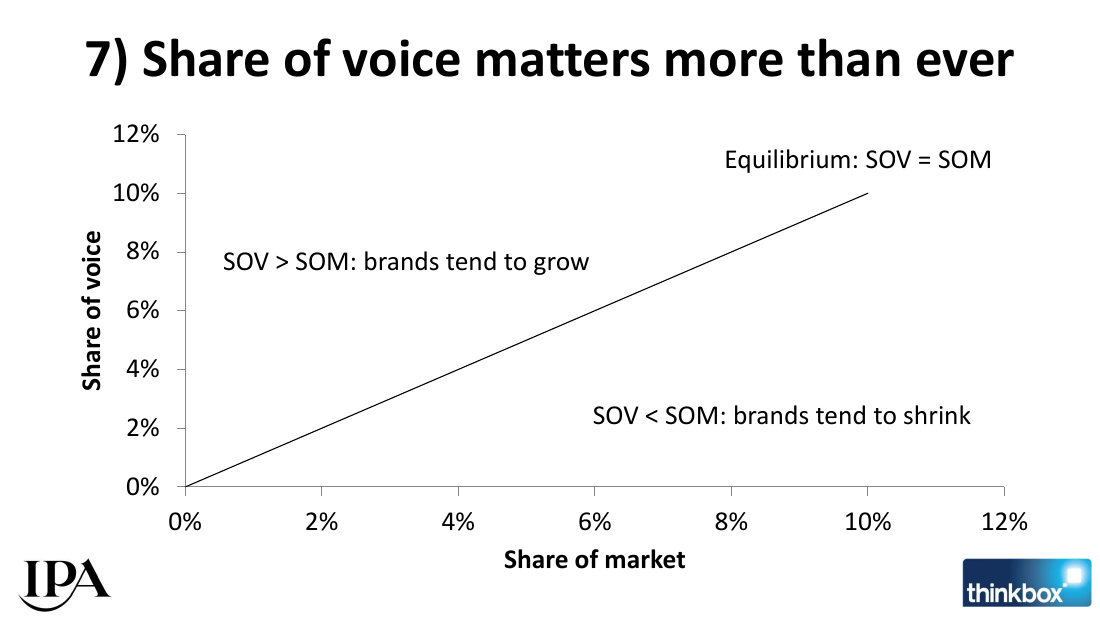
The effectiveness research is unambiguous about why. Les Binet and Peter Field analyzed nearly a thousand campaigns in the IPA Databank and found that the best-performing mix is roughly 60% brand building and 40% activation, that share of voice is the single most important driver of long-term growth, and that as the industry shifted toward short-term, measurable campaigns, overall effectiveness fell. Their advice for new media is pointed: dial up brand building over activation, especially on newer channels. The three studies that just dropped are a textbook example of the short-termism they warned about, applied to the newest channel there is.
Source: Binet and Field, The Long and the Short of It, IPA presentation
Brand effects also show up somewhere else, later, and get credited to whatever channel happened to be standing there. The cleanest illustration is out-of-home. A Nielsen study commissioned by the OAAA found that more than 40% of people had searched for a brand online after seeing it on a billboard. The billboard got no credit. Search did. That is the same pattern Kevin’s data hints at, with AI visibility leading direct traffic by a few weeks for the brands where the signal was strong enough to see. Take the OAAA number as an illustration rather than gospel, since it’s a 2019 industry-funded survey, but the mechanism it describes is exactly how brand channels have always worked.
If you want the most precise analog, it isn’t bought media at all. It’s PR. Earned media is unpaid, uncontrollable, non-deterministic and nearly impossible to attribute, and every serious brand funds it anyway because being named in the right place by a source people trust changes what they believe. An AI answer is earned media composed by a machine. It synthesizes your owned content, the shared conversation about you, and the earned coverage you’ve accumulated into a single recommendation, and it does so at a scale no publication ever reached. Treating that as a performance channel is a category error. Treating it the way you’d treat a feature in the most-read publication in your industry is simply correct.
The measurement undercounts on top of that
Even if you accept the traffic framing on its own terms, the referral data these studies rely on misses most of what AI actually sends. Three problems compound here, and together they mean the “AI traffic” line in your GA4 report is a floor, not a measurement.
- Dark traffic. AI assistants routinely strip the referrer, people copy URLs out of ChatGPT and paste them into a browser, and a large share of AI-influenced visits land in analytics as direct. Kevin’s own estimate is that about 70% of AI traffic is attributed to direct, and GA4 still has no AI channel grouping out of the box. Any study that counts AI referrals by referrer is measuring the minority of visits that happened to carry one.
- Google’s AI surfaces land in the control group. Clicks from AI Overviews and AI Mode usually carry a google.com referrer and show up as Google organic. That means the biggest AI search surface in the world sits inside the very bucket these studies use as the benchmark. Marie’s own line that Google is the surface sending the most visitors to your business is true, and it concedes the point, because an increasing share of those Google visitors came through an AI-composed answer. The benchmark is quietly turning into the thing being measured.
- Most exposures never had a link to click. BrightEdge found that ChatGPT mentions brands 3.2 times more often than it cites them, and Kevin’s own ghost-citations research found that 62% of citations never name the brand at all. The mention is the exposure. The citation is a subset of it. And the click is a subset of that. Counting the innermost ring and calling it the channel is how you arrive at 0.62%.
Measurement matures after the channel does
Every brand channel in history had an audience before it had measurement, and the brands that waited for the measurement to arrive before investing are the ones that spent the next decade catching up. Television had reach before it had Nielsen ratings, ratings before it had brand-lift studies, and brand-lift studies long before marketing mix modeling could put a number on it. Social media spent years being dismissed as unmeasurable vanity before brand-lift studies and MMM integration made it legible to a CFO. AI search is at the start of that same curve, and “we can’t measure it yet” has never once been a good reason to ignore a channel billions of people use.
The MMM story is instructive, because the tools we now use to measure every unattributable channel are younger than most people think. Mix modeling fell out of favor in the early 2000s as digital advertising promised deterministic attribution, and it only came back when that promise collapsed under privacy changes and walled gardens. Meta released Robyn as open source in 2021, and Google launched Meridian broadly in January 2025. The modern measurement stack for TV, CTV and social is a few years old. Expecting AI search to have a mature one in 2026 is holding it to a standard no other channel met at the same age.
What it does have is the beginning of one, and it’s the framework we’ve been using at iPullRank.
- Input metrics track whether your content is eligible to be retrieved at all: passage-level relevance, entity richness, how you perform across the synthetic queries fan-out generates, and what AI crawlers are actually doing on your site.
- Channel metrics track whether you show up inside the generative layer: share of voice across the prompt space your buyers actually use, mention frequency, citation position and sentiment, with prompt-volume estimates from tools like Profound becoming the equivalent of reach.
- Performance metrics track where the effect lands weeks later: branded search, homepage and direct traffic trends, assisted pipeline and self-reported attribution.
None of that is exotic. It’s the same input, channel, outcome structure every brand team already uses for PR and media, applied to a new surface.
If you want to start building that measurement now rather than waiting for the industry to hand it to you, I laid out three ways to spend Q4 budget on AI search and show results by February.
The agentic web runs on the same layer
Marie’s advice to prepare for the agentic web is good advice, and it’s also the strongest argument against her own conclusion. Agents don’t have a separate source of truth. When an agent decides which three vendors to shortlist, which product to put in the cart, or which clinic to book, it reasons over the same retrieved passages, the same entity knowledge and the same synthesized consideration sets that a human sees in an AI answer today. The brand work that gets you into the answer now is the brand work that gets you into the agent’s shortlist later. You can’t skip the first part and arrive at the second.

This is where the chat mental model and the agentic future meet. A person in a conversation doesn’t expect to go anywhere, and an agent acting for that person won’t go anywhere either unless the brand it already trusts is the one it’s transacting with. Absence from the answer today means absence from the consideration set, and in an agentic world the consideration set is the entire funnel. Incumbency compounds in both directions, which is why the brands treating this as a brand channel now will be very hard to dislodge by the time UCP/ACP and WebMCP are the default way commerce happens.
There’s one more reason the “just focus on Google” framing has a short shelf life. The line between Google organic and AI search is dissolving. AI Overviews already sit on top of the core results page, AI Mode is a tap away from inside it, and Alphabet now talks about the two as a single Search experience when it reports to investors. I’ve also been saying for a while now that this is the year hyperpersonalization comes back to the core SERP rather than staying confined to the generative surfaces. When the ten blue links themselves are reranked by a user embedding and sit underneath a composed answer, the “Google organic” that these studies use as the benchmark will be AI search. At that point the question isn’t whether to invest in AI search. It’s whether you noticed when search became it.
What a CMO should actually do
Budget it like brand, not like performance. That’s the whole recommendation, and everything else follows from it. Social media went through this exact argument fifteen years ago: an algorithmic channel that was unpredictable, hard to attribute, and rarely expected to convert on day one, and the C-suite kept investing in it without needing a projection because the audience was obviously there. Social marketers named their category and got a budget line. AI search is in the same position, and the “distraction” framing is the same “free traffic” trap that has capped SEO budgets for two decades: if a channel is only worth what its last click proves, it will always be worth less than it is.
Measure it with the toolsets built for this, not the ones inherited from SEO. A new generation of AI visibility platforms, Profound among them, was designed around prompts, answers and share of voice rather than keywords and rankings, and they carry none of the baggage of a discipline that spent twenty years optimizing for the click. They exist today, and they are only getting better. Share of voice across the prompts your buyers use, along with mention frequency, citation position and sentiment, are your channel metrics. Branded search, direct traffic and self-reported attribution are the lagging outcomes, read on a quarterly horizon rather than a monthly one. Where you can, run a holdout, whether that’s by geography, by product line or by business unit, and compare the two. And get AI share of voice into your mix model as an input, because once it’s there the conversation with finance changes from “does this work” to “how much should we spend.”
Build it by increasing the surface area of your brand across the web, because the whole web is what the machine is reading. Earned media accounts for the overwhelming majority of what AI assistants cite, and fan-out means the system is checking your claims against many sources before it repeats them. That makes this a shared, owned and earned problem, not just a website problem, and it’s why I keep describing the work as relevance engineering rather than GEO. You’re not optimizing a page for a parser. You’re making sure that across every surface the model might retrieve from, the same true, specific, well-evidenced story about your brand comes back.
And stop treating “we can’t attribute it” as a reason to wait. The brands that will own their categories in AI answers in 2028 are deciding right now, with imperfect data, that being in the conversation matters more than being able to prove it in GA4. That is how every brand channel has always been won.
The wrong question, answered correctly
Three good researchers asked whether AI Search is a performance channel, and they got the right answer. It isn’t. It was never going to be, because the people on the other side of it are having a conversation, not browsing a list of links, and the machine composes the answer instead of pointing to yours. What they didn’t ask is whether a channel that over a billion people use every week to decide what to believe and what to buy deserves to be treated like the brand channel it obviously is. Nothing in a referral report can answer that question, and nothing in a referral report should be used to dismiss it.
There’s an irony sitting in the byline of the post that kicked this off. Rand’s next book is called Zero Click Marketing (co-authored with Amanda Natividad), and the case it makes, that influence now happens on platforms that never send you a visit and that marketers have to learn to work there anyway, is the best argument for this article that anyone has written. He’s also the person who stood on stage at SEO Week and told the industry that it’s bigger than SEO, that search has a branding problem it may never overcome. He was right then, and this is what that looks like now. The channel got bigger than the click. The measurement hasn’t caught up. That’s a reason to build the measurement, not a reason to look away.