Somewhere in your inbox right now is a proposal for “GEO.” Or “AEO.” Or “LLMO,” “AIO,” or “AI SEO.” Five names, one thing, and nobody has sat you down and explained it in language that doesn’t assume you already work in marketing.
That’s what this is.
Here’s the bigger picture before we get into the details. Your buyers used to find your company by typing a few words into Google and scanning a list of links. Now they ask a machine a full question and get a full answer. The machine reads your website, but it also reads what the press says about you, what customers say in reviews and on Reddit, what’s on YouTube, and what your competitors claim, and then it decides whether you belong in the answer.
Discovery is now mediated by AI, and the thing being judged is no longer your website but everything the internet says about you.
Back in 2020, I wrote SEO for the Procurement Professional so procurement teams could buy search work with confidence. This is the sequel, for a different world. It gives you enough to evaluate the proposals in front of you: what AI Search is, how it relates to the search work you’ve already been paying for, who sells it, why they’re so hard to compare, and the questions that separate a real partner from a rebranded SEO shop trying to ride the wave.
I run the pioneering agency in this space, so I’m not neutral, and I’ll tell you when I’m pitching. Everything before that is meant to be useful whether you hire us or not.
First, What is AI Search?
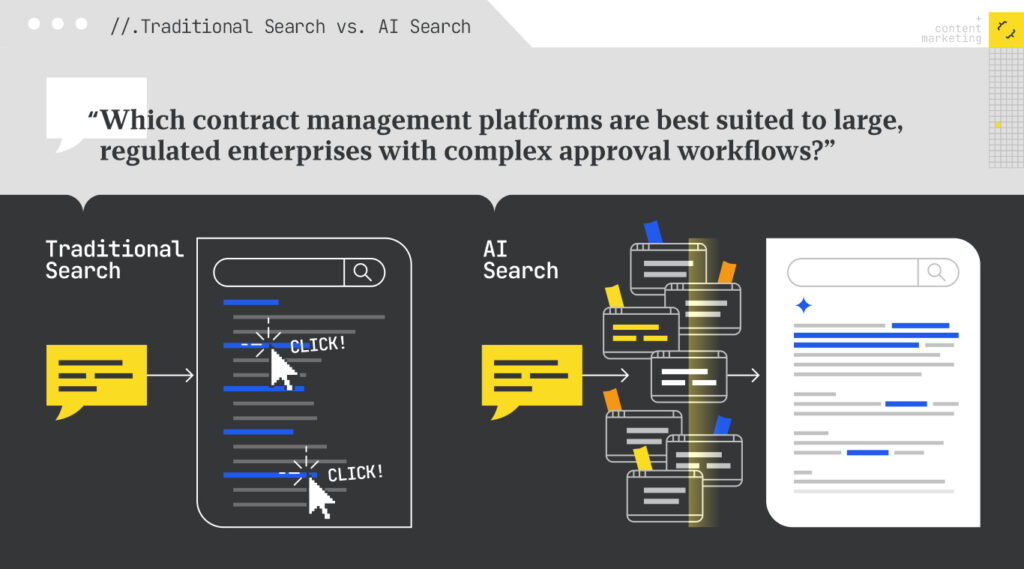
AI Search is any search experience where a machine reads the sources and writes you an answer instead of handing you ten links.
You’ve used it whether you meant to or not. Type a question into Google and there’s a good chance a paragraph of generated text appears above the results. That’s an AI Overview. Click the AI Mode tab and you get a full conversational answer with a handful of links tucked into it. Open ChatGPT, Perplexity, Gemini, Copilot, or Claude and ask what the best enterprise contract management platform is, and you get a shortlist with names on it, delivered with total confidence.
Here’s what matters for you. Those answers get built from a set of sources the system selects. The system decides which pages to read, which to trust, which brands to name, and which to leave out. If your company is in that set, you’re in the conversation. If not, the buyer never sees you and never knows what they missed.
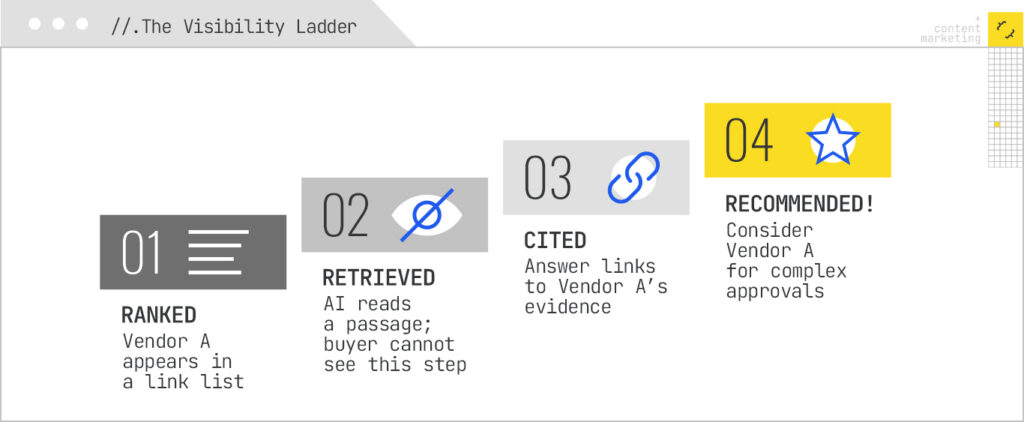
Keep this ladder in mind for the rest of the piece:
- Ranked. Your page appears in a traditional list of results. The old game.
- Retrieved. The AI system pulled your content into its working set while building an answer. Nobody sees this happen.
- Cited. The answer links to you or names you as a source.
- Recommended. The answer tells the user to consider you, buy from you, or call you.
Every rung up costs more effort and is worth more. Most of the confusion in the proposals you’re reading comes from vendors blurring these together, so hold on to the distinction.
One more thing: the clicks are evaporating. When the answer is on the page, fewer people click through to anyone. Classic Search is considered to just be a performance channel you measured in clicks. AI Search is primarily a brand channel you measure in whether you’re named, how often, and how you’re described. We’ll come back to that under measurement.
How does this relate to the SEO we already pay for?
Closely, and I’ll keep this short, because it’s the last time this piece dwells on it.
Here’s the plainest way I can put it: classic SEO makes you eligible. It doesn’t make you the answer.
Eligibility is the price of admission. Every system that answers questions, Google included, has to be able to find your pages, load them, read them, and understand what they’re about. Everything you’ve paid for over the last decade (crawlability, speed, clean structure, content that matches how people search, links from credible sites) is still required. The overlap is real. It’s also not enough on its own.
Getting selected is a different test. When an AI system builds an answer, it breaks the question into smaller questions, pulls specific passages from across the web, judges each passage on its own for clarity, depth, and trust, and weighs what the rest of the internet says about you. Being the top result for a keyword can get you considered. It doesn’t get you chosen.
Which brings us to the bigger shift. The thing being evaluated is no longer your website. It’s your whole content ecosystem: the media you own (your site, your video, your documentation), the media you earn (press, analyst coverage, reviews, awards), and the media you share (Reddit, YouTube, LinkedIn, the communities where your buyers talk to each other). The machines read all three and treat them as one body of evidence about your brand. A program that only touches your website is working on a third of the problem.
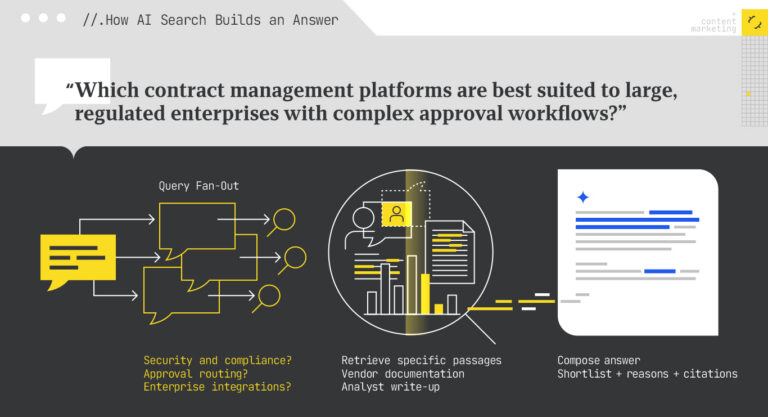
At iPullRank, we call the discipline that covers all of it Relevance Engineering: the art and science of improving visibility on any surface where people search, built from information retrieval (the computer science behind search), content strategy, user experience, artificial intelligence, measurement, and digital PR. It’s a bigger job than optimizing a website, and it’s the job.
The goal is simple to say and hard to do: be recommended by AI and remembered by people.
How is AI Search optimization done?
Across your whole content ecosystem, not just your website. The work breaks into six buckets.

- Research. It starts with the prompts your audience actually type into an AI system, and the smaller questions the system breaks those into behind the scenes. There is no search volume number to anchor on. A good team builds that prompt set from real customer language, sales calls, support tickets, and the AI systems themselves, and keeps it current.
- Owned media: technical readiness. Can the AI systems reach your content and read it? Which bots you allow, whether your pages render without JavaScript, how fast they load, and whether the page structure makes it obvious what each section answers. This is the eligibility layer.
- Owned media: content. Not “more blog posts.” Content that answers a specific question in a clear, self-contained passage, says something the other sources don’t already say, and is written so a machine can lift the right piece and quote it. A lot of this work is rewriting what you already have rather than producing new volume.
- Earned media. Trade press, analyst coverage, reviews, awards, and the comparison articles buyers read. AI systems lean hard on what credible third parties say. If the press hasn’t covered you in two years and your review profiles are thin, the machine has little to go on. This is digital PR work.
- Shared media. Reddit, YouTube, LinkedIn, industry communities, and anywhere else your customers talk to each other. The systems treat these as evidence of what real people think, and they cite them constantly. Building a footprint here is community and creator work, not web development.
- Measurement. Tracking whether you show up, where, how you’re described, and whether any of it moves the business. This gets its own section below, because it’s where most vendors are weakest.
Here’s what a single fix looks like inside a large company, and notice how it touches all three kinds of media. Say buyers ask ChatGPT for the best vendor in your category for enterprise companies, a competitor gets named every time, and you don’t.
- The agency traces why: the competitor has three recent analyst mentions, a strong G2 profile, and a comparison page that answers the question directly. You have a product page that says “solutions for businesses of all sizes.”
- Product marketing agrees on how you describe your enterprise fit, in one sentence, everywhere.
- Marketing rewrites the product page and builds a comparison page. Legal reviews the competitive claims.
- Comms pitches the story to two trade publications and updates your analyst briefings.
- Customer success runs a review campaign so your G2 and Capterra profiles reflect the customers you actually serve.
- Engineering fixes the product page so it renders fully without JavaScript, and IT confirms the AI crawlers aren’t blocked at the firewall.
- The agency re-tests the question across platforms for six weeks and reports on citation share.

Seven steps, six departments, and nothing in it is a single team’s problem. When you evaluate a vendor, ask how they get cross-functional work done. The ones who’ve done it in an enterprise will have a specific answer. The ones who haven’t will talk about content.
What is required to get AI Search results in the enterprise?
Two kinds of complexity, plus three things that are new to this era.
Enterprise needs come from complexity in one of two places: the site or the organization. A site with two million URLs, six content management systems, and a decade of acquisitions has technical problems a 200-page site never has. An organization with regional marketing teams, a brand council, a center of excellence, and a nine-week legal review cycle has coordination problems a startup never has. Most enterprises have both. The partner you hire needs to be comfortable in the boardroom and in the codebase, and it needs solutions that scale past what one team can do by hand.
Here’s what’s new:
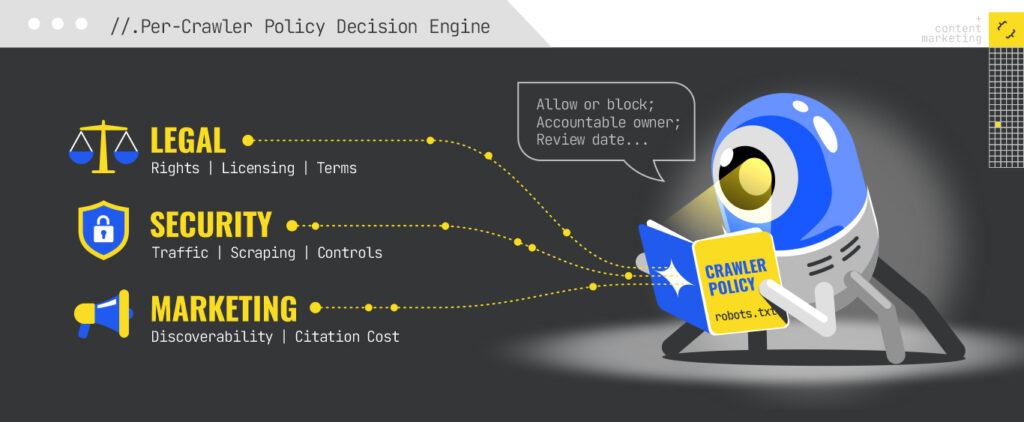
- Bot access is a company-wide policy question. Whether you let OpenAI, Anthropic, Perplexity, and Google’s AI crawlers read your site is a legal question (licensing, terms of use), a security question (traffic, scraping), and a marketing question (block them and you don’t get cited) all at once. In most enterprises three departments own a piece of that decision and nobody owns the whole thing. Somebody has to.
- What the AI says about your brand is a reputation problem. When ChatGPT describes your company inaccurately, or credits a competitor’s feature to you, that is not an SEO bug. It’s a comms and risk issue and deserves the same urgency as a bad headline. Your AI Search partner needs a working relationship with corporate communications, not just the web team.
- Speed matters more than it did. The platforms change daily. In the span of a year Google launched AI Mode, changed when AI Overviews appear, and shifted which kinds of sources get cited. An agency that needs a quarter to get a recommendation approved is optimizing for a system that no longer exists. Your internal approval process is part of the equation, and a good partner will say so on day one.
- Industry specificity is not inherently an advantage. One thing that hasn’t changed: a vendor being “specialized in your industry” does not guarantee better outcomes. Retrieval works the same way for insurance as it does for enterprise software. You want a team that already knows how the machines work and can learn your industry fast, not the reverse.
Why is it difficult to find a good AI Search vendor?
Because the market is about three years old and moving faster than anyone outside of the frontier labs can keep up.
- There are no standards yet. Search marketing was never regulated, but it had twenty years of accumulated practice, conferences, and a rough consensus on what good work looked like. AI Search has about three. There is no certification, no governing body, and no agreed definition of the thing being sold.
- Everyone rebranded overnight. Search agencies, PR firms, and media shops alike. Same team, same slide deck, new abbreviation on the cover. Some of them did the hard work of retooling. Most changed the header on the website. From the outside, the two look identical.
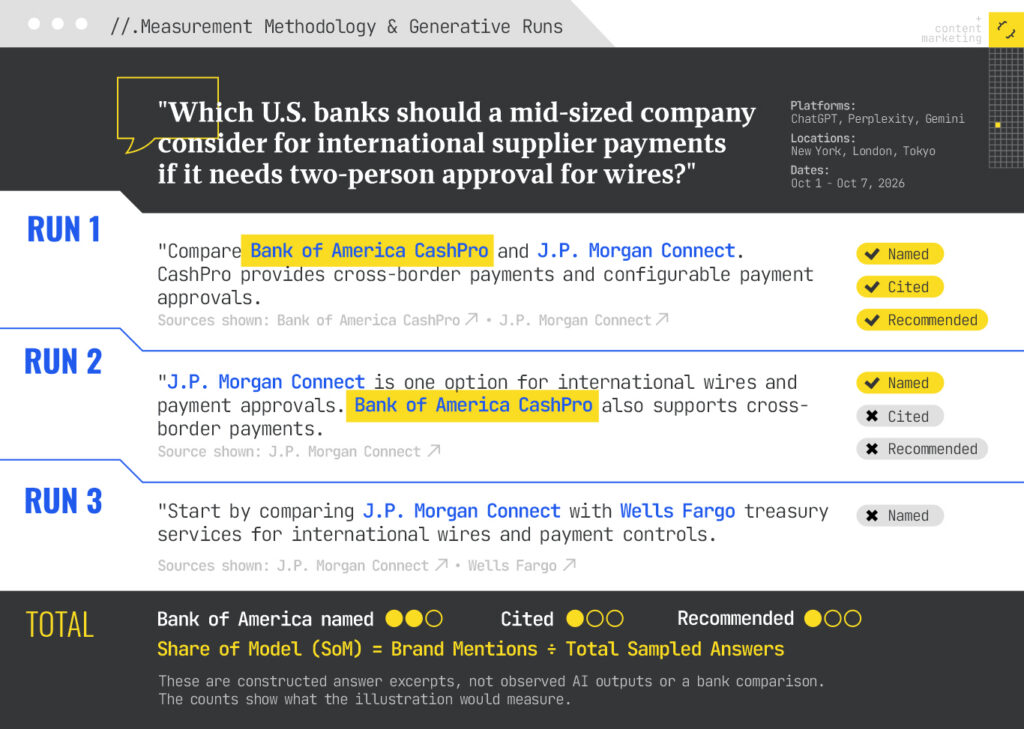
- Nobody measures it the same way. Every visibility tool samples a different set of questions, at different frequencies, from different locations, and reports different numbers. Two vendors can show you opposite results for the same brand and both be telling the truth about what their tool saw. That makes comparing proposals close to impossible unless you make them explain their method.
- The answers change every time you ask. Ask ChatGPT the same question twice and you’ll get two different answers, sometimes naming different companies. A vendor can screenshot a “win” that your actual buyer will never see. Any claim about visibility that isn’t based on repeated sampling over time is an anecdote.
- The platforms share almost nothing. Traditional search at least gave you keyword volumes, rankings, and click data. AI platforms publish almost nothing about what people ask or how they answer. Google reports some AI traffic in its tools but blends it in with everything else. Anyone claiming to know exactly how many people asked about your category is estimating.
- Dashboards are being sold as strategy. A tool that tracks whether you appear for a list of prompts is monitoring. Useful, necessary, and not the same thing as knowing what to change. Plenty of proposals stop at the dashboard.
- Hype makes big claims cheap. “400% increase in AI visibility” sounds excellent until you learn it went from two citations to eight. Ask for the denominator every time.
The upside is that this difficulty works in your favor if you know what to ask. The vendors that can answer the questions in the RFP section below are a short list. The rest will disqualify themselves.
What types of companies do this work?
Five kinds, and you’ll probably see at least three of them in the same RFP round.
- Holding company agencies. The big networks now bundle “AI visibility” into the media or creative retainer you may already have. They’re excellent at the executive layer: the strategy deck, the brand narrative, the quarterly business review. The actual expertise is usually thin, often a small team servicing the whole network, and sometimes subcontracted. You’ll get polished reporting on work that may not move.
- Search agencies that repositioned. The largest group by far. The range here is enormous. Some spent the last two years rebuilding their methods, hiring for digital PR, and developing their own measurement. Others changed the homepage and kept the deliverables. Both call it the same thing. The good ones are the strongest on the eligibility layer, because they were already doing more than meta tags. The question is whether they’ve built anything for getting selected, and whether they can work cross-functionally at all.
- AI visibility software platforms. Companies whose product tracks which brands appear across ChatGPT, Perplexity, Google, and the rest. Several have added services teams. The data is often very good and the recommendations are often generic, because software has to say something useful to every customer. Strong on monitoring, weaker on doing. However, this is rapidly evolving as these tools add agentic workflows to their toolkits.
- PR and communications firms. New entrants, and for a logical reason: third-party coverage drives a lot of what AI systems say about you, and earned media is their business. They tend to have no technical capability and no measurement beyond placements. Useful as a partner in the mix. Risky as the lead.
- GEO-native startups. Firms founded in the last two or three years specifically around this problem. Some are sharp and fast. Most are small, unproven at enterprise scale, and lean heavily on automated content production. You’re betting on whether they’ll exist in three years and whether your legal team will accept their process.
No single category is right for everyone. What matters is whether the company you pick can cover both layers of the problem, has the sophistication to work inside a large organization, and can show you results with a method you can audit.
So, where does iPullRank fit?
Here’s where I start pitching, as promised.
iPullRank is a roughly 40-person agency built around one idea: relevance should be engineered and measured, not guessed at. We’ve done enterprise SEO since 2014, and we were publishing on how large language models would change search before most of the current vendors existed. We didn’t rebrand into this. We were already here. And the results are the kind this piece tells you to demand, with the denominators attached: a telecommunications brand went from 712 to 3,235 AI Overview inclusions, and a vehicle marketplace went from appearing in 32% of ChatGPT answers for its category to 67% in under a year.
In the taxonomy above, we sit between the boutique and the software company, with the executive sophistication of the holding companies because our leadership worked in those environments. We have the technical depth to work with your engineering team on rendering and crawler access. We have the content and digital PR capability to move the third-party sources the machines trust. And we have the data to back it up.
We partner with Profound, the AI marketing platform built for the agentic era. It shows what your customers are actually asking AI across ChatGPT, Perplexity, Google, and the rest, how the answer engines describe you and where they get it wrong, and it deploys agents to act on what it finds. We built ExactScience, our own platform, to score how relevant your content is to the questions that matter and to track results at enterprise scale. Together they give us the data to see, the tools to act, and a measurement method we can show you and you can audit. We also wrote the AI Search Manual, the first free, long-form guide to how these systems actually work, because we’d rather you understand it than take our word for it.
What we’re not: a media network, a dashboard company, or a PR firm. We don’t sell software as the deliverable. We do run paid media in some engagements, and may offer it specifically for AI Search, but it isn’t the center of what we do. If you need those, we’ll work alongside the people who provide them, and we’ve done that plenty of times.
End of pitch for now. Back to the educational part.
How do these types of companies stack up?
Here’s how the categories typically compare on the things that matter for an enterprise program. The last column is us, so weigh it accordingly, and use the RFP questions below to check any specific firm against its category.
Capability | Holding company agency | Rebranded SEO agency | AI visibility software | PR / comms firm | GEO-native startup | iPullRank |
|---|---|---|---|---|---|---|
Executive and strategic sophistication | Strong | Moderate | Weak | Strong | Weak | Strong |
Technical readiness (owned media) | Weak | Strong | Strong | Weak | Moderate | Strong |
Content capability (owned media) | Strong | Moderate | Moderate | Moderate | Moderate | Strong |
Earned and shared media influence | Moderate | Varies widely | Weak | Strong | Weak | Strong |
Measurement rigor | Weak | Moderate | Strong | Weak | Strong | Strong |
Proprietary tooling and data | Weak | Moderate | Strong | Weak | Moderate | Strong |
Speed and adaptability | Weak | Moderate | Strong | Moderate | Strong | Strong |
Experimentation | Weak | Moderate | Moderate | Weak | Moderate | Strong |
Navigating enterprise process | Strong | Moderate | Moderate | Strong | Weak | Strong |
Likely to exist in three years | Strong | Strong | Moderate | Strong | Weak | Strong |
Two patterns worth noticing. The categories that are strong on the executive layer tend to be weak on the technical layer, and vice versa. And nobody except the software companies is naturally strong on measurement, which is why so many programs can’t prove they worked. Whoever you pick, make sure the gaps in their column get covered by someone.
What should procurement professionals look for in a strong AI Search partner?
Here are thirteen things that you should consider. Most vendors will clear six or seven. The ones you want clear all of them.
- They talk about outcomes, not just activity. Citations, share of voice, pipeline influenced. Not “we’ll publish 40 pieces of content a quarter.” Volume is what agencies focus on when they can’t measure results.
- They have a measurement method they can explain in five minutes and defend for an hour. Which platforms, how many questions, how often they sample, from where, and what the denominator is. If the method lives inside a tool they don’t control and can’t explain, that’s a problem.
- They can explain how the machines work to a non-technical audience. If they can’t make retrieval make sense to you, they can’t make it make sense to your CMO or your CFO, and the program will lose funding.
- They work across your whole content ecosystem. Technical and content work on the media you own, plus real capability in the media you earn and share. A vendor who only touches your website is working on a third of the problem.
- They have a position on AI crawler access. They should be able to walk your legal team through the tradeoffs of blocking versus allowing each major bot, and they should have done it before.
- They prioritize. Fifty recommendations ranked by effort and impact beat a 200-page audit every time. Your teams have limited capacity, and a good partner plans around that instead of pretending otherwise.
- They change their approach when the platforms change. Ask what’s different about their method today versus a year ago. If the answer is “nothing,” they aren’t paying attention. They should also have a defensible opinion on where this is heading. Ask how we should prepare for what search looks like in two years and why. You want a point of view grounded in how the systems actually work, not a recap of last month’s headlines.
- They build or use tooling beyond the off-the-shelf dashboards, and they know its limits. Every tool samples differently. A partner who can tell you where their data is weak is more trustworthy than one who says it’s complete.
- They experiment. They can test a change on a set of pages or questions, measure the effect against a control, and tell you whether it worked. Ship-and-hope is not a method.
- They can talk to engineers. Tickets, user stories, acceptance criteria, showing up to sprint planning. Recommendations that don’t get built don’t count.
- They integrate with your other teams. Comms, brand, paid media, product marketing. AI Search cuts across all of them, and a vendor operating in a silo will hit a wall by month three.
- They are confident in the method and honest about the machines. A strong partner knows exactly what to do, why it works, and can show you the results. What they can’t promise is how the platforms will behave. Anyone who guarantees a specific citation position is either lying or doesn’t understand the system. Confidence in the strategy plus candor about the system is the combination you want. Certainty about both is the red flag.
- They have account leadership that can navigate a large organization. You want someone who can chair a steering committee with six stakeholders, not just send a weekly status email.
Questions to put in your RFP
Copy these. They’re designed so that those that are still figuring it out can’t hide and a real practitioner can’t resist.
On Measurement
- Which AI platforms do you measure, and how many prompts do you track per platform for a client our size?
- How do you determine which prompts to track?
- How often do you sample each prompt, from how many locations, and how do you account for the same question returning different answers on different runs?
- Define “visibility” as you report it. What’s the numerator and what’s the denominator?
- Show us a sample report with the underlying data, not just the charts.
On Method
- Walk us through how you’d diagnose why a competitor is cited for a question and we aren’t.
- What’s your process for updating third-party sources (reviews, forums, press, social media) that the AI systems draw on? Who on your team does that work?
- What is your recommendation on allowing or blocking AI crawlers, and how have you handled that conversation with a client’s legal team?
- What has changed in your approach in the last twelve months, and why?
On Capability
- Who specifically will work on our account, what have they done in AI Search before, and how much of their time do we get?
- Describe how you’ve worked with an enterprise engineering team to get technical recommendations built. What did the handoff look like?
- How do you run an experiment, and how do you decide whether a change worked?
On Proof
- Provide a before-and-after case study with the measurement method disclosed, the time period, and the absolute numbers, not just percentages.
- Provide a reference we can call who has been through at least two quarterly reviews with you.
On Commercial Terms
- What tooling is included, what’s passed through at cost, and what happens to our data and dashboards if we leave?
- What does the first 90 days look like, and what will we have in hand at the end of them?
A vendor who answers all sixteen clearly is worth a conversation regardless of what their website calls the service. A vendor who answers questions 1 through 5 with a product name and a logo is selling you a dashboard.
What are common misconceptions enterprise companies have about AI Search?
You’ll hear most of these in your own building before you hear them from a vendor.
“AI Search means SEO is dead, so we can cut that budget.” SEO is the eligibility layer. Cut it and you fall out of both the old results and the new answers. The right move is to reallocate, not to eliminate.
“We just need an llms.txt file.” This is a text file that’s supposed to tell AI systems what’s on your site. Agentic AI tools, the kind that browse or write code on someone’s behalf, do read it. Google’s search platforms don’t. It won’t hurt you. It also won’t do much for your visibility in search. Anyone leading with it is leading with the easiest thing on their list.
“We just need to add structured data.” Schema markup helps machines parse your pages. It does not make your answer better than your competitor’s answer. It’s a formatting fix being sold as a strategy.
“We should block the AI bots to protect our content.” That’s a legitimate legal position, and it has a marketing cost: blocked means uncited. Make the decision consciously, with legal, security, and marketing in the same room, rather than by default because someone in IT added a line to a file.
“If we rank number one, we’ll get cited.” There’s overlap, but it isn’t one to one. The systems pull passages, not pages, and they weigh what third parties say about you. Plenty of number one results never get quoted.
“AI traffic is tiny, so it doesn’t matter.” The share is small today. Reports across the industry consistently show that visitors arriving from AI answers convert at a higher rate than traditional search visitors, because they arrive pre-qualified. And the bigger effect never shows up in traffic at all: the buyer who saw you recommended and went straight to your sales team.
“It’s too early. Let’s wait until it settles.” Citation patterns are sticky. The brands the systems learn to name now become the default answer, and unseating a default is far more expensive than becoming one. Waiting is a decision with a cost.
“We’re a big brand. The AI already knows us.” The model knows your name. Whether it recommends you for a specific question depends on whether your content and your third-party footprint answer that question better than the alternatives. Brand recognition gets you in the room. It doesn’t get you picked.
“We can generate our way in with AI-written content.” The systems are good at recognizing content that says what a hundred other pages already say. What gets cited is information the other sources don’t have. Volume without new information is noise, and the machines treat it that way.
How should you measure it, and what does success look like?
In three tiers, and if a proposal only covers one of them, you’re missing a big part of the picture.
Most AI Search reporting stops at “did we show up.” That’s necessary and it isn’t enough, because it tells you nothing about why you showed up or whether it mattered. We use a three-tier framework that connects the work to the visibility to the business.
Tier | The question it answers | Example metrics | Who controls it | How fast it moves |
|---|---|---|---|---|
Input Metrics | Is our content built to be retrieved and quoted? | Passage relevance, entity salience, AI bot activity on the site, rankings for the sub-questions the systems generate | You and your agency | Weeks. These change as soon as the work ships. |
Channel Metrics | Are we showing up, how often, and how are we described? | Share of voice, citation rate, citation quality, citation sentiment across each AI platform | The platforms, influenced by you | One to three months, as systems recrawl and third-party sources shift |
Performance Metrics | Is it moving the business? | Traffic from AI sources, key events, conversions, engagement depth, pipeline influenced | Your business | Lags the channel metrics by a quarter or more |
Here’s why the tiers matter to you specifically. Input metrics are the leading indicators. They tell you whether the vendor is doing the right work before the results show up, which means you can tell in month two whether you’re on track rather than waiting until month nine to find out you weren’t. Channel metrics are what most tools report, and they’re where the sampling problems from earlier live, so insist on the method. Performance metrics are what your CFO cares about, and they’re also where this gets hard, because a buyer who saw you recommended in ChatGPT and then typed your name into Google shows up in your analytics as “branded search,” not as AI.
A sensible program reports all three, is clear about which tier each number lives in, and never claims a performance result it can only infer.

What success looks like at the end of year one, in plain terms: your content scores well on the input measures for the questions that matter to your business; you’re cited for a growing share of those questions across the platforms your buyers use, and described accurately when you are; and the traffic and conversions you can attribute are growing, with an agreed method for estimating the influence you can’t attribute directly. If a vendor can’t describe success in those terms, ask them what they’d put in the year-end review instead.
What do commercial models look like?
Mostly the same shapes you’ve bought before, with a few terms worth negotiating differently.
The common structures. A fixed-scope diagnostic (four to twelve weeks, a defined set of deliverables) followed by a monthly retainer is the most typical arrangement, and for good reason: nobody can scope the ongoing work until they’ve seen inside your site and your organization. Pure project engagements exist for narrow problems, like a crawler access decision or a content overhaul for one business line. Software platforms price per seat or per number of questions tracked, with services layered on top.
How scope gets defined. Expect the scope to be written in deliverables: a diagnostic, content sprints, technical specifications, a measurement plan, monthly reporting. That’s how agencies scope, and it’s how you’ll compare proposals side by side. What to insist on is the line between the two: every deliverable should map to a prompt in your question set or a metric in the measurement plan, so the activity you’re buying has a stated reason to exist and a way to tell whether it worked.
Contract length. Channel metrics take two to six months to move (depending on how quickly your organization and can implement) and performance metrics lag behind that, so a program shorter than twelve months will end before you can judge it.
Tooling. Ask what’s included and what’s passed through. Third-party visibility platforms can cost as much as the services, and some vendors mark them up. Ask whether the dashboards and the historical data are yours when the engagement ends. If the answer is no, price that in.
Be wary of performance pricing. Paying per citation or per point of share-of-voice sounds appealing and is a bad idea here, because the underlying measurements vary run to run and the vendor picks the sampling method. You’d be paying a bonus on a number they control. Tie incentives to input metrics and business outcomes you measure yourself and agree upon the baseline measurements prior to starting, if you tie them to anything.
Data and access. The vendor will need access to your analytics, your search console data, and your server logs. Get the access and ownership terms in the master agreement, along with what happens to any custom tooling they build for you.
What is iPullRank's approach?
Pitching again. Our approach comes out of research, not a rebrand. We’ve spent years studying how retrieval systems and language models actually decide what to cite: reading the patents and the papers, testing the systems themselves, building our own measurement to check what we find, and publishing the results in the AI Search Manual so the rest of the industry can check them too. The six steps below are the operating model that research produced. We call the discipline Relevance Engineering, and the program that delivers it is our AI Search Strategy Program.
- Strategic planning. We start with your buyers, not with keywords. Our persona-driven research process now includes the questions your buyers ask AI systems and the sub-questions those systems generate behind the scenes. We audit where you stand today across Google’s AI features, ChatGPT, Perplexity, and the rest, and we map the gaps to specific work.
- Content strategy. We score your existing content on the input metrics (how relevant each passage is to the questions that matter, how much it says that nobody else says) and rebuild it to be quotable. We embed with your marketing team rather than throwing content over the wall, because in an enterprise the approval process is half the job. And because being cited only matters if the human on the other end acts, the content has to work for people too. Relevance Engineering gets you in the door. We call the other half Resonance Design, and it’s what keeps them there.
- Technical development. We work directly with your engineers. That means rendering fixes, crawler access policy with your legal and security teams, and page structure that makes each answer easy to lift. Recommendations arrive as user stories with acceptance criteria, and we show up to sprint planning.
- Promotion. This is the earned and shared media side of the ecosystem: digital PR into the trade press and analyst community, review programs, and native work on Reddit, YouTube, and the communities where your buyers talk, coordinated with your comms team and your paid and owned channels so the message is consistent everywhere the machines look.
- Measurement. All three tiers, reported together, with the sampling method written down. We see what buyers ask and how the answer engines respond through our partnership with Profound, and we score content relevance in ExactScience, our own platform, so we can explain every number on the report.
- Optimization. We run controlled experiments: change a set of pages or a set of questions, hold out a comparable set, measure the difference. Then we do it again. The platforms change monthly and our method changes with them.
What this looks like from your side is one team that can sit with your CMO on Monday, your engineering lead on Tuesday, and your head of comms on Wednesday, and say the same thing to all three in language each of them understands. That’s the job.
Terms you'll see in proposals
The short version of each, in the order you’re most likely to run into them.
Term | What it means for you |
|---|---|
GEO, AEO, LLMO, AIO, AI SEO | Five names for the same thing: getting your brand into AI-generated answers. Generative Engine Optimization is the most common. Don’t let the abbreviation drive the vendor choice. |
AI Overview | The AI-written summary that appears at the top of many Google results. |
AI Mode | Google’s fully conversational search experience, a tab next to the regular results. |
Large language model (LLM) | The technology behind ChatGPT, Gemini, Claude, and the rest. It reads text and writes answers. |
Content ecosystem | Everything the internet says about your brand, across the media you own, earn, and share. The unit the machines actually evaluate. |
Owned, earned, and shared media | Owned: your site, video, and documentation. Earned: press, analyst coverage, reviews, awards. Shared: Reddit, YouTube, LinkedIn, communities. AI systems read all three. |
Query fan-out | When an AI system breaks your one question into several smaller questions and searches for each of them before answering. This is why one page rarely wins on its own. |
Retrieval, grounding, RAG (retrieval-augmented generation) | RAG stands for retrieval-augmented generation: the system retrieves current web content first, then generates its answer from what it found, instead of relying only on what it memorized in training. “Grounding” is the same idea. This is where your content gets picked up or doesn’t. |
Passage | A self-contained chunk of a page. AI systems retrieve and quote passages, not whole pages. |
Citation | The answer linking to or naming your site as a source. The thing most of this work is trying to earn. |
Share of voice | Of all the times a set of prompts was answered, how often you were mentioned relative to competitors. The most common headline metric, and the one most sensitive to how it’s sampled. |
Entity | A thing the system recognizes as a thing: your company, your product, your executives. Being a well-defined entity is part of being eligible. |
Embedding | A mathematical representation of what a piece of text means, which lets a machine compare your passage to a question. When a vendor talks about relevance scores, this is usually underneath. |
Information gain | Whether your content says something the other sources don’t. Content with no information gain tends to get ignored. |
Crawler, bot | The software an AI company uses to read your site. Each has a name (GPTBot, ClaudeBot, PerplexityBot, Google-Extended) and you can allow or block each one. |
llms.txt | A text file describing your site for AI systems. Agentic tools read it; Google’s search platforms don’t. Cheap to add, little effect on search visibility. |
Structured data, schema | Code on your pages that labels what things are (a product, a price, an author). Helps machines parse. Doesn’t make your content better. |
Hallucination | When the AI states something false with confidence, including about your company. A reputation issue, not just a technical one. |
Nondeterminism | The same prompt producing different answers on different runs. The reason a single screenshot proves nothing. |
Zero-click | A search where the user got what they needed without clicking through to any site. Increasingly the norm, and the reason traffic alone understates your visibility. |
Relevance Engineering | Our term for the discipline: the art and science of improving visibility on any surface where people search, built from information retrieval, content strategy, user experience, AI, measurement, and digital PR. |
Resonance Design | The other half: content built so the people who find you stay, trust you, and act. Relevance gets you found. Resonance gets you chosen by the human. |
What are some resources to learn more?
If you want to go deeper before the vendor meetings, start with these. None of them require a marketing background.
- The AI Search Manual. Our long-form guide to how AI search systems work and what to do about it. Start with the chapter on measurement if you only read one.
- From Clicks to Citations: New AI Search Measurement Metrics. The three-tier framework from the measurement section above, in full.
- Beyond Rankings: Designing AI Search Metrics for the Next Era of SEO. Why the old scorecard doesn’t work and what replaces it.
- An Introduction to Relevance Engineering. The thinking behind the discipline.
- How AI Mode Works. A walkthrough of Google’s conversational search and what it means for brands.
- Engineering Relevant Content: Tips to Get Your Content into LLMs. The practical side of getting selected.
- How Enterprise SEO Needs to Embrace the AI Movement. The organizational argument, for the people who own the budget.
- How to Win Visibility in AI Search (webinar). If you’d rather watch than read.
- SEO for the Procurement Professional. The original piece this one follows, still useful for the foundation.
Thanks for reading this far. You now know more about how AI Search actually works than most of the people who will pitch you on it, and you have sixteen questions that will sort the real practitioners from the rebrands in one round.
If you’d like one of those practitioners in the room, that’s us. We’ve been engineering relevance for enterprise brands since before the machines started talking back, we measure everything with a method you can audit, and we’ll tell you what we don’t know. Reach out and let’s talk about where your brand stands today and what it would take to be recommended by AI and remembered by people.