
Most clicks go to sites the searcher never named, Google absorbs about a third of Wikipedia's would-be traffic but barely dents Reddit's, and ChatGPT now pulls more of its clicks from ads than any other top destination.

TL;DR
Nearly half of Google searches now end without a click, but treating zero-click as a single number misses what’s actually happening. The rate changes dramatically depending on who is searching, where they’re searching, what device they’re using, and what they’re searching for.
Some search experiences have effectively become closed systems where Google answers the question directly, while others still reliably generate clicks. Understanding that difference matters far more than debating whether zero-click is “good” or “bad” for SEO.
—–
Using the Datos clickstream panel, consisting of real search events from 9.1 million people over 15 months, we measured zero-click behavior across every cut we could: platform, country, age, query type, destination, and Google property.
What We Wanted to Test
The conversation around zero-click search tends to collapse everything into a single percentage. Depending on who you ask, Google is sending less traffic, AI is eating clicks, and/or SEO is becoming less effective. But averages hide variance.
A global zero-click rate can tell you something is happening, but it can’t tell you where it’s happening, who it’s affecting, or whether it matters to your business. A publisher, an ecommerce brand, and a SaaS company can all live inside the same search ecosystem while experiencing completely different outcomes.
So rather than re-confirm that zero-click is high, we set out to map its variance.
Primary research question:
Zero-click rate is real and rising, but how does the rate vary meaningfully across user cohorts in ways that aggregate studies miss?
Secondary questions:
- Is zero-click behavior increasing over time?
- Do desktop and mobile users behave differently?
- Which countries have the highest zero-click behavior?
- Which categories still drive clicks?
- Which domains reliably earn traffic from Google?
- Are some searches effectively “closed loops” inside the SERP?
The Hypothesis
Our bet was the aggregate number is real, but strategically misleading; once you split it by cohort, the spread would be wide enough that “the zero-click rate” stops being a single thing you can plan around. If that holds, the practical implication is that any zero-click figure is more useful with a cohort attached.
Methodology
Dataset
The data comes from Datos, a clickstream panel that records real search activity from millions of opted-in users. Every row is one search event: the user issued a query and either clicked a result (organic or paid) or didn’t click anything at all. Our window is October 2024 through December 2025: 13.1 billion events, 10.2 billion sessions, 9.1 million users, with continuous daily coverage. (Those users ran about 2.5 Google searches a day each across the window.)
What Counts as a Zero-Click Search
- In the clicktype-based data model: blank = impression, Organic/Paid = click
- A session is a zero-click search if no click row exists for that Session ID
What We Measured
Our anchor metric is the session-level zero-click rate: the share of searches that produced no click at all. We report it at the session level because that matches how SparkToro and Similarweb define it, which keeps our number comparable to the figures the industry already cites, however, our sample is 10-100 times larger than their studies.
Alongside it, we measured organic-vs-paid click composition, the top destinations clicks actually go to, the keywords that most often end without a click, and the same zero-click rate sliced by platform, country, age, and Google property.
Analysis Approach
We started with the overall zero-click rate, then repeatedly segmented the data to see where behavior diverged. Each analysis looked at the same core question (Does this search end with a click?) through a different lens: geography, device type, demographics, query patterns, and destination websites.
Rather than treating search behavior as a single global trend, we approached it as a collection of local behaviors that could be compared against one another. In practice, that meant looking less for a headline number and more for the places where the headline number stopped being useful.
Finding 1: 46.96% of Google Searches End Without a Click
Across 10.2 billion Google searches between October 2024 and December 2025, nearly half, 46.96%, ended without a single click.
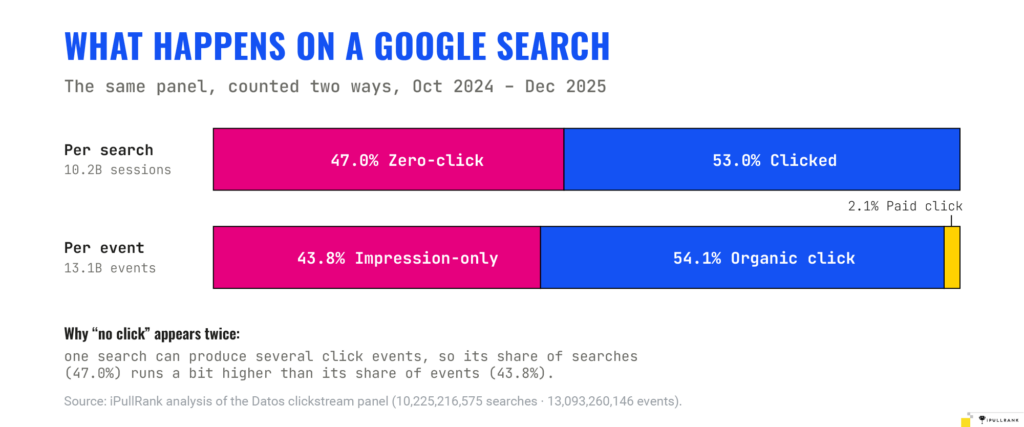
Users got their answer before clicking on organic or paid SERP results.

Additionally, most searches are shallow. Across the panel, 76.0% consisted of a single event with one query and one outcome, and then the session was over. That single event splits almost evenly: 37.8% of all searches ended with no click, and 38.2% ended after exactly one click. Less than a quarter involved a second click, a return to the results page, or a reworded query. 2.0% of searches involved three or more events.
Finding 2: Zero-Click Is Rising, but Slowly
Over the 15 months we tracked, the zero-click rate climbed gently, getting steeper over time. It rose about 2.6 percentage points between October 2024 and December 2025.
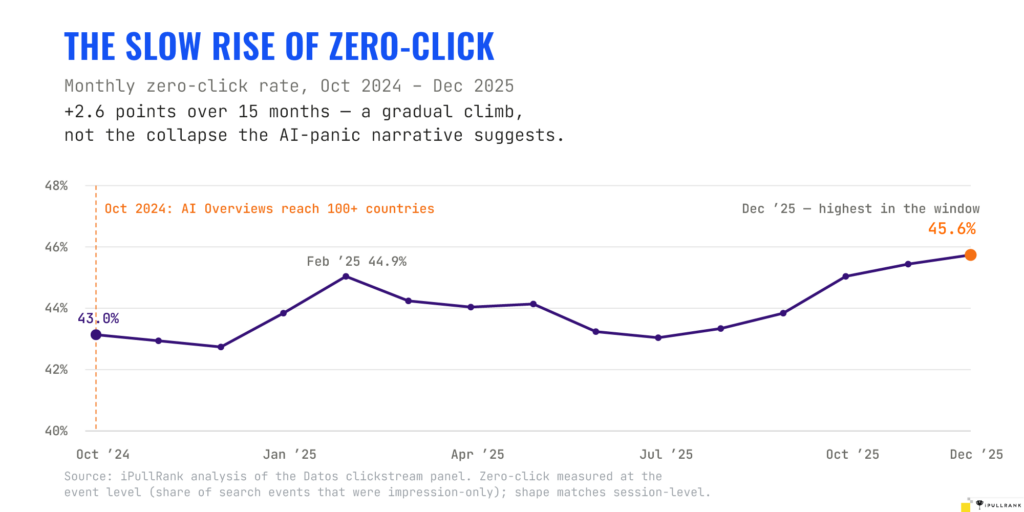
In October 2024, Google brought AI Overviews to over 100 countries, drastically widening the range of queries that could trigger an AI summary. December 2025 was the single highest zero-click month in our entire dataset. So, while the overall pace is gradual, the year-over-year gap widened noticeably at the end of the period.
Notable individual months:
- Feb 2025 outlier (44.9%): the first month above 44% by a meaningful margin
- Dec 2025 peak (45.6%): the highest zero-click in the entire window, suggesting the trend continuing into 2026
Comparing each month to the same month a year earlier:
- October 2024 → October 2025: +1.9 points
- November 2024 → November 2025: +2.5 points
- December 2024 → December 2025: +2.9 points

The key detail that could concern organic SEOs: rising zero-click rate is coming almost entirely out of organic clicks, not ads. The share of searches ending in an organic click dropped by about 2.8 points, while ad clicks show no change during this time. In organic search, the user is 25 times more likely to click than on a paid ad.
Finding 3: Most Google Clicks Are Discovery, Not Navigation
A major Google function is to use it as a shortcut to reach a site people already have in mind, like Amazon, Netflix, or Youtube.
But that’s not where the clicks actually go. We checked whether each click landed on a site whose name appeared in the search itself (if you searched “nike shoes” and clicked nike.com, you knew where you were going) versus a site you didn’t name (you searched “best running shoes” and clicked a review site or a retailer you never typed).
Only about 14% of Google clicks go to a site the searcher actually named. The other 86% are discovery: Google introducing people to destinations they didn’t ask for by name. That is the conservative floor, as our method counts “branded” searches when the site’s name appears literally in the search. Multi-word brands like “the new york times” → nytimes.com could slip through uncounted. Therefore, the true navigational share is somewhat higher, likely in the high teens, but almost certainly under 20%. Either way, the vast majority of Google clicks (north of 80%) are discovery.

That reframes Google from a shortcut to sites you already know to a discovery engine. Those 86 out of every 100 clicks are up for grabs based on what ranks, not who’s already famous. The brand-recall clicks (the 14.0%) were never really winnable through SEO anyway; the discovery clicks are the whole game.
One likely explanation is that search history is stealing these navigational clicks. The sites you go to frequently will populate with as little as one character, and you never end up on the SERP at all. You can even navigate to Google Drive files in the search bar without navigating to the page itself.
There’s a smaller, sneakier finding hiding inside the branded clicks, though.

When a branded search ends in a click, that click is about 1.3 times as likely to be a paid ad as on an unbranded search (4.4% vs 3.3%). When someone searches a brand by name, that brand often buys an ad on its own name, paying to sit at the top of a results page it already dominates organically. That’s “defensive bidding”. Coca-Cola pays for the “coca-cola” ad slot so a competitor can’t grab it, even though Coke ranks #1 for free right below.
It’s a quietly expensive habit. Brands spend real money defending searches they’d win anyway.
Finding 4: Which Destinations Win Clicks, and Which Ones Google Replaces
We took the 25 sites that get the most Google clicks and asked one question of each: across the searches that normally send that site traffic, how often does Google answer on the results page itself, so the click never happens?
Think of it as a vulnerability score. A low number means a site reliably captures its clicks (when its topics come up, people click through). A high number means Google is intercepting those searches with its own answer box, and the site is losing traffic it would otherwise get.
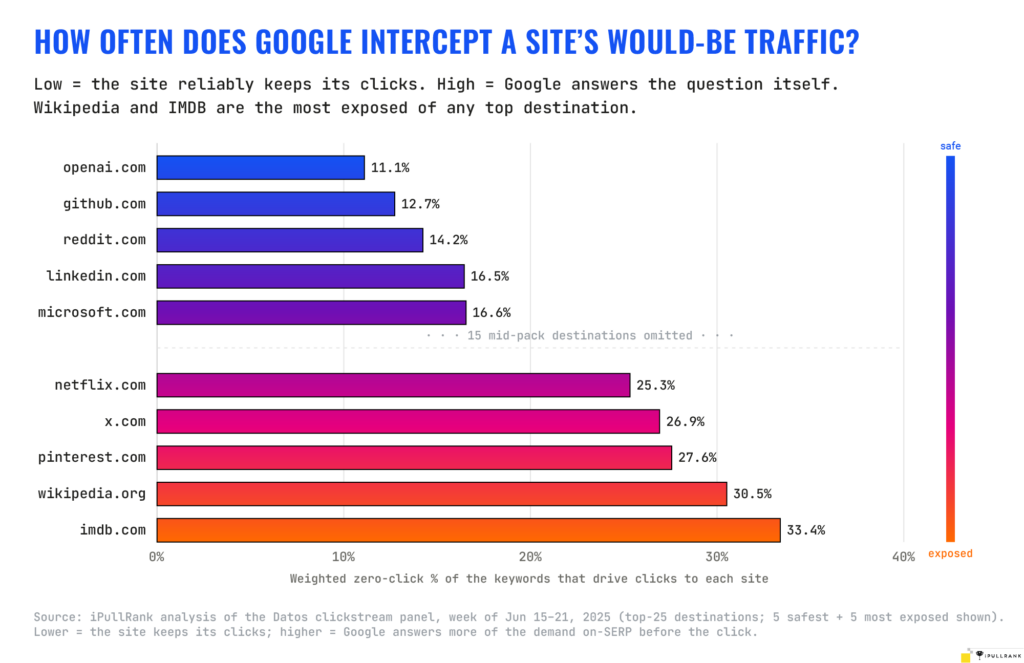
The results split the internet’s biggest destinations into two camps.
The safe ones (sites Google can’t easily replace):
- OpenAI (only 11.1% of its would-be searches get intercepted)
- GitHub (12.7%)
- Reddit (14.2%)
- LinkedIn (16.5%)
- Amazon (16.6%)
When people search their way toward these sites, they almost always click through. Google doesn’t have a good way to answer, “take me to ChatGPT,” “show me this specific GitHub repo,” or “what do real people on Reddit think” with a snippet.
The vulnerable sites:
- Wikipedia (30.5% of its would-be searches get intercepted by Google)
- IMDB (33.4%)
These are two of the most-visited destinations on the entire web from Google. Think of it this way: the things people search to reach Wikipedia (facts, definitions, “who is,” “what is,” “when did”) and IMDB (movie casts, release dates, “who played”) are exactly the things Google now answers in a knowledge panel. About a third of the traffic those sites would have earned a few years ago now stops at the results page.
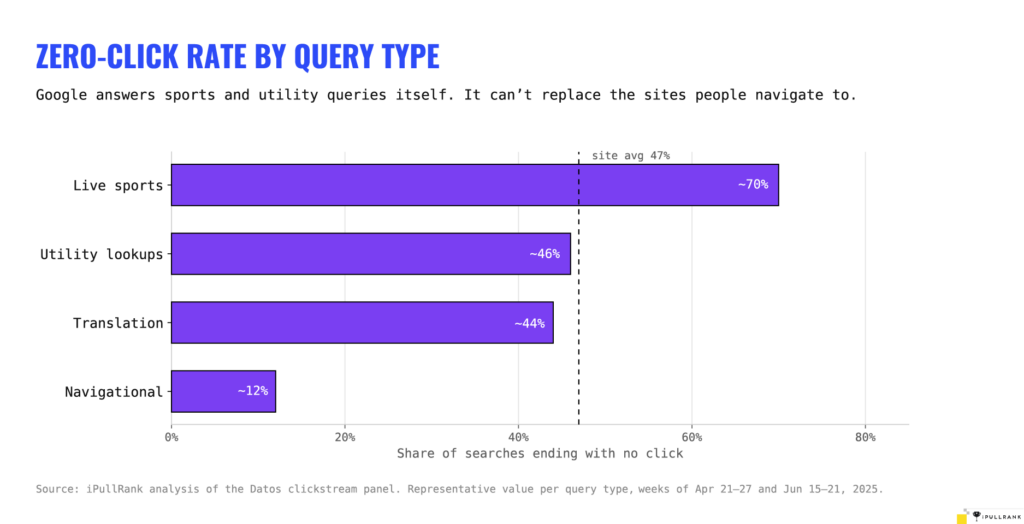
When we sorted searches by query type, the zero-click rate spread across a clean spectrum. Live sports sit at the top: a score or fixture pulls up Google’s sports widget, so the answer is already on the page and the click rarely happens. Utility lookups (calculator, weather, timer, conversions) and translation land in the middle, right around the site-wide average, because Google has built a dedicated widget or an inline translate box for each. For navigational searches, when someone types “youtube,” “chatgpt,” or “gmail,” Google can’t be those sites, so there’s almost always still a click.
Reddit is a great example of this dynamic. Google can summarize a fact, but it can’t yet replace a thread of real humans arguing about which mattress is actually worth it. So the “best X according to real people” searches still send the click, and Reddit catches it.
Also, traditional news sites are absent from the top 25. No NYT, CNN, BBC, Washington Post, ESPN, Bloomberg. Either news consumption is increasingly happening elsewhere, news queries are surfacing in formats that generate fewer clicks, or their sites may even block Google from crawling. What we can say is that traditional news publishers are largely absent from the destinations receiving the most Google traffic in this dataset.
Finding 5: ChatGPT Draws More Paid Clicks Than Any Other Top Google Destination
AI tools have quietly become a top destination on Google, and OpenAI is buying its way to the top of the page.
When we ranked the sites people click to most often from Google search, ChatGPT came in at #6, ahead of nearly every website on the internet. Only YouTube, Google’s own pages, Reddit, Facebook, and Wikipedia send more clicks. People are searching “chatgpt” on Google and clicking through, millions of times a week.

Of all the top destinations, ChatGPT has by far the highest share of paid clicks: about 4.75% of its Google traffic comes from ads, versus 0.2% for YouTube, zero for Wikipedia, and under 2% for Amazon, a company that lives and dies by paid search. We can’t see OpenAI’s actual ad spend from this data (we don’t have cost-per-click, and we only capture the paid clicks that landed on ChatGPT, not everything OpenAI bid on), but it’s clear that a much larger slice of ChatGPT’s Google traffic is paid than any other site at the top.

So the “AI versus Google” framing misses what’s actually happening. OpenAI isn’t routing around Google. It’s paying Google for traffic, drawing a larger share of paid clicks than any other top destination. The two companies look as much like customer and vendor right now as they do rivals.
And it’s not just ChatGPT. DeepSeek now pulls navigational Google searches at nearly the same click-through reliability as ChatGPT. Add in Gemini, and AI tools together pull about 720,000 navigational Google searches a week in our panel. A brand-new category of destination has appeared in the span of about a year, and people are still using Google to get to it.
The takeaway is that AI tools have become a destination on Google, like YouTube or Wikipedia, rather than a replacement for it. At least for now, the road to the AI tools still runs through the search bar.
Finding 6: "Mobile Is Zero-Click" Isn't a Global Truth
When we split zero-click behavior by device and country, the “mobile is zero-click” rule turned out to be wildly uneven. In the UK, people zero-click 65% of the time on mobile but only 46% on desktop, a 19-point gap. In Indonesia, it’s 55% on mobile versus 49% on desktop, a 6-point gap. Same behavior, very different stories.
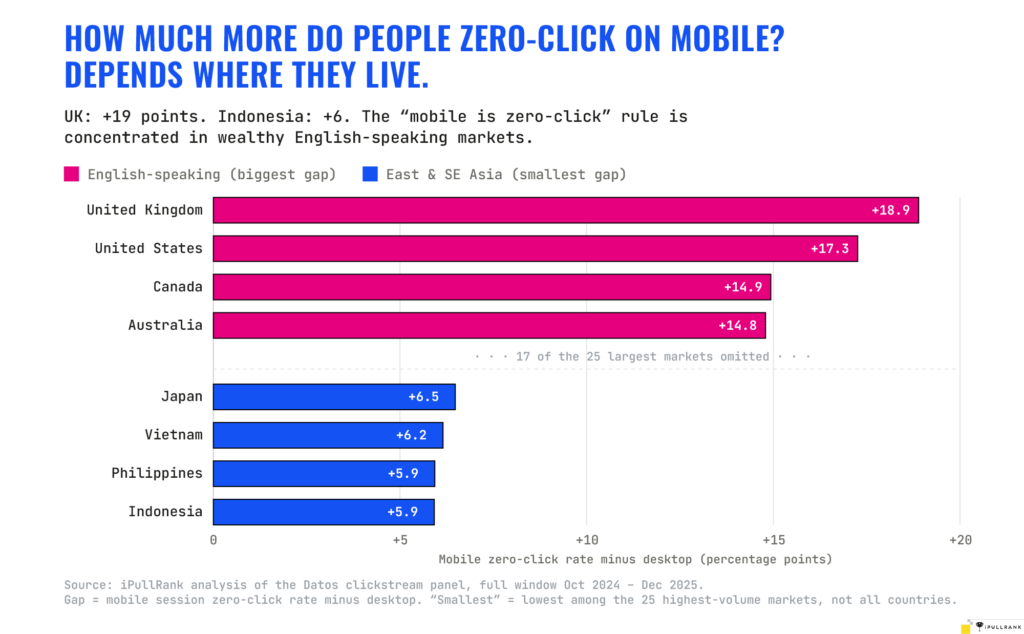
Sort every market by that gap and the pattern is clean. The biggest mobile penalties are all in English-speaking countries: the UK (+19 points), the US (+17), Canada (+15), and Australia (+15). The smallest are all in Asia: Indonesia, the Philippines, Vietnam, and Japan all sit near +6. The “mobile kills the click” effect is real, but it’s concentrated in English-speaking markets. Across much of Asia, a phone and a laptop produce nearly identical search behavior.
The effect is strong enough that in five markets, more than 60% of mobile searches end without a click: the US (66%), UK (65%), Australia (64%), Canada (62%), and Mexico (61%). In those countries, the results page is now the most likely end of a mobile search.
That’s whether people click at all. When they do click, a second split appears, and it doesn’t follow the same map.
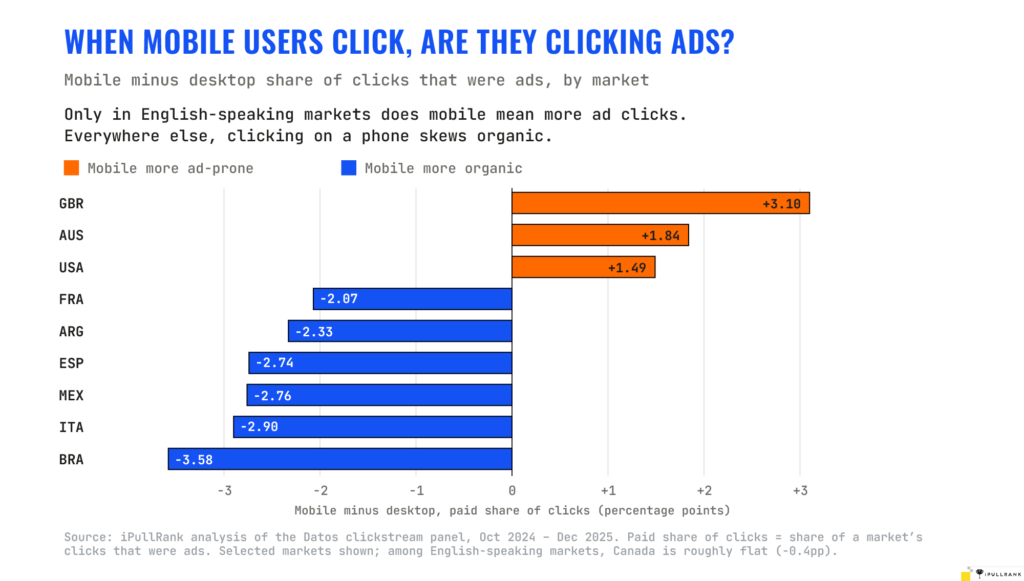
In the UK, Australia, and the US, mobile clicks are more likely to be ads than desktop clicks are. British mobile users click an ad on 9.4% of their clicks, versus 6.3% on desktop. That runs against the usual assumption that mobile cannibalizes paid clicks: in these markets the mobile ad ecosystem is more aggressive, and users go along with it.
Everywhere else, the opposite holds. In Brazil, Italy, Mexico, Spain, Argentina, and France, mobile clicks skew organic, so when someone clicks on a phone it’s rarely an ad. The mobile ad market in those countries is simply weaker than it is on desktop.
The question, “Does mobile help or hurt ad clicks?” has no global answer. It depends on the country, and the gaps between countries are bigger than the gap between devices. That’s the real lesson here: zero-click rate, ad share, and click-through are not single numbers but behaviors that move with the map.
Finding 7: Zero-Click Is Less Common on Local Google Domains
Zero-click searching changes sharply depending on what country you’re in, and which version of Google you’re using.
Across the markets we measured, the zero-click rate ranged from about 41% in Japan and Vietnam to 54% in the Philippines, a 13-point spread between the most and least click-happy countries. The US sat at 49%, and other English-speaking markets clustered tightly between 45% and 50%.
The two ends of the range are interesting on their own. Filipino searchers abandon more than half their searches without a click, the highest rate of any major market. Japanese and Vietnamese searchers click through most reliably, even on their phones.
Then there’s a layer almost nobody looks at: which Google you use.
Almost everyone in the world uses plain google.com (about 98% of all the searches we saw), even people who live in countries with their own local Google (google.co.uk, google.de, google.com.br, and so on). When we compared the two domains, within the same country, it showed people on google.com zero-click more than people on their local Google.
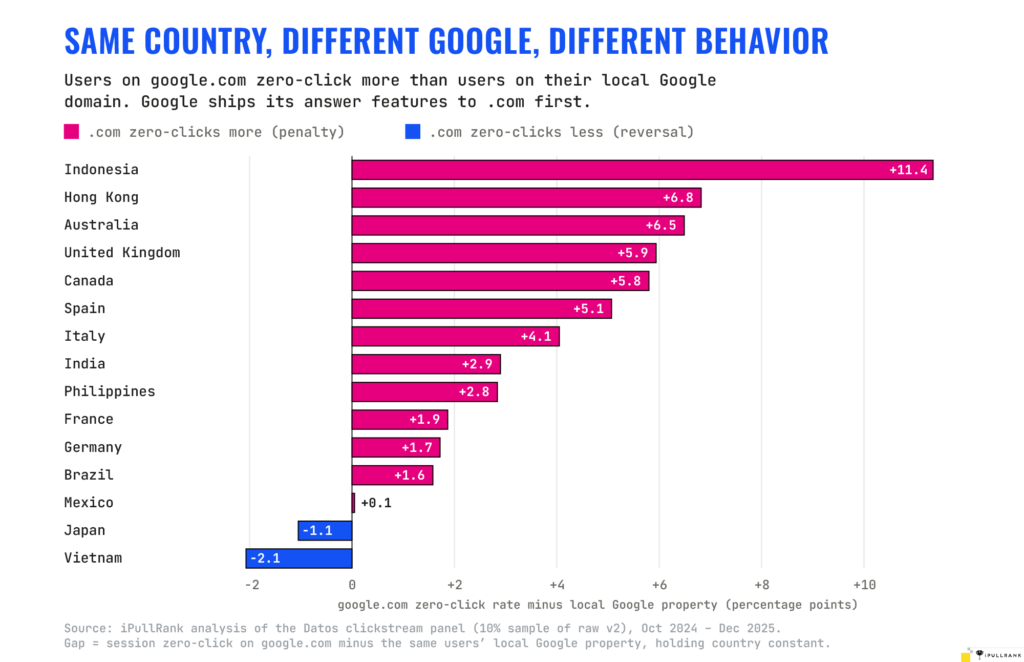
In Indonesia the gap is huge: users on google.com zero-click 11 points more than users on google.co.id. In the UK, Australia, and Canada it’s a 6-point gap. The likely explanation is that Google rolls out its newest answer features (AI Overviews, knowledge panels, instant-answer boxes) on google.com first. The regional versions lag behind, so they still feel a little more like “old Google,” where you clicked a blue link to get your answer.
(Two exceptions are Japan and Vietnam, the same two countries with the lowest zero-click rates overall. Whatever makes those markets click-happy holds up no matter which Google they use.)
Finding 8: Younger Searchers Are More Likely to Zero-Click
According to a one-week slice of data with age and gender, the younger the searcher, the more likely they were to take the answer off the results page and never click.
The older the searcher, the more likely they were to click an ad:
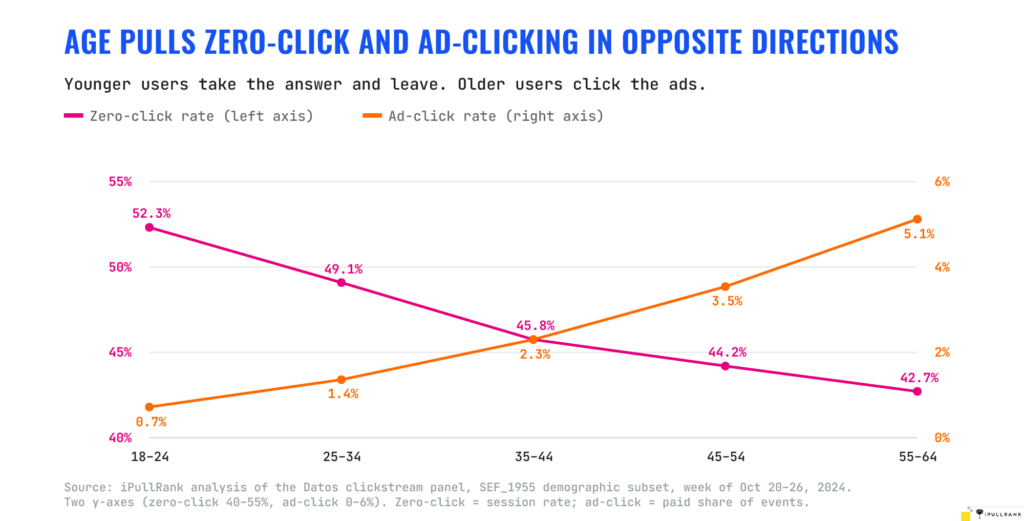
Every age bracket clicks through a little more than the one below it. The gap between the youngest and oldest groups is about 10 points.
However, older searchers click ads far more often than younger ones. The 55–64 group clicked paid ads about seven times more often than 18–24-year-olds, and more than 20 times more often than the under-18s. Where younger users zero-click and move on, older users are more willing to click a sponsored result.
For marketers, the implications cut both ways. If your audience skews young, more of your would-be search traffic is evaporating into zero-click answers, and SEO has to fight the snippet. If your audience skews older, paid search is meaningfully more effective, because older users actually click the ads.
Men and women zero-click at nearly identical rates: women around 47.5%, men around 47.0%. However, women click ads about a third more often than men (roughly 2.4% of clicks vs 1.8%).
What This Means for Brands
The biggest takeaway isn’t just that search traffic is disappearing but the probability of earning a click depends increasingly on context.
Some categories now compete directly with Google’s own answers. Others continue to attract clicks because the destination itself is the value. Nobody needs to visit a website to convert miles to kilometers, but they still need to visit Reddit to read a discussion or GitHub to access a repository.
That distinction matters because it shifts the question from “How do we rank?” to “What value exists beyond the answer itself?”
Brands operating in fact-based, reference-style content categories should expect more competition from the SERP itself. Brands built around products, communities, tools, experiences, or proprietary information are generally more insulated.
The practical implication is that measuring organic performance with a single benchmark becomes increasingly difficult. Search behavior differs by country, device, audience, and query type. Brands that understand those differences will have a clearer picture of where search still drives value and where it doesn’t.
What This Study Does and Does Not Prove
What This Study Supports
- Direct measurement of zero-click rate at the largest sample size publicly available
- Cohort-level variation in zero-click behavior
- Temporal trend during the AI Overview rollout window
What This Study Cannot Prove
- Rank-CTR: Datos doesn’t expose organic rank for most clicks, so we can’t build “what’s the CTR of position 1 vs position 3” from this data.
- SERP feature impact in isolation: We can’t attribute clicks specifically to AI Overviews vs Knowledge Panels vs Featured Snippets.
- Cross-device user behavior: Datos User ID is per-device, so we can’t measure “do mixed-device users behave differently.”
Caveats
- The panel is 94.5% desktop, so overall headlines are effectively desktop-weighted.
- The demographic panel is only one week, and 72% male, ages 25-44 dominant.
- Two age bands, 25-34 and 35-44, represent 97.4% of the sample (200M of 205M events). The 18-24, 45-54, and 55-64 bands are smaller, but still statistically large (147K+ sessions each).
The iPullRank POV
The takeaway here is that “zero-click rate” isn’t a single number you can plan around. The aggregate studies (SparkToro near 60%, Similarweb near 37%) are right on average, but the average is the least useful part of the picture.
In our panel, the rate runs from about 41% in Japan to 54% in the Philippines, from 46% on desktop to 66% on US mobile, and shifts again by query type.
That changes how search should be measured. A single organic benchmark, one rank, or one national click-through rate can’t describe an ecosystem where behavior varies by country, device, age, Google property, query type, and destination.
It also misvalues what a search is now. When the answer arrives on the results page, a search behaves less like a transaction and more like an impression: it still reaches the user and shapes what they take away, even when no click follows.
Counted only by the clicks that survive, search looks like it’s shrinking, but counted by reach and influence, it’s doing something else. Measurement has to follow, tracking visibility, citations, and outcomes by segment instead of collapsing everything into one line.
That is the shift underneath what we call Relevance Engineering: building presence for whichever surface a brand’s customers actually use, rather than optimizing for a single results page that no longer behaves the same way for everyone.
Google is fragmenting into dozens of behaviors by market, device, and query, and layering its own answers on top of the ones it can handle itself. Planning against the national average misses all of it. The real work is knowing where, and for whom, a search still ends in a click, and building for those conditions specifically.