

When I first started in SEO, I thought keyword research was relatively straightforward: find the phrase, understand what it means, and make sure the right page mentions it enough. Repeat until the little red bubbles on the map turn green (I should mention that I started out in a local agency).
Now, I’m not saying it was ever positioned to be that simple where I was, but to my knowledge that was the gist. It’s important you know this because it’s the only way I can properly communicate how quickly, effectively, and irreversibly working at iPullRank dashed those notions.
What changed for me here was not that keywords got harder. They just stopped feeling so self-contained. Before, I had been putting them into boxes, which ended up putting the people searching them into boxes, too. It’s actually wild now to look back and cringe at how I used to think ‘why is my faucet dripping’ was the end-all, be-all of that user’s journey.
Anyway, the more I trained on keyword research the way iPullRank does it, the more obvious it became that a keyword is often just the most visible part of a much larger thing: a problem, a need, a comparison, a hesitation, a decision in progress, a whole trail of follow-up questions hiding just behind the first one.
That shift changed how I think about the work, particularly as we optimize to reach a whole new type of customer–answer engines. So here are the three biggest things iPullRank taught me about keyword research in the age of AI Search and Relevance Engineering.
1. Keywords Reveal a Landscape, Not Just a Term
This was the first and biggest shift for me. I’m going to use one of our deliverables, the Keyword Portfolio, as an example to guide us through because it was and continues to be a cornerstone of my growth.
Early on, I thought being good at keyword research meant being good at understanding the words in front of me. And yes, that still matters. We should absolutely care about language, modifiers, and the little nuances between queries that look similar but aren’t. That is real. That is useful.
What iPullRank allowed me to see more clearly is that the query itself is just the beginning. Someone isn’t asking about their leaky faucet on Google, reading that it might be due to worn-out equipment or mineral deposits, and stopping there. And if we rank well for only that, nothing else, we’re essentially giving Google free traffic.
To younger me’s credit, when you don’t have the knowledge or experience, ‘why is my faucet dripping’ looks like a straightforward question with a straightforward answer. But when you pull on it a little, it quickly opens into a much larger set of needs.
It might go something like this: You notice your faucet is dripping, so you ask Google and get some conflicting, confusing answers about why from the first blurb of AI-generated text you see. You turn the faucet’s handle tighter for the tenth time, but the sound doesn’t stop. The reality that your sink is malfunctioning sets in.
The rest unravels from there, questions flowing from your fingertips to the beat of every drip:
- What is causing this?
- Is it serious?
- Can I fix it myself?
- Do I need a plumber?
- What is that going to cost me?
- Which company should I choose?
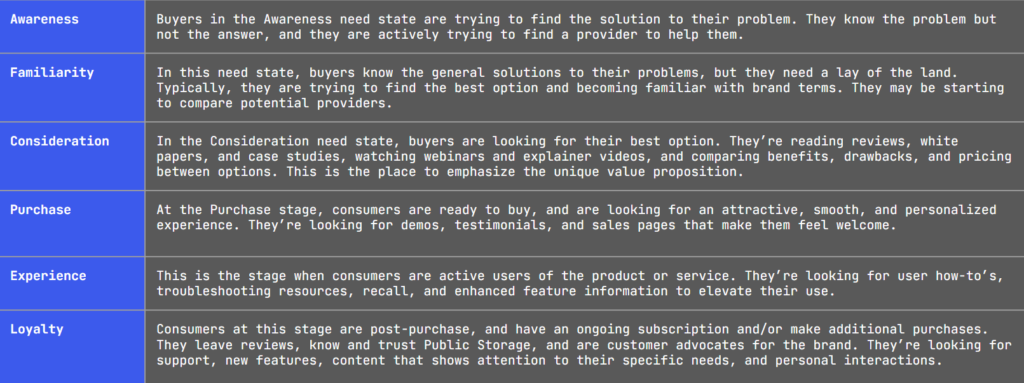
This is where my old “just target the keyword” mindset starts to break down. Because one query sets off a chain reaction of related needs, each one varying slightly in intent, urgency, and expectation.
That’s where iPullRank’s unique style of keyword research, fueling deliverables like our Keyword Portfolio, comes in. At first, it is exactly what you would expect: a giant list of curated keywords full of shifting intents and slightly different variations of the same underlying topic. It is pure evidence of demand, strings of words clients have seen over and over again.
As I now know, we simply cannot leave it there.
We gather a broad universe of relevant queries around a topic, then clean, cluster, and enrich that dataset with the signals that make it strategically useful. Some of those are classic keyword metrics, like search volume, trend, ranking, and SERP features. Others give us more context: entities, intent, need state, jobs to be done, performance metrics like clicks and bounce rate, and where that keyword currently lives on the site versus where it should live instead.
In other words, we are not just looking at a keyword as a string of words. We are looking at the role it plays in helping a person solve a problem.
That is what makes the Keyword Portfolio so useful. It helps us move from “here is a giant spreadsheet of plumbing-related keywords” to “here is the opportunity space, organized in a way we can actually use.” Instead of stopping at a list, we create a structured view of the landscape.
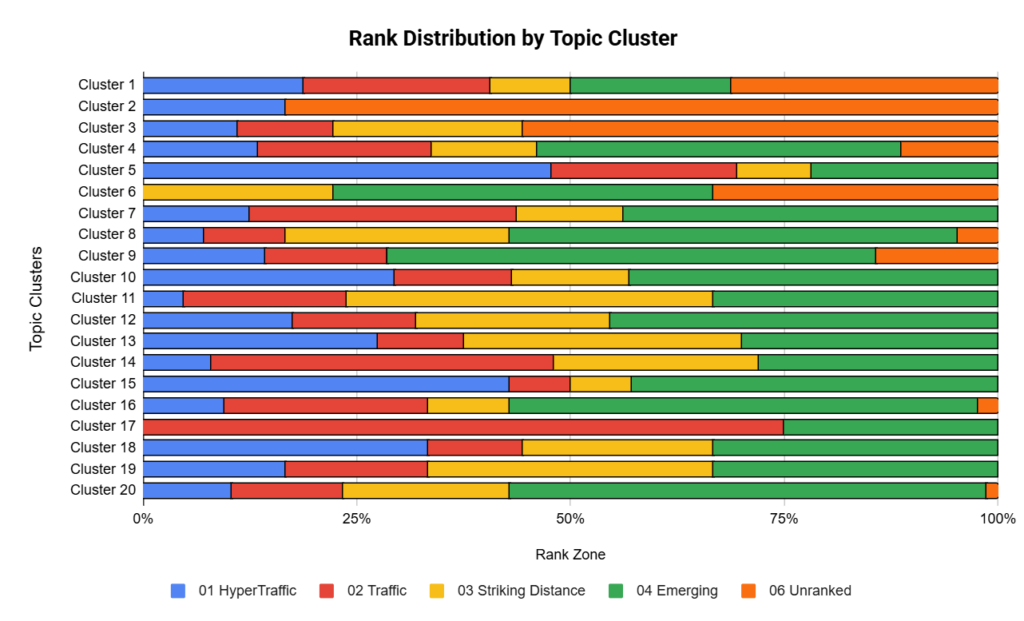
And that matters, because the Portfolio is not just there to tell you what people search. It starts to show you where demand lives, which topics are already working, which audiences or need states are underserved, where the biggest gaps sit, and where the current experience may be sending people to the wrong page entirely.
Once we understand the shape of the opportunity, the next question becomes whether our content is actually equipped to follow it.
2. Visibility Without Relevance is Fragile
A keyword list, even a curated one beefed up with all sorts of useful metrics, still only captures a glimpse of that journey because people do not search in boxes. They branch, they refine, they spiral. I did it just the other day about–you guessed it–my leaky faucet.
That behavior matters even more in the age of AI Search. Users do it naturally, moving from one question to the next as their understanding evolves. LLMs do something similar, expanding prompts into related sub-questions and adjacent needs in order to retrieve and assemble a fuller answer. Either way, the original keyword is only the starting point.
That is where our Keyword Matrix comes in.

If the Keyword Portfolio helps us organize and prioritize the opportunity space, the Keyword Matrix helps us evaluate whether our existing content is actually built to meet it. It takes priority keywords from the Portfolio and expands them into fan-out queries: the follow-up questions, comparisons, adjacent concerns, and next-step needs that tend to gather around the original search.
Using the faucet example, the Portfolio helps us identify the main topic and the demand around it. The Matrix helps us follow the trail outward. “Why is my faucet dripping?” does not stay tidy for long. It unravels into all those questions about severity, DIY fixes, replacement parts, plumber costs, urgency, and who to trust. Suddenly, we’re no longer asking whether a page lines up with the right phrase. We’re asking whether that page can actually support the broader journey unfolding around it.
That is why we classify each expanded query by type, whether it is a reformulation, comparison, implicit need, related concept, personalized variation, or entity expansion, and identify the routing format most likely to serve it well. In other words, we are not just asking what the follow-up questions are. We are asking what kind of question each one is, and what kind of content would actually be useful when it shows up.
Query Type | Definition | Original Query | Expanded Query |
Comparative | A query that evaluates two or more options against each other to determine differences, similarities, or superiority. | dripping faucet | dripping faucet vs leaking pipe |
Implicit | A query where the user’s underlying need, problem, or evaluation intent is suggested but not explicitly stated. | dripping faucet | best way to fix a dripping faucet |
Related | A query that explores adjacent or supporting concepts connected to the original topic without directly restating it. | dripping faucet | what causes a faucet to drip |
Reformulation | A reworded or slightly modified version of the original query that maintains the same core intent. | dripping faucet | leaking faucet |
Personalized | A query tailored to a specific role, industry, company size, or use case. | dripping faucet | dripping faucet fix for renters |
Entity Expansion | A query that expands from the original topic to include related features, integrations, competitors, subcategories, or associated entities. | dripping faucet | dripping faucet cartridge replacement |
For each expanded query, we look at where the brand is currently showing up, if it is showing up at all, by mapping that query to its ranking page, current Google standing, and preferred routing format. Then we identify the three most relevant passages on that page and score them using cosine similarity against the expanded query. That helps us evaluate not just whether a page is present, but whether the page, its format, and the passages doing the heavy lifting are actually a fit for what the user or answer engine is trying to figure out.
Because not every query wants the same thing. A how-to question may want step-by-step instructions. A cost-related one may need a pricing page, calculator, or FAQ. A comparison query may be much better served by a comparison table or buyer’s guide. A definition-heavy query may want a glossary or explainer hub.
This changed the way I think about visibility. For a long time, I treated it purely as a ranking conversation. I asked things like, “Is the page ranking?” and “How do we move it up?” But answer engines make it much harder to ignore the gap between being visible and being useful. A page can rank, even mention the keyword directly, and still not be the best answer.
Working on my first Keyword Matrix was when I finally stopped asking, “Does this page target the keyword?” and started asking, “Is this page actually equipped to do its part in carrying the journey from start to finish?”
3. Research Only Matters if it Informs What You Do Next
This was what made it all click for me.
I think a lot of keyword research can be incredibly impressive-looking without being especially useful. It can be sprawling, color-coded, rich with tabs and filters and metrics, and still leave you staring at it thinking, okay…now what? You might even be asking yourself that right now.
What iPullRank taught me is that the real value of keyword research is not just in how much you collect, how much data you feed in, or even how nicely you organize it. It’s in whether it helps you make better decisions. That’s why the Keyword Portfolio and Keyword Matrix work so well together.
And importantly, that is also how we present them. We do not just hand clients a giant spreadsheet and wish them luck. We surface the patterns that matter most, then translate those patterns into a clear go-forward plan. That means moving from “here is where the demand sits” to “here is where the journey is thin, mismatched, or under-supported.”
The Portfolio helps us identify the opportunity. The Matrix drills that opportunity down.
Especially in the age of AI Search, we need both. Together, they turn research into something much closer to a decision-making system than a static deliverable. They help you prioritize. They help you diagnose. They help you stop mistaking a very beautiful, very detailed spreadsheet no one knows how to use for strategy.

That is what allows us to move from observation to recommendation. Sometimes the answer is optimization: the right page exists, but it needs stronger coverage, fresher information, better internal linking, or more relevant supporting sections. Sometimes the issue is structural: the page may rank, but it is the wrong format for the need, and the recommendation becomes to reroute that query to a more appropriate page type. Other times, the gap is clear enough that the recommendation is net new content, because we do not have an asset that meaningfully supports that part of the journey yet.
And that is where this work started to feel very real and very important. We are not just saying “make more content.” We’re making actionable suggestions like:
- Build a state-resource hub because localized demand is sitting there and the current architecture is not really supporting it.
- Create an interactive tool because users are trying to estimate, compare, or personalize, not just read.
- Add comparison tables where people are actively weighing options.
- Refresh high-performing pages before they decay.
- Build net new content where the opportunity is obvious, but the asset does not exist yet.
It also lays the foundation for the work that comes next. The same insights that shape the research inform content audits by showing where content is thin, missing, or in the wrong format; site audits by helping us spot where structural or technical issues may be holding that content back; and monthly reporting by giving us a more grounded way to measure whether the changes we make are actually improving visibility and usefulness over time.
The Portfolio and Matrix are not just research outputs. They are tools for prioritization. They help us diagnose issues more clearly, tie opportunities back to business relevance, and make recommendations that are actually actionable.
That is also what makes this work feel so different now. Once search becomes more expansive, more interpretive, and more answer-driven, our keyword research has to grow up a little too. It cannot just be thorough. It has to be useful.
Because at the end of the day, a beautiful spreadsheet is not a strategy. Knowing what to do next is.
If you’re wondering what happens after the research phase, and how these insights start informing real content strategy decisions at iPullRank, check out our recent article on the Omnimedia Content Audit.