Say What? The Best Things We Heard at SEO Week 2026
by Francine Monahan
05.07.2026
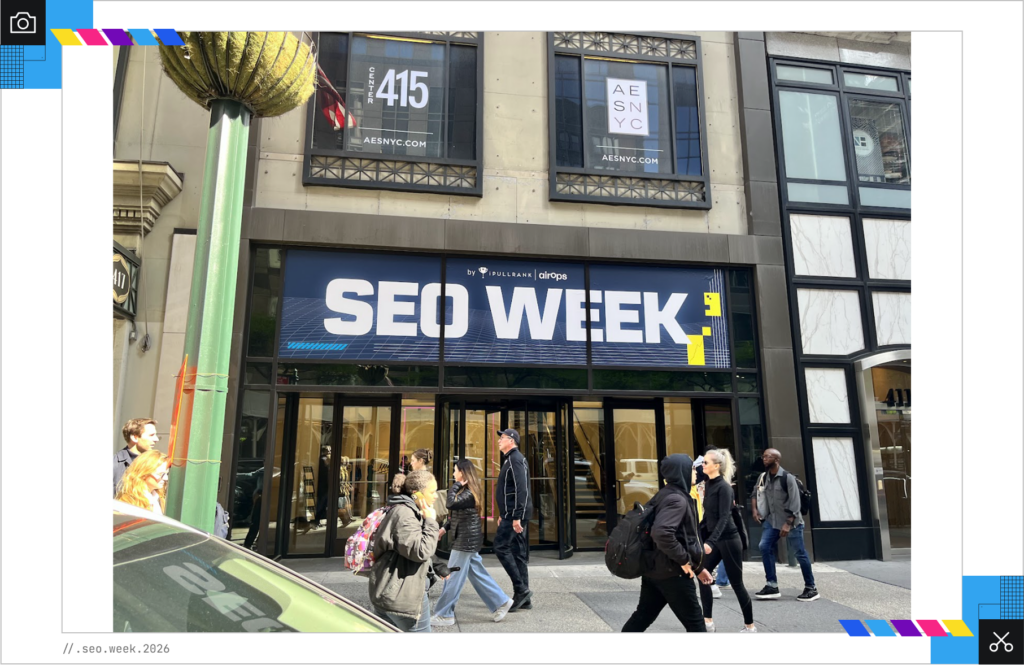
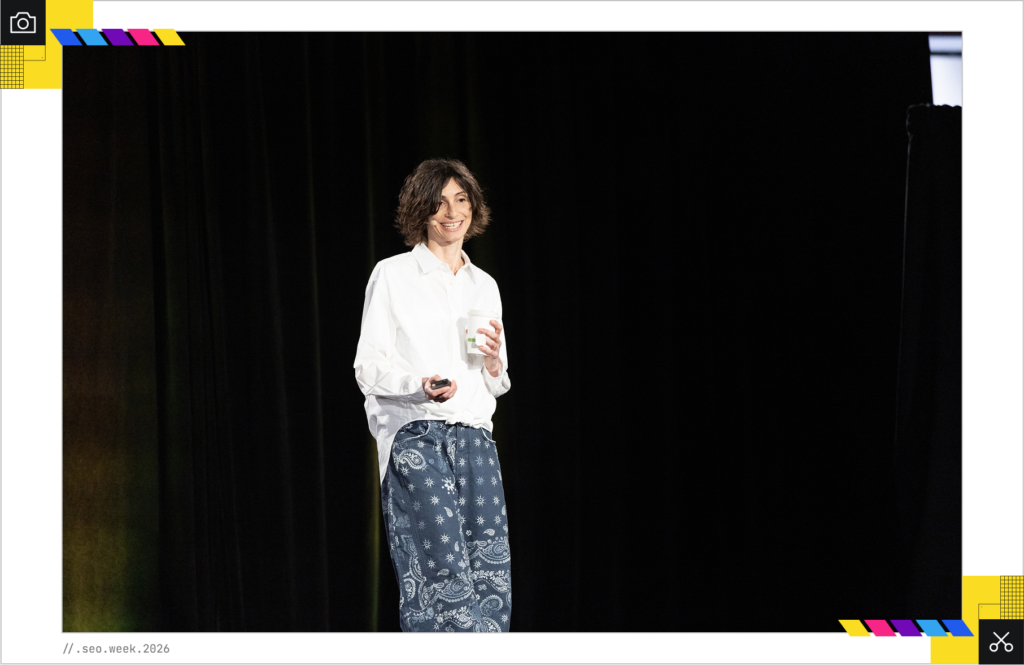
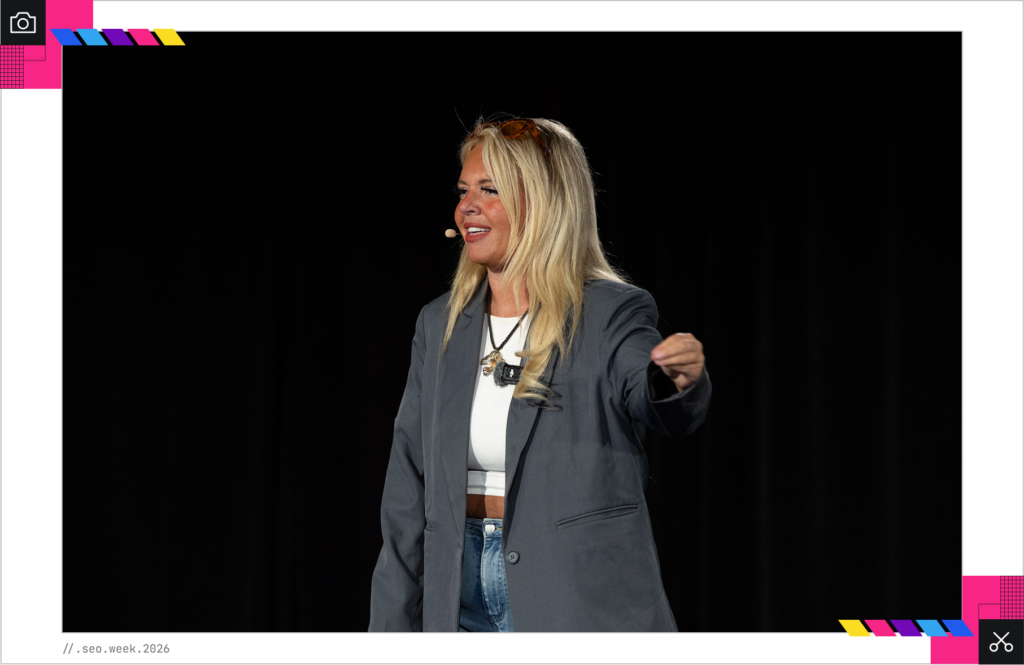
Our annual SEO Week conference is a hotbed of industry legends, new voices, and brilliant scientific minds having the nerdiest and most interesting conversations. But this doesn’t just take place at receptions or in the hallways during breaks. It also takes place on the stage.
This year’s speakers focused on navigating AI Search strategy and guiding clients through all the changes in this new era of visibility. They also hit on topics like branding, personas, trust, and building your own tools.
In this blog, we’ll take a look at the different topics covered at SEO Week and some of the best quotes we heard from our brilliant speakers. Quotes you’ll want to save for later, share with your boss, reference in your next presentation, and even put in your AOL Instant Messenger away message (if that still existed).
Changing Your Thinking for the Future
Let’s start here because everything else flows from it. Day 4’s theme may have been the future, but at a conference like this, the future has a say throughout. More than one speaker this year made the case that the problem often isn’t your tactics but your mindset.
Brittan King’s session, Managing the FUD Out of Change, tackled this head-on. The FUD she was referring to is fear, uncertainty, and doubt, and her argument was that these are signals to pay attention to, not just push through. She shared data showing 67% of marketing leaders expect major AI disruptions, and 81% of consumers name trust as a top decision factor. The underlying point is that the fear you’re feeling isn’t irrational, but letting it run the show absolutely is.
“We have to change how we think for the future that we’re facing. What if we use fear as a signal and not a strategy?”
Brittan King
Fractional CRO, iPullRank on Day 2: The Psychology
Ilana Gershteyn brought a similar message from a different angle. Her session on working through Google drops was about what happens inside your head when things go sideways. She introduced the idea of internal “parts” (the fixer, the researcher, the performer) and made the case that when these parts take over in extreme roles, they cloud your thinking rather than sharpen it. Before you type a reply to your panicking client, figure out which part is at the keyboard.
“Calm isn’t a feeling. It’s what’s left when no part is in the lead.”
Ilana Gershteyn
Director of SEO, Edmunds on Day 4: The Future
And Lisa Paasche, drawing on her experience scaling and exiting a successful agency, brought the neuroscience: belief, connection, and being vulnerable are all important for success. She made the case for psychological safety as a performance multiplier.
“A brain under threat is not a creative brain.”
Lisa Paasche
Founder, EKTE Vision on Day 4: The Future
With two Yext studies looking at 38 million data points, Christian Ward helped clarify where to focus. User experience and user interfaces have changed due to AI, memory and personalization now rewrite visibility, and we’re moving in the direction where all of the content that can be created, will be created. People want the simplest and most direct way to get the answer they’re looking for.
“No one wants to go to your website or your client’s website. The vast majority just want the answer.”
Christian Ward
CDO, Yext on Day 4: The Future
The industry is changing faster than it ever has, and the people who navigate it best don’t always have all the answers. They’ve just figured out how to think clearly when they don’t.
Focus on Branding
Here’s a sentence you probably didn’t expect to hear at an SEO conference: visibility is not enough.
In an era when zero-click results and AI Overviews can give your content all the visibility in the world while sending your site zero clicks, the distinction matters more than it ever did. Wil Reynolds called out the growing pile of “zombie content” that nobody believes or trusts, and the futility of “marketing whack-a-mole” of just checking off monthly tasks to keep leadership off your back.
“The job of marketing was never to just be seen or be visible. You have to turn that visibility into something believable about your brand.”
Wil Reynolds
Founder and CEO, Seer Interactive on Day 2: The Psychology
Ross Simmonds took this further by talking about LLM memory. The premise of his talk was that models are learning about your brand every single day, and if you’re not actively shaping what they learn, someone else is shaping it for you. Most thought leadership content is mediocre right now, so brands need to create genuinely shareable frameworks and memorable language to get baked into the model’s understanding of a category.
“I think that memory is one of the most important concepts in our industry for the next 48 months. This is a pivotal moment for all of us to recognize we have an opportunity.”
Ross Simmonds
Founder and CEO, Foundation Marketing on Day 3: The Ecosystem
Alex Halliday introduced a three-part system for content teams with brand context at the center, along with humans in the loop, and performance checks at the end. He said to avoid becoming a content factory churning out AI content because it could impact your brand.
“You can lean into AI too quickly and have your brand flattened.”
Alex Halliday
Founder and CEO, AirOps on Day 2: The Psychology
Jordan Leschinsky reframed the whole branding problem through the lens of what’s earned versus what’s owned. Owned content is the entry fee. What actually drives AI visibility is editorial coverage, media mentions, bylines, PR, and community presence, which is all the stuff that SEOs traditionally left to someone else. But the truth is that the concept of siloing these focuses is dead.
“PR has an SEO problem. They’re not actively publishing their narrative online, someone else is.”
Jordan Leschinsky
VP Strategy, Vayner Media on Day 4: The Future
Carrie Rose talked about digital PR, influencer marketing, brand campaigns, video content, and social content, and the role they all play in visibility. But she emphasized that we need to get more connected as humans and not just algorithms. We know what’s relevant to customers due to the many touchpoints they have now. The various search bars have become the gateways to behavior.
“Google is literally telling you what content to create.”
Carrie Rose
CEO and Founder, Rise at Seven on Day 3: The Ecosystem
The takeaway from this entire thread of the conference is that brand is no longer a separate department’s concern. It’s the foundation of everything that works now.
A Matter of Trust
If branding is about being believable, trust is about earning the right to be believed in the first place. And it came up in some form in almost every session.
Ian Lurie’s argument was simple: teach. Not surface-level content marketing teaching, but genuinely useful, frictionless solutions to real problems. His reasoning was that all algorithms are ultimately trying to sell trust to their users. The content that gets rewarded is the content that deserves to be trusted.
“Algorithms are selling trust. We have to do the things that get them to reward trust.”
Ian Lurie
Digital Marketing Nerd, Ian Lurie LLC on Day 2: The Psychology
John Doherty’s session on the death of the middleman landed squarely in this category, too. His argument was that AI is becoming change management. The three things it can’t replicate (empathy, ethics, and taste) are exactly the things that build trust. Agencies and in-house teams that figure out how to lead with those will survive the transition.
“AI can make the content but it can’t make people care.”
John Doherty
Founder, JFD Coaching on Day 2: The Psychology
Angela Skane, drawing lessons from TikTok Shop’s breakout success, made the same point in consumer terms. The formula behind TikTok creator success is psychology, social proof, real human desires, and authentic storytelling. The same levers work in written content just like they always have.
“People buy from people they trust.”
Angela Skane
Content and SEO Strategy Manager, Newfold Digital on Day 3: The Ecosystem
Angela Clark’s session was more internally focused for organizations and hit on the trust gap that exists within organizations when leaders mandate AI tools without genuine buy-in from the people doing the work. She surveyed search professionals and found the top AI fears are:
Skill atrophy
Pressure to deliver faster
Conflicts with personal values
Her message to leaders: survey your own teams, because if you don’t have buy-in at the ground level, your strategy isn’t going anywhere.
“The people who are on the front lines doing the production and working with clients, you need to have their buy-in.”
Angela Clark
Senior Content Strategist, iPullRank on Day 2: The Psychology
Building Your Own Tools
This topic had a particular energy in the room. You can probably call it the DIY renaissance of SEO.
Mike King’s talk, appropriately titled, “F*ck It, I’ll Do It Myself,” was essentially a love letter to open source and a critique of the current tool landscape. His argument is that most SEO platforms are still doing traditional keyword math while we shift from a Google-shaped web to an agent-shaped web. His solution wasn’t to wait for vendors to catch up. He built the tools himself, including a search telemetry project and Vectour, a community open source library of vector embeddings, and released them for the community.
“What matters is: are we embracing this technology and serving the end users? However you get there, in a responsible way of course, is how you get there.”
Mike King
Founder and SEO, iPullRank on Day 1: The Science
Noah Learner took the same thesis and applied it to the product thinking process. He built SEOLoop, a search revenue platform, with AI and no dev team. The session showed how to spot the process that should be software, scope it so AI can build it, and ship something your org actually uses.
“Focus on building painkillers. It’s not about vitamins. It’s about solving real problems that are tied to business goals.”
Noah Learner
Director of Innovation, Sterling Sky on Day 1: The Science
Annie Cushing brought necessary balance to the build-everything energy with her session on disaster-proofing your code with lessons all pointing to the same truth that if you don’t give AI guardrails, it’ll do whatever it wants. Lack of structure compounds into technical debt. Small shortcuts create fragility. Treat AI like a new hire and structure it, package it, explain it, and optimize it.
“AI is a notoriously lazy programmer.”
Annie Cushing
Founder, Annielytics on Day 1: The Science
Sam Torres rounded out this section with a practical framework for building modular machine learning pipelines that automate competitor research, content gap analysis, and keyword cannibalization at scale using embeddings, clustering, and LLMs. LLMs are great at labeling data and finding gaps so you can create something to give to an executive team. Her advice was to start small and build momentum.
“I want to automate everything in my life.”
Sam Torres
Sr. Manager Technical SEO, Pipedrive on Day 3: The Ecosystem
The Importance of Personas
This is where things got a little unsettling. Garrett Sussman ran a year-long experiment to find out: do different user personas get different results from AI search? The answer, based on 100,000 prompts across four personas over twelve months, is yes. He also tested Google’s Personal Intelligence features granting access to his email, photos, and behavioral data, and found that personalization in AI Search isn’t coming. It’s already here. LLMs not only made personalized recommendations for him, but also for his wife and daughter, which it identified by name.
“Google has everything and it’s creepy as hell. They want more with your explicit permission.”
Garrett Sussman
Director of Marketing, iPullRank on Day 2: The Psychology
Ray Martinez discussed a case study of his work at Archer Education to build an AI-ready higher-ed knowledge graph of entities, gaps, silos, and personas. He learned that 70% of students are using AI to explore program options and being influenced before they even touch his site, so he needed to focus more on the right type of content to build authority for this audience.
“We had to change. And we knew we couldn’t just change the vibe, we had to evolve. We had to do more.”
Ray Martinez
VP of SEO, Archer Education on Day 3: The Ecosystem
Adjusting for the Future of AI Search/GEO
Here’s where half the conference lived. There were many sessions discussing the search evolution and what marketers need to know to stay visible. Krishna Madhavan opened things up with a series of new visibility tools soon to be released from Microsoft. He emphasized that ranking still happens. It just happens many times across many queries.
“Visibility belongs to content that AI can trust, understand and ground. Content needs to pass these gates.”
Krishna Madhavan
Principal Product Manager, Microsoft on Day 1: The Science
Dale Bertrand looked at the GEO conversation through a financial lens. Traffic growth is now divorced from business growth and the metrics SEOs have been using to prove their value are increasingly disconnected from the CFO’s world. He introduced a framework built around three Ts: tight (aligned with business goals), true (accurate), and translated (in the language of finance).
“AI Search broke attribution. This makes it hard for us to prove the value of our GEO campaigns.”
Dale Bertrand
President, Fire&Spark on Day 1: The Science
Jori Ford’s HEO framework (Hybrid Engine Optimization) addressed the same measurement chaos from the practitioner’s perspective. Her HEO score is deterministic, verifiable, and built on first-party data through a weekly system designed to separate noise from signal at a time when everyone’s dashboards are screaming.
“Everything is broken and shattered, the earthquake has occurred, but it’s okay. All we have to do is focus.”
Jori Ford
Chief Marketing and Product Officer, FoodBoss on Day 1: The Science
Brie Moreau spent 2,000 hours and analyzed 2+ million AI citations to reverse-engineer what actually determines visibility inside LLMs. He found that Google ranking and LLM ranking are not the same thing, and optimizing for one doesn’t guarantee the other.
“Ranking in Google is not going to get you ranking in the LLMs.”
Brie Moreau
Founder of White Light Digital Marketing on Day 3: The Ecosystem
And Ryan Jones, who’s been banging this drum since 2016, made the point that most SEOs don’t want to hear but need to: the clicks aren’t coming back. The SERP is shifting, the internet is now more bot traffic than human traffic, and the optimization targets have fundamentally changed.
“It’s a bot-first internet now. Our new user is not just a person behind a keyboard.”
Ryan Jones
SVP SEO, Razorfish and Founder, SERPrecon on Day 4: The Future
Paul Shapiro added that AI isn’t eliminating jobs yet. He shared stats from Goldman Sachs projecting 30% median productivity gain on specific tasks thanks to AI, and JPMorgan seeing a 40 to 50% improvement for operations.
“The future is agentic. We need to lean in.”
Paul Shapiro
Lead Product Manager, Web Intelligence, Uber on Day 4: The Future
If there was a single, unified message from the GEO-focused talks at SEO Week, it came from Brian Cosgrove, who put it the most cleanly:
“Stop trying to write the answer and focus on being the answer.”
Brian Cosgrove
Principal, BrainDo on Day 3: The Ecosystem
The New Measurements in AI Search
An important topic to keep top of mind as the web changes is measurement: what are the new metrics to show success these days to executive teams?
Zach Chahalis’ talk dove deep into new AI Search metrics that reflect how systems interpret content and metric behavior by query type and intent. He then translated the insights into controlled experiments and applied the findings to content templates and editorial strategy.
New metrics include:
Content-keyword cosine similarity
Comprehensive coverage index
Strategic entity richness score
Explanatory efficiency index
Optimal chunkability score
Information gain score
“You need to be experimenting constantly. Everything is constantly changing. What works now may not work in 3 weeks or 3 months.”
Zach Chahalis
Senior Director of SEO and Data Analytics, iPullRank on Day 3: The Ecosystem
James Cadwallader took us through the ways to shape what AI says about your brand and the layers to AI Search, including “do I show up?” and “how am I being talked about?” He talked about a Profound study that found AI responses are more verbose and 50% of the responses don’t even answer the question directly. He also announced new Profound tools like a sentiment analysis tool, and one called FactCheck that can compare what models are saying about you and identify inaccuracies.
“What we’re trying to understand is the accuracy of the responses. If we have an objective truth and we compare it to the LLM response, is it deviating from that truth?”
James Cadwallader
Co-founder and CEO, Profound on Day 4: The Future
Brie Anderson’s talk showed how to connect your work to your revenue using the data you have despite the fact that we made the mistake of telling clients over the years that we could get them to rank high and our metrics were all that mattered. In reality, the metrics are a moving goal post that keep changing, so if we keep selling that solution, we will lose. It’s not just about proving value anymore but about business metrics like user acquisition and traffic acquisition reports.
But she also offered my favorite quote of the entire conference to remind everyone of what we’re really here for:
“You are more than the traffic that you generate.”
Brie Anderson
Owner, BEAST Analytics on Day 3: The Ecosystem
SEO Week: Where Conversations Change the Industry
The future of this industry isn’t going to be handed to us, and it’s not going to be figured out by waiting for the next core update to tell us what to do. The speakers at SEO Week were building, measuring, testing, and thinking differently about what the job actually is now.
That’s exactly why conversations like the ones we had at SEO Week 2026 matter. Not because any one speaker had The One Ultimate Answer, but because the collective intelligence in that room is the closest thing to a compass we’ve got right now.
Want to be part of the conversation next year? Super early bird tickets for SEO Week 2027 are on sale now, and this is the best price you’ll see. Grab your tickets before they’re gone.
The future’s going to keep moving whether we’re ready or not, so you might as well be in the room when it does.