
Most of the content that exists on the web today was written for a world where Google was the only thing that mattered. But you know by now that this is changing.
“AI is a quickly expanding channel that is going to be the main way in which people interact with information on the web,” said iPullRank SEO Engineer Michael Tandoh.
So where does that leave you? Probably less visible than you think.
Sure, the SEO fundamentals still apply. Technical SEO matters and content quality matters. But there’s more to the story now with AI Search. There are new metrics to measure success and different areas on which to focus your visibility efforts. Optimization can be very confusing and difficult to figure out these days if you’re not in the SEO trenches like us.
This is where an AI Search Audit can come in very handy. What do they offer? And how do they differ from a traditional SEO audit? Let’s have a chat about audits and what they can do for your business.
What an AI Search Audit Looks At
The audit isn’t a checklist but a full diagnostic of your digital presence across the signals that determine whether AI systems retrieve, interpret, and cite your content.
That starts with the technical layer where the fundamentals still matter. Slow pages, broken links, and poor site structure do more than just affect your Google rankings these days. They make your content unparsable for AI systems as well. If a crawler can’t get to it cleanly, an LLM isn’t going to surface it.

“The baseline technical SEO of your website is still a priority for AI and it’s just as important as it is for traditional SEO,” said iPullRank Lead Relevance Engineer Patrick Schofield.
From there, we go deeper. We measure how well your content maps to the way your audience actually asks questions. This is not just keyword matching but passage-level relevance, entity coverage, and cosine similarity. We look at how your content is structured to be extracted and cited, which is a genuinely different question than how it’s structured to rank. We evaluate your entity signals and knowledge graph presence, because AI systems reason about your brand as an entity across the whole web.
Our audits also contain a comprehensive report of your competitors to see how you stack up, including visibility, citations, and keyword overlap.

And then we run synthetic queries using our Qforia tool. We build prompts that reflect how your specific personas search and test your visibility against them. This is where you find out whether you’re showing up in LLMs or your competitors are showing up instead.
What Makes Our AI Audits Unique
Here’s what makes this audit different. We run our proprietary Relevance Engineering metrics across your content, your historical data, and your competitors’. No other agency has these metrics. We developed them because standard SEO measurement wasn’t built for a probabilistic, AI-driven search environment.
Some of the metrics we look at include:
- Word Count: Content length proxy (after extraction).
- Entity Count: Breadth of distinct entities (excluding pure numeric/date entities).
- Conceptual Depth (Wikidata-backed): Average depth of entities in Wikidata type hierarchies (proxy for conceptual specificity vs genericness).
- Optimal Chunkability: Alignment between paragraphing and semantic breakpoints (higher suggests the page is easier to chunk cleanly).
- Cosine Similarity: Topical alignment between the page and its intended target query.

Our metrics tell you how your content performs from an AI perspective and whether it’s the kind of content AI systems reach for when generating an answer. And with this information we can make actionable recommendations such as:
- Where to fill gaps in topic coverage
- What content to update
- If there’s any duplicate content to remove/edit
- What changes to make to your titles, meta descriptions and headers
- And so much more
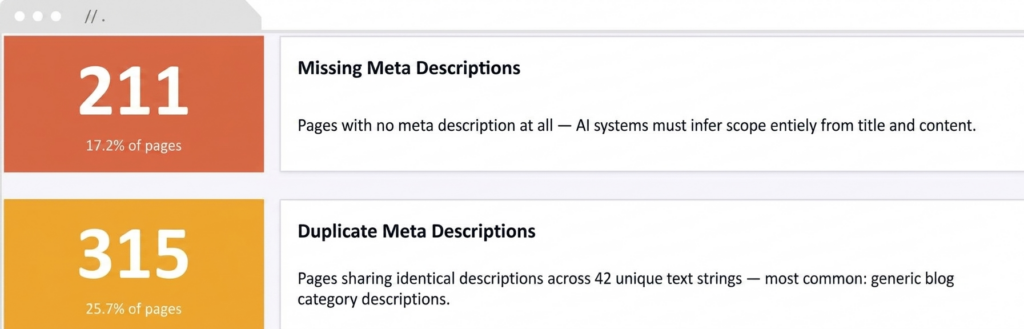
“One of the benefits of working with iPR on an AI Search Audit is we have these proprietary Relevance Engineering metrics that we run over your content, baseline data, and competitors,” Patrick said. “We look at how your content performs from an AI perspective and what levers you need to pull to influence AI citations.”
The Data We Collect
As we audit your website, these are the data points we focus on and collect to help guide you toward more visibility in AI Search:
- Retrieval and Technical
- Crawl depth and internal linking accessibility
- Page speed and Time to First Byte (TTFB)
- Status codes and crawl success rates
- AI bot accessibility and response reliability
- Content and Semantic Signals
- Content-to-query cosine similarity
- Entity coverage and distribution
- Content depth and structure
- Passage-level relevance
- Citation and Structure
- Content formatting for extractability
- Internal linking patterns
- Structured content (FAQs, lists, definitions)
- Synthetic Query Coverage
- Presence/absence across AI-generated queries
- Keyword cluster gaps
- Competitive coverage comparison
- Schema and Machine Interpretability
- Structured data implementation
- Entity clarity and disambiguation
- Alignment with knowledge graph expectations

What Declining Clicks Are Actually Telling You
If your organic traffic is down and you’re trying to figure out why, AI is almost certainly part of the story. AI models are intercepting queries that used to send people to your site, and search is probabilistic now, which means the results are different each time. So now it’s all about whether you’re the source being cited and how often.

That’s what this audit tells you. And more importantly, it tells you what to do about it, with recommendations scored by impact and ease of implementation, so your team isn’t staring at a 40-page report trying to figure out where to start.
One thing that gets lost in the AI Search conversation is that these channels behave more like brand channels. Being represented accurately and consistently across AI-driven discovery surfaces is a brand presence problem.
As iPullRank CEO Mike King said: “Classic search measurement is really about performance, but AI Search channels are more like branding channels so you have to think about performance differently.”
What Do You Get with an AI Search Audit?
The audit is delivered as a slide deck supported by linked data worksheets your team can dig into. Every recommendation is prioritized across benefit, ease, and readiness, and grouped into foundational, technical, and growth opportunities.

There are specific, actionable suggestions for new content to create, interactive tools to build, technical SEO changes to make, and much more.
You walk away knowing exactly where you stand, what’s holding you back, and what to fix first. We can help each individual client with each problem because we have the data that backs up different journeys for each company.
Getting an AI Search Audit
This comprehensive audit isn’t easy to build. It takes time and resources to parse through an entire website, analyze your competition, and measure performance against multiple metrics. It can be overwhelming for marketers to even consider creating something like this themselves in-house without expert guidance.
You don’t have to figure this out alone, though. We’ve spent years developing the metrics, the methodology, and the data to tell you where you stand and what to do about it. No one else has what we have here, and we built it specifically because the old measurement frameworks just didn’t cut it anymore.
If you want to know how visible you actually are in AI Search and what it’s going to take to improve, reach out to us today to get your own AI Search Audit.
“Your strategy for success determines your path forward,” Patrick said.