
From a soon to be published Profound survey of 2,300+ American shoppers, 58% reported using AI at least once a week to browse products or make purchases.
Does that surprise you? It’s an impressive AI adoption statistic only three years after the launch of ChatGPT. And being so close to Black Friday and the holiday shopping season, it’s an important strategy consideration for marketers.
Around 8% of the commerce world passes through an AI engine at some point in the shopping process, and Adobe expects AI traffic to rise by 520% YoY this holiday season. People of all demographics are researching products to buy on TikTok and Reddit, delivering over $33,000 in ecommerce sales every 10 seconds. There’s clearly a lot to prepare for in the future of ecommerce, but still a lot of uncertainty.

“We are in such a weird space where anything that we say today could go out the window tomorrow,” said iPullRank’s Director of Marketing Garrett Sussman. “Everyone’s search behavior has never been more complex.”
Let’s take a look at some data from Profound around AI search ecommerce behavior patterns and see if we can’t help you capitalize on a few opportunities this holiday season.
Buyer Journeys in Ecommerce
A 27-year-old hedge fund manager from Manhattan buying a smart watch online is going to be different than a 42-year-old runner in Austin. If they jump between a Google search, a YouTube video, a buyer’s guide, and seven other digital touch points, how are you going to account for the AI Search channels of that journey? Their prompts and outputs will look wildly different based on their context.
As Josh Blyskal, AI Strategist and Researcher at Profound said, “This is a volatile space. Everything is changing. This is the best information that exists right now.”
Over 78% of American customers do a mix of in-store and online shopping. And although Google still has most of the market when it comes to search, you still need to consider ChatGPT’s exponential growth. Its new shopping result population rate has become fairly consistent lately.

“We are just at the beginning of the way that user behavior is changing.”
- Garrett Sussman
Ecommerce is still growing overall, but if you look at the conversion rate patterns in this recent scholarly paper, ChatGPT referrals to ecommerce websites are trending upwards, while other channels remain fairly stagnant.

AI search isn’t the highest-converting channel yet, but a year from now, it could be.
“We’re moving into zero-click,” Josh said. “The user behavior’s going to dictate the way that this thing’s going to go and the user behavior is very clear.”
The strategy is changing, and it can be difficult for marketers or executives in various industries, from automotive to finance, to keep up. Every type of product, business, and consumer is different.
AI Ecommerce Strategies
To ensure visibility in every search channel, you will need to open up the floodgates, so to speak, with what product info you include.
Feature completeness is what Josh thinks should take focus.
“If someone says, ‘I want red shoes made out of leather with suede that are not super heavy and clunky,’ there are fields in that entire product feed that are going to dictate whether your product passes or doesn’t.” – Josh Blyskal
A lot of people don’t have that kind of structured information with their products. If you don’t, then you’re limiting who can find you. However, there is also the concern that scammers will try to add too many variations of their product to gain more visibility (like listing AirPods for teachers and AirPods for athletes for the same product).
OpenAI will have to be vigilant and responsible to address bad-faith players who attempt to manipulate the LLMs. That’s likely why they began doing a manual approval process via this form (which is fine for now, but they’ll need to come up with a better method in the future):

The OpenAI Bias
The challenge for marketers now is not knowing what will impact your business’s visibility short term vs. long term. It’s still unclear what biases LLMs operate under and what parameters ensure that certain products show up in results, but thanks to OpenAI’s new partnerships with multiple stores and outlets, visibility is affected.
For example, big box retailers like OpenAI’s new partner Walmart have consistent product feeds that work well on ChatGPT. But on the other side, there are many small Etsy or Shopify shops in its network that can actually win out against major competing companies because of their partnership with OpenAI.
Due to the lack of transparency, it’s difficult to determine how these partnerships may influence the recommendations.

Ecommerce in Google Lens, AI Overviews, and AI Mode
Omnimedia considerations for your AI Search strategy are necessary. Relevance Engineering requires marketers to pay attention to how their brand is represented in more visual search media.
Google Lens allows shoppers to photograph something with their phone and identify it, as well as search for more information on the product. Google is currently developing Project Astra, which incorporates capabilities like screen sharing and video understanding to make the process even easier.
Knowing this, online shopping brands need clean, consistent product photography and recognizable visual markets, or they will fail to match in real-world lookups.
AI Overviews continue to fall behind when it comes to providing fresh, timely content. As shown in this example below, when searching for Black Friday gifts, it references articles written last year:

Although AI Mode isn’t a huge improvement yet, it does continue to evolve and introduce new features, like the comparison feature launched in September, allowing you to select certain products and compare them during the shopping process:

High-quality content plays a big role in how helpful channels like AI Mode can become, and Garrett believes that there isn’t enough good content out there, and most humans aren’t able to produce it.
“It’s the SEOs and the marketers’ responsibility to produce that content,” Garrett said.
Google’s Shopping Graph takes information from retailer feeds, product pages, review data, videos, and more into a single product graph. If your product data is thin or inconsistent, you will weaken the entire Shopping Graph.
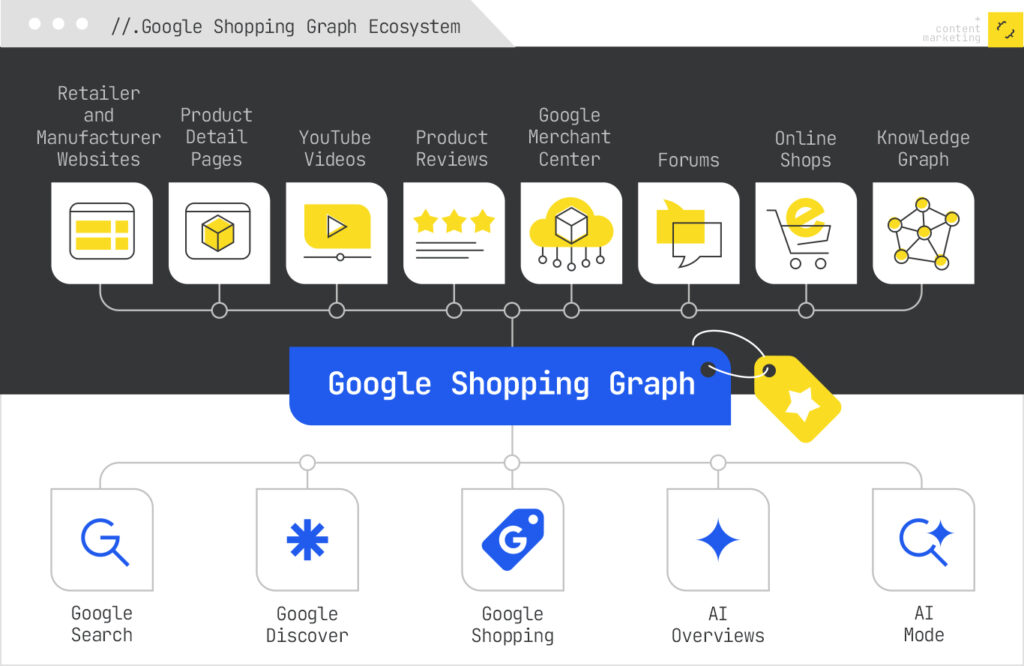
Overall, Garrett believes that until AI Mode becomes a default search engine, there probably won’t be any big changes to the industry.
“When it does, it’s going to disrupt all of SEO,” he said.
Black Friday Insights
A click isn’t the measure of a page’s success anymore. So, what is? Becoming a trusted source, being present in the answers, and your editorial presence in all channels.
Sure, AI search still isn’t the main way people search, but adoption is increasing, with the majority of prompts going to ChatGPT.

Looking at Personas
If you’re using a lot of persona data in a prompt, you won’t receive the same results as someone else, so tracking results can be nonspecific. However, persona data can help you see if you’re creating content in the right direction.
Profound provided Black Friday data by age and income, among other demographics, that may help you get an idea of your buyers and where they come from.

But, of course, the frequency at which AI search results change can make data difficult to parse. Using Black Friday footwear-related prompts as an example, you can see citations fluctuated over the past year for the top-cited websites.
“There’s nothing stable about this,” Garret said. “It’s all volatile.”

Real people shopping online are asking very specific questions these days, like if they should wait until Black Friday to buy a new phone, or what payment plans will be available for an Apple device. This means marketers will have to include as much detail as possible about their product to cover all possible queries (more on that next).

Optimizing Product Content for AI Search
When you’re creating content that you want to get drawn into LLMs, your content needs to be clear, concise, and easy to understand.
ChatGPT is pulling snippets of content, and ecommerce outlets have product description and product title limits (for example, Google Shopping limits product descriptions to 5,000 characters). So, you have a limited amount of space to make your point.
“It’s a density problem,” Josh said.
Some suggestions for ensuring your content has a better chance of getting picked up by LLMs include:
- Be clear: Your brand voice and tone can’t interfere with the clarity of your content.
- Break it up: Split your content into easily digestible chunks so it’s easy to pull.
- Be direct: The fluffier your content is, the less helpful it is.
- Use semantic triples: Your sentence structure should have a clear subject-predicate-object structure.
- Use rich product descriptions: They should offer insight into the specific use cases, features and applications of the product.
- Aim for field completion: Be sure to completely fill out all product detail fields.
- Avoid ambiguity: Contextualize your content to ensure the right people find your product in the right place and reduce retrieval errors.
- Provide exclusive insights: Unique content or proprietary data increases the likelihood of your page being retrieved.
For help with these strategies, iPullRank has its Qforia tool for query fanout simulations, as well as the Relevance Doctor tool that breaks your content into passages and scores each for semantic similarity.

Preparing for Ecommerce Changes
What works today with AI search might not work tomorrow, and the rules are still being written. The question now isn’t whether you should optimize for AI search, but how quickly you can adapt.
For example, one of the most cited sources in AI search right now is YouTube. However, we don’t know if the LLMs are pulling from video transcripts or metadata. Other factors may impact YouTube visibility and retrieval as well, such as influencers receiving an order from your shop and unboxing it in a video. How accessible are your product packages for videos? Are you making it easy for them to create interesting content with your product? Everything can play a part in visibility.
We’re engineering for context and creating content for AI engines. But we also must understand and prepare for the volatility and constant change. Nothing is certain yet, but we can work to prepare for the future.
“I don’t think anyone has the answers,” Josh said. “Anyone who says they have the answers is crazy or they just want to sell you something.”