
If you had told me two years ago that I would be using vector embedding models to calculate cosine similarity between search queries and page copy, I would have looked at you like you had five heads.
At the time, I was pulling espresso shots.
Two years ago, my world revolved around dialed-in grinds, milk temperatures, and the anxiety of a line out the door at 8 a.m. I knew how long a shot should run. I knew when the foam was wrong. I knew exactly how much time I had before someone leaned over the counter and asked why their oat milk latte was taking so long.
I knew how to reset the machine when it stalled mid-rush. I knew which drinks would back the line up and which ones I could move through quickly. I knew that if prep was not done before the crowd hit, the entire shift would feel heavier than it had to.
My job was physical. Fast. Immediate. You saw the result of your work in seconds.
Fast forward to today, and I work at iPullRank.
Instead of pulling espresso, I am pulling insights. Instead of memorizing drink orders, I am mapping queries to intent. Instead of optimizing workflows behind a counter, I am helping teams understand how users actually search, think, and make decisions.
On paper, it looks like a career pivot. In reality, it has been a continuation. The tools changed, the system changed, and the stakes changed. But the instinct to understand how things work and how to make them work better stayed the same.
And once I understood that, the leap did not feel impossible.
It felt learnable. It felt buildable.
And it is something you can do, too.
Espresso Bars and Search Engines Are Both Opinionated Systems
Working as a barista teaches you very quickly that you are not operating in chaos but in a system that only looks chaotic if you do not understand it.
There are predictable rushes, clear bottlenecks, and upstream prep that determines whether the rest of the shift is smooth or miserable. When something breaks early in the process, everything downstream suffers.
That lesson maps cleanly to how we work at iPullRank.
Search engines are not neutral. They are opinionated systems with preferences, constraints, and patterns. Queries are not literal requests. They are compressed signals of intent, context, and expectation.
A customer saying, “I want something strong but not bitter,” is not that different from a user searching a vague, underspecified query and expecting the result to just get it.
At iPullRank, we do not treat queries as keywords to match. We treat them as expressions of demand. That is why we spend so much time classifying intent, generating synthetic queries, and evaluating whether a page actually satisfies what someone is trying to accomplish.
Long before I had language for semantic alignment or intent modeling, I had already learned the instinct to understand what was really being asked, to notice friction before it became frustration, and to fix the system instead of just reacting to the symptom.
That instinct became the foundation for everything I do now.
What It’s Like Being a Digital Marketing Analyst
When I first moved into digital marketing, I thought the hardest part would be learning the tools.
Sure, there was a learning curve: analyzing SERPs, working with large datasets, running embeddings, understanding why something ranks and whether it actually deserves to.
But the real shift was mental.
Being a Digital Marketing Analyst at iPullRank means working at the intersection of disciplines. You are constantly absorbing how different people think about the same problem.
You sit alongside engineers during technical site audits, listening to them break down crawl paths, rendering behavior, log file anomalies, and internal link structures. They are not just asking whether Google can access a page but whether the architecture makes sense.
You collaborate with content strategists who think about relevance and creativity at the same time, always pushing the boundaries of what content can do in the era of AI search. They think about how structure, narrative flow, and multimodal elements can make content clearer, more intuitive, and easier for both users and algorithms to understand.
And through all of that, you are operating inside the mindset of Relevance Engineering, which is the idea that visibility should be earned through alignment. That content should clearly reflect what a business stands for and what users are actually trying to accomplish. That search is a demand modeling problem, not a keyword volume problem.
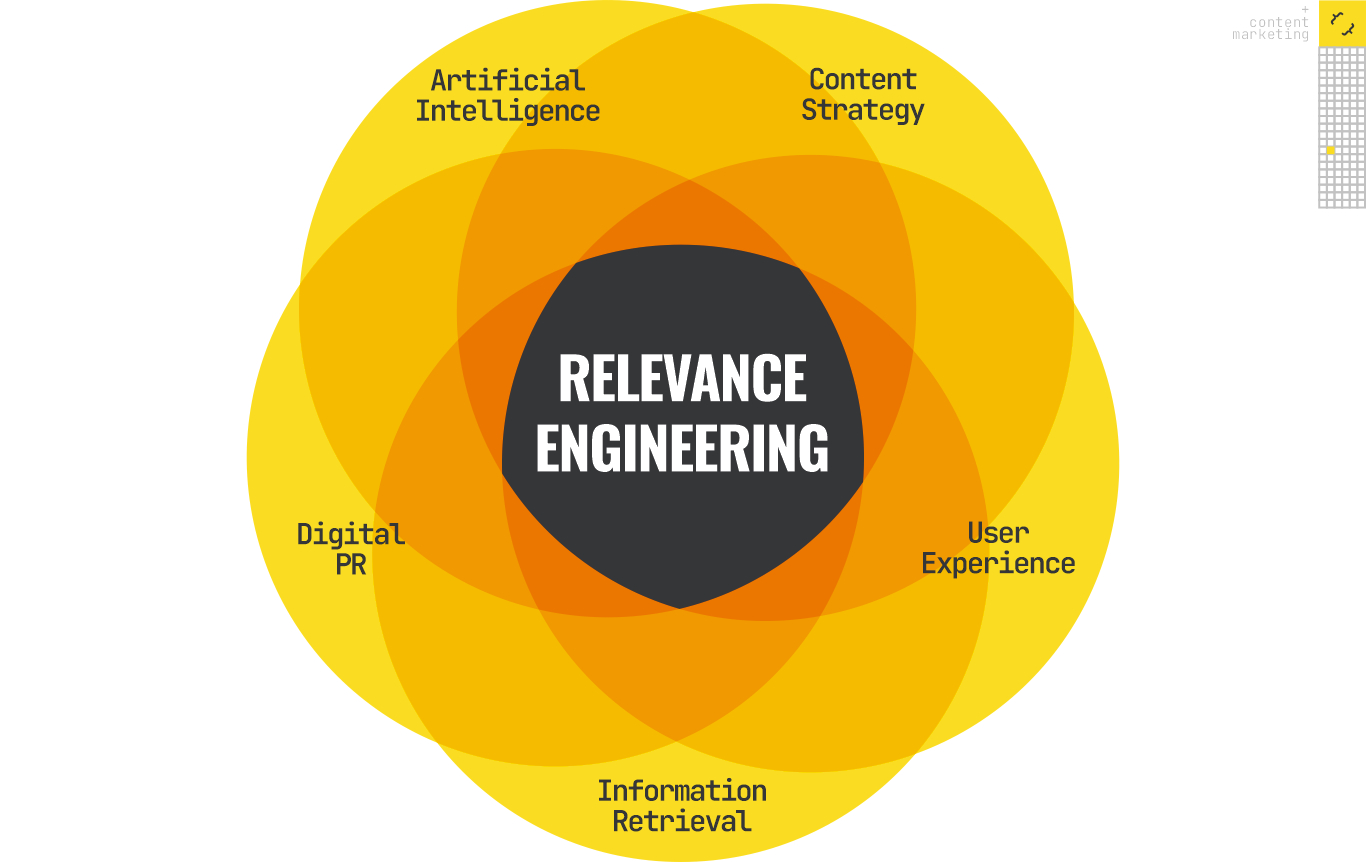
That perspective is part of the culture at iPullRank, shaped heavily by Mike King’s thinking around Relevance Engineering. It is beyond just a framework we reference; it is how we approach the work.
Being immersed in that environment changes you.
One day, you are reviewing Google Search Console data and realizing a drop is not a loss but a redistribution of intent. The next, you are evaluating whether a multimodal asset expands a page’s intent surface area or just decorates it.
You start to see that everything is connected and nothing operates in isolation. And as a Digital Marketing Analyst, you are in the middle of it all.
You see how engineering decisions affect content performance. You see how narrative structure affects discoverability. You see how shifts in demand expose gaps in architecture. You are close enough to the data to notice patterns and close enough to strategy to understand what they mean.
The opportunity to work across teams opened the door to projects that changed everything for me.
Concentrating Authority: What Consolidation Taught Me
One of the first major projects I worked on was a large content consolidation initiative alongside a content engineer.
When we opened up the crawl, I remember just scrolling.
More than a thousand blog posts over years of publishing. The first post went live when I was six years old. I had just figured out how to tie my shoes while the blog was already compounding domain authority.
There were topics that felt related but not quite aligned, articles that partially answered the same question from slightly different angles, pages ranking (but not always for the right reasons), and multiple URLs quietly competing for the same demand.
The Relevance Engineering mindset shaped how we approached it. Instead of looking at pages one by one and asking whether they had traffic, we zoomed out and asked what the blog as a whole was reinforcing. Were these posts strengthening the site’s core identity, or diffusing authority across loosely connected topics?
We quantified strategic alignment across the 1,000+ blog posts and consolidated or removed over 500 underperforming pieces, lifting sitewide semantic relevance by roughly 2 to 3 percent.

The broader methodology is explored at depth in this breakdown of Relevance Engineering at scale.
What stayed with me most was this: consolidation is not deletion but rather concentration.
Authority is not built by publishing more but by reinforcing what matters.
Being part of that process has changed how I view content libraries. I no longer see a blog as a collection of posts. I see it as a system that either compounds clarity or diffuses it.
Expanding Visibility Instead of Protecting It
Another project that changed the way I think was a page title audit.
On the surface, it was straightforward:
- Review titles
- Improve alignment
- Increase click-through rate where possible
But as we worked our way through it, we began to question something more fundamental: Why were we treating the “optimal character range” as a hard rule instead of a guideline?
Instead of forcing titles to stay within a tight length constraint, we allowed them to expand when it improved clarity and semantic relevance. We incorporated more descriptive, relevant keyword phrases and focused on how well the title reflected the page’s actual content.
After implementing updates, we stepped back and measured impact.
We compared optimized pages against similar pages that hadn’t been updated yet. We evaluated impression growth, breakout probability, CTR movement, and position shifts.
The optimized group averaged more than 4,500 additional impressions, while the comparison group saw a decrease in impressions.
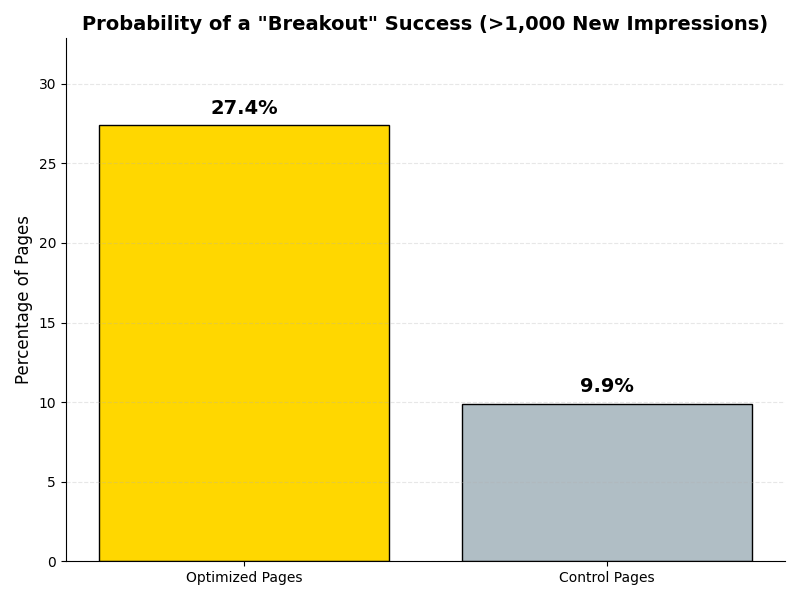
Breakout probability increased significantly. We defined a “Breakout Success” as a page that gained more than 1,000 new impressions. After optimizing titles, we nearly tripled the likelihood of a page becoming a breakout winner, increasing from 9.9% in the control group to 27.4% in the optimized group.
The CTR dipped slightly, but less than the broader site trend, decreasing by 0.23% compared to a 0.32% decline in the control group. And the average position dropped by eight spots.
At first glance, that position decrease could look negative. But when we zoomed out, the interpretation changed.
The expanded titles enabled pages to enter higher-volume, more competitive query spaces where we previously had little presence. The average position shifted because we were now competing in broader SERPs.
Instead of losing visibility we were expanding into new territory.
That framing aligns closely with the systems thinking outlined in Chapter 12 of our AI Search Manual. Metrics do not operate in isolation. An average position decline or a slight CTR dip can be a natural byproduct of expanding into higher-volume, more competitive query spaces.
This audit reinforced something I was learning across projects: Optimization is not just about preservation. Sometimes it is about strategic expansion, and expansion often looks uncomfortable before it looks impressive.
Proving the Power of Multimodal Content
Currently, I am building a scoring system designed to connect website content and video content in a way that is measurable and strategic.
The mindset going into it is simple: start with low-lift opportunities.
Instead of asking clients to invest immediately in new video production, the first goal is to identify highly relevant pages where existing videos can be embedded. These are pages that already perform well or sit in strategically important areas of the site, and where semantic similarity scores indicate strong alignment with an existing video asset.
If we can embed a relevant video into a high-value page and measure performance shifts, that becomes proof. And the best part is that it does not require new production. It leverages assets the client already owns.
The scoring system makes this possible by layering semantic alignment with business context. I embed both video transcripts and site pages, calculate cosine similarity, and then weigh those results against page traffic, engagement metrics, and strategic priority. From there, we can surface prime embedding candidates that represent high-impact, low-effort wins.
Once we validate that embedding existing videos meaningfully improves performance, that data becomes the foundation for a larger initiative. High-performing blog posts that show strong engagement and strategic value but lack video become candidates for production. The decision is no longer speculative. It is informed by measured impact from the embedding tests.
The system also identifies videos that have no strong semantic match across the site. When similarity scores are consistently low, that signals a content gap. The topic exists on YouTube, but not within the site architecture. That becomes an opportunity to build new supporting content.
What I like most about this approach is that it lowers the barrier for clients.
They do not have to commit to a full-scale video strategy on faith. They can see the benefits of multimodal reinforcement using assets they already have. It creates momentum, builds internal confidence, and turns multimodal into a measurable lever.
Sometimes the most powerful strategy is not building something new but activating what is already there.
From Supporting the Work to Shaping It
Looking back at these projects, I can see my own growth reflected in them.
In the consolidation initiative, I was learning, supporting, and absorbing how a content engineer thought about systems and structure. It was the first time I used cosine similarity for a client.
With the title audit, I moved from assisting with execution to participating in interpretation. I was helping assess how expanded titles influenced visibility and learning how to weigh tradeoffs instead of reacting to single metrics.
The multimodal scoring system began as something I was curious about. I saw an opportunity and proposed a way to model it. Now I am designing the framework, building the logic, and defining how we evaluate whether it works.
Each stage has been incredibly rewarding in a different way. Not because the work became more complex but because my role in shaping it did.
Still Learning, Still Building
That progression is what ultimately moved me from executing tasks to thinking like a consultant. But thinking like a consultant does not mean having all of the answers.
If anything, it means being more comfortable sitting inside the questions.
It means breaking problems down when they feel overwhelming. It means being honest about tradeoffs. It means explaining your reasoning clearly enough that someone else can challenge it.
Two years ago, I was making caramel lattes. Now, I am modeling semantic similarity and designing frameworks that connect multimodal assets across a site.
The tools are different. The stakes are different. But the growth has not come from suddenly knowing everything. It has come from staying curious long enough to learn it.
And I am still learning. Every project exposes something new. Every client conversation sharpens something. Every system I build reveals another layer I had not seen before.
Growth did not stop when I became a Digital Marketing Analyst. It accelerated.
If You’re Thinking About Making The Leap
If you are considering a pivot into SEO, digital marketing, or consulting work in general, here is what I have learned.
You do not need to start with technical mastery.
What transfers more than you think are the soft skills you underestimate:
- Staying calm when the pressure spikes
- Remembering the process when things get chaotic
- Balancing speed with quality
- Listening carefully enough to hear what someone is actually asking for
Customer service taught me how to listen. Memorizing drink recipes taught me how to respect the process. Handling a rush taught me how to stay calm under pressure. Fixing mistakes in real time taught me how to problem-solve without ego.
If there is one thing I hope you take away from this, it’s this:
Being new is not a weakness. It’s perspective.
When you are new, you notice the friction others have learned to live with. You question assumptions that have gone unchallenged for years. You see the seams in the system before they disappear into routine.
You are close enough to the edges to see where it bends. And that is an advantage if you use it.
You can learn the tools and the terminology but what matters more is your willingness to stay curious, stay rigorous, and stay uncomfortable long enough to grow.
Somewhere along the way, I stopped feeling like I was catching up and started realizing I was contributing.
If you are standing at the edge of a career change, wondering whether you are technical enough or ready enough, here is what I know now:
- The work is learnable.
- The skills are transferable.
- And growth happens faster than you think when you stay curious long enough.
You do not have to abandon who you were to become who you are becoming.
And yes, I can still make a mean cappuccino.