

In the past, computers had to be told how to do a task. These days, one can just tell an AI agent what the goal is, and it takes care of the “how”. And according to research by Deloitte, by 2028, agentic AI is expected to be used moderately by nearly 3 in 4 companies:

Welcome to the age of AI automation. Instead of needing a 50-step script to process a vendor refund, an AI agent understands the goal (“process the refund according to our Q1 policy”), interprets the data in the email, navigates the software, and only pauses to ask a human for help when a complex judgment call is required.
Unlike rigid legacy systems that require constant IT support for configuration changes, AI automation solutions are designed to be scalable and adaptable. This evolution allows for AI agents that can understand context, reason, and make decisions.
Automation turns the insights found by AI into tangible business outcomes. In this chapter, we will explore the benefits of automations and how to build and manage these workflows for a business.
Implementing AI automation creates immediate operational value and long-term strategic advantages. Some of the key benefits include:

To determine which parts of your business are ready for automation, you must perform a strategic audit of your current workflows. This involves rooting your search in genuine business problems.
Before committing to an AI agent for a specific process, apply this three-part test to separate genuine AI opportunities from tasks better suited for simple software automation:
Task Type | Description | AI Role | Example |
High Repetition, Low Reasoning | Simple “copy-paste” or data-entry tasks. | Traditional robotic process automation (RPA) | Moving data from an email into a spreadsheet. |
High Repetition, High Reasoning | Tasks with high volume that require understanding of context. | Agentic Automation | Reading a customer complaint and deciding if it’s a “billing” or a “technical” issue. |
Low Repetition, High Reasoning | Complex, one-off strategic decisions. | Advisory | Drafting a 5-year market-expansion strategy. |
Variable/Dynamic | Tasks for which the “rules” change based on the data found. | Autonomous Agents | Reconciling a vendor invoice that has “fuzzy” or missing descriptions. |
During your audit, look for specific friction points that signal a high need for automation:
Based on current technology standards, the following business functions are prime targets for AI automation:
Once you have audited your business and selected high-impact use cases, follow this implementation road map:
Do not attempt to automate everything at once. Select one high-value use case to start with. This will allow you to learn from the first project, build stakeholder trust, and avoid spreading resources too thin. Choose a pilot project in a single team or department to test outcomes.
Select tools based on the complexity of the task:
Ensure your data is clean and representative. If source data has errors, automation will only scale those errors. Break down data silos by using platforms that integrate with existing systems via standard APIs to avoid major rework.
Design systems where AI handles the heavy lifting, but humans remain in control of complex decisions, are critical for maintaining trust and ensuring ethical oversight. For example, an AI might draft a response or flag a risk, but a human would validate it before final execution.
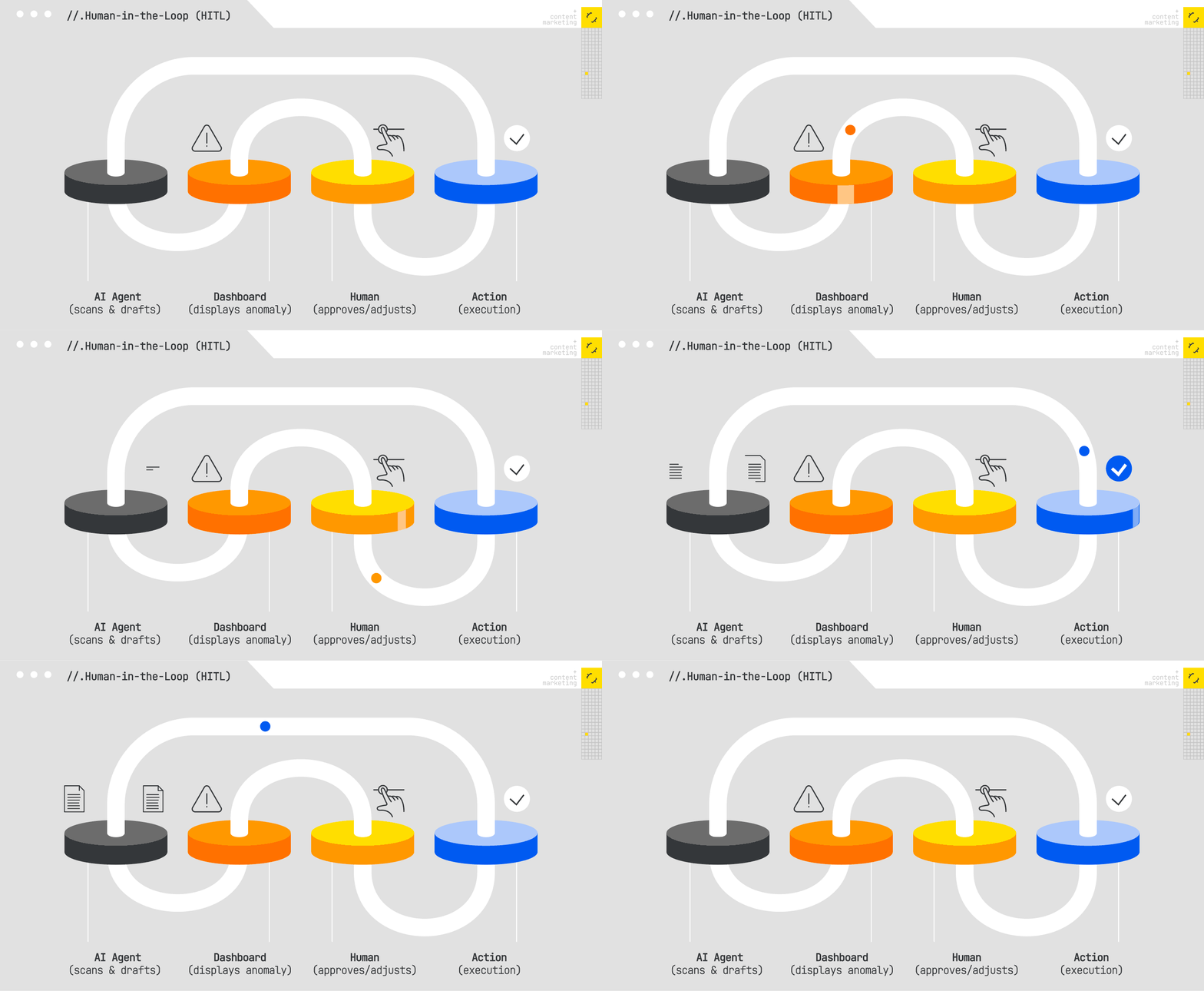
Define clear KPIs such as time savings, error rates, or customer-satisfaction scores. Once the pilot demonstrates ROI, leverage the established data connections and governance structures to expand the automation to more complex use cases.
Ensure your automation strategy includes robust data-privacy measures and transparency. AI systems should be designed to be understandable and fair, with clear boundaries that protect sensitive information.
A growing number of companies provide tools to automate complex workflows, though they target different aspects of business operations. Here are a few we use at iPullRank:

As we have explored, the true power of agentic AI lies not just in its ability to process information, but in its capacity to reason and execute. By implementing a strategic audit, selecting the right tools, and maintaining an HITL philosophy, organizations can transform from reactive entities into proactive, automated engines of growth.
If your brand isn’t being retrieved, synthesized, and cited in AI Overviews, AI Mode, ChatGPT, or Perplexity, you’re missing from the decisions that matter. Relevance Engineering structures content for clarity, optimizes for retrieval, and measures real impact. Content Resonance turns that visibility into lasting connection.
Schedule a call with iPullRank to own the conversations that drive your market.

The appendix includes everything you need to operationalize the ideas in this manual, downloadable tools, reporting templates, and prompt recipes for GEO testing. You’ll also find a glossary that breaks down technical terms and concepts to keep your team aligned. Use this section as your implementation hub.
//.eBook

The AI Search Manual is your operating manual for being seen in the next iteration of Organic Search where answers are generated, not linked.
Prefer to read in chunks? We’ll send the AI Search Manual as an email series—complete with extra commentary, fresh examples, and early access to new tools. Stay sharp and stay ahead, one email at a time.

We’ll break it up and send it straight to your inbox along with all of the great insights, real-world examples, and early access to new tools we’re testing. It’s the easiest way to keep up without blocking off your whole afternoon.