
For decades, local queries like “where to get a sandwich” or a “plumber near me” followed a predictable path. A user typed a keyword into a search bar, scanned a list of links or a map pack, and clicked through to a website to find an answer. This was a world of manual discovery where businesses fought for the top spot by optimizing for algorithms.
But hyper-personalization in AI Search is pulling local search into the future. We are moving beyond the era of simple directory listings and keyword matching into a dynamic, intent-driven ecosystem defined as “Local 3.0.” Visibility is no longer just about ranking, but about probabilistic relevance and being the most trustworthy answer served to an AI agent that is already familiar with the user’s history, dietary restrictions, and brand loyalties before the question is even asked.
As search shifts from business websites into conversational interfaces like ChatGPT, Gemini, and Perplexity, we are moving toward optimizing for citations. This in turn requires a change in how local businesses must manage their digital footprint to remain discoverable.
This chapter will outline the impact of AI on local search, the critical role of memory and personalization in future queries, and the mechanics of visibility in an AI-fragmented world.
As local search migrates into AI interfaces, the Map Pack is undergoing a transformation: It is no longer just a list of three businesses with a map.
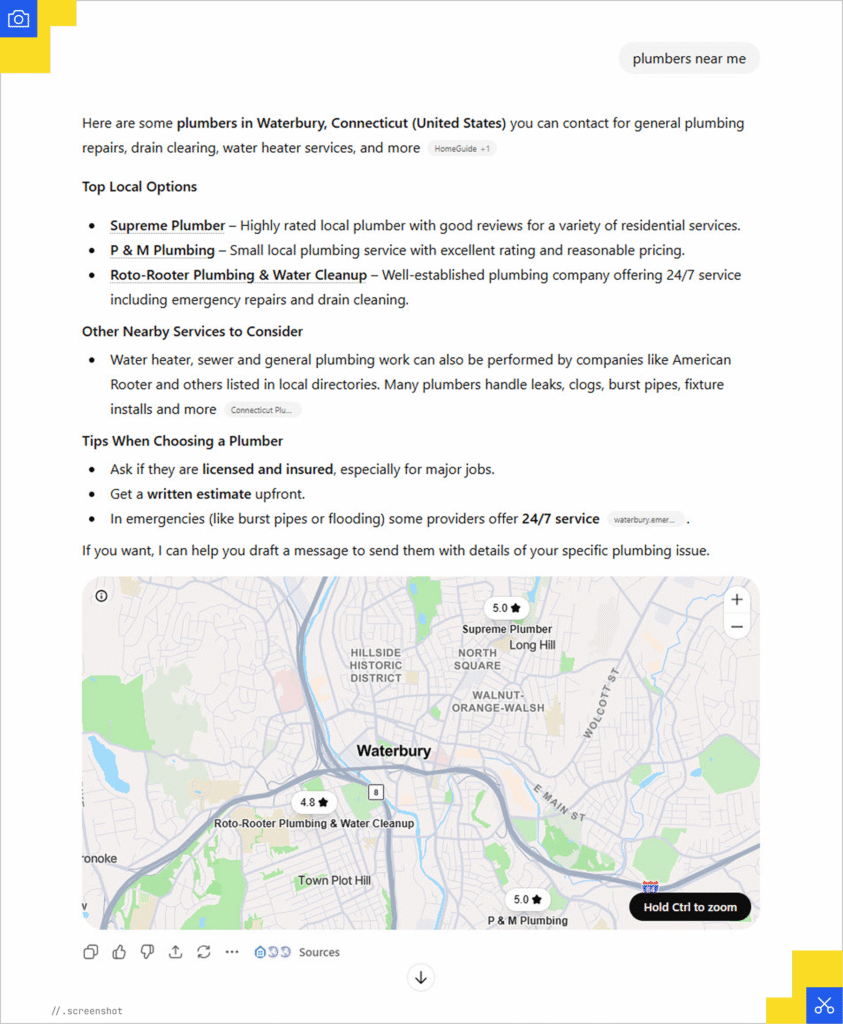
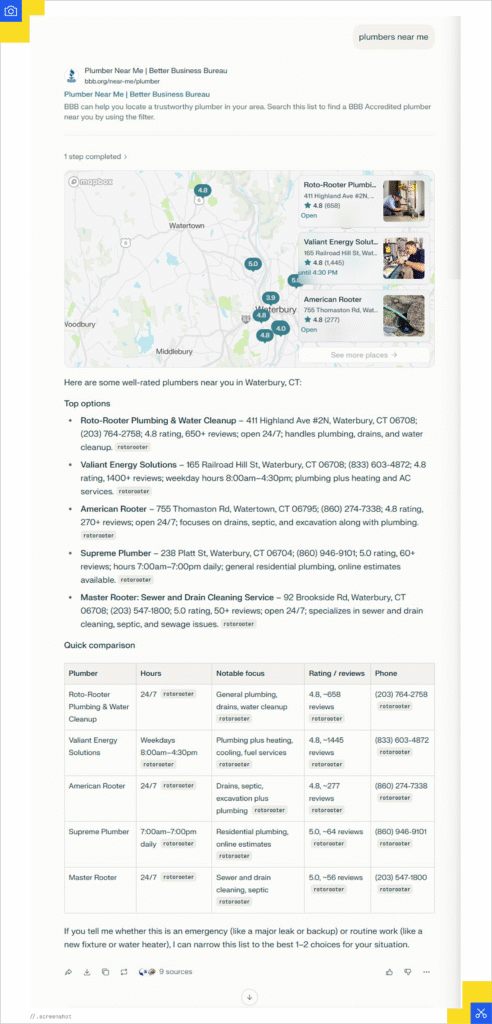
The visual layout varies depending on which model you’re using. While traditional Google Maps displays a broad grid of pins, AI platforms prioritize curated intent, as seen in this example of searching for “plumbers near me.”
ChatGPT: Along with a map, this model provides top local options, other nearby services to consider, and some tips to help you make your selection.
Perplexity: This platform also provides a map in its results, and lists sources alongside it, often grouping the results into categories. It even provided a quick comparison table.
Gemini: This model also groups the results into categories and offers a comparison table, and at the end gives a quick tip of how to prepare for service.

Despite the rise of LLMs, the Google Business Profile (GBP) remains the foundation for local AI visibility. AI models don’t just guess where you are — they pull from the Google Knowledge Graph.
But AI Overviews are now being blended directly into GBPs. So in the future, Google may no longer show a snippet of your website, because it has generated an AI summary at the top of the Map Pack instead.
This can make optimizing your GBP categories, attributes, and Q&A sections more critical than ever, since these are the data points the AI uses to create its summary.
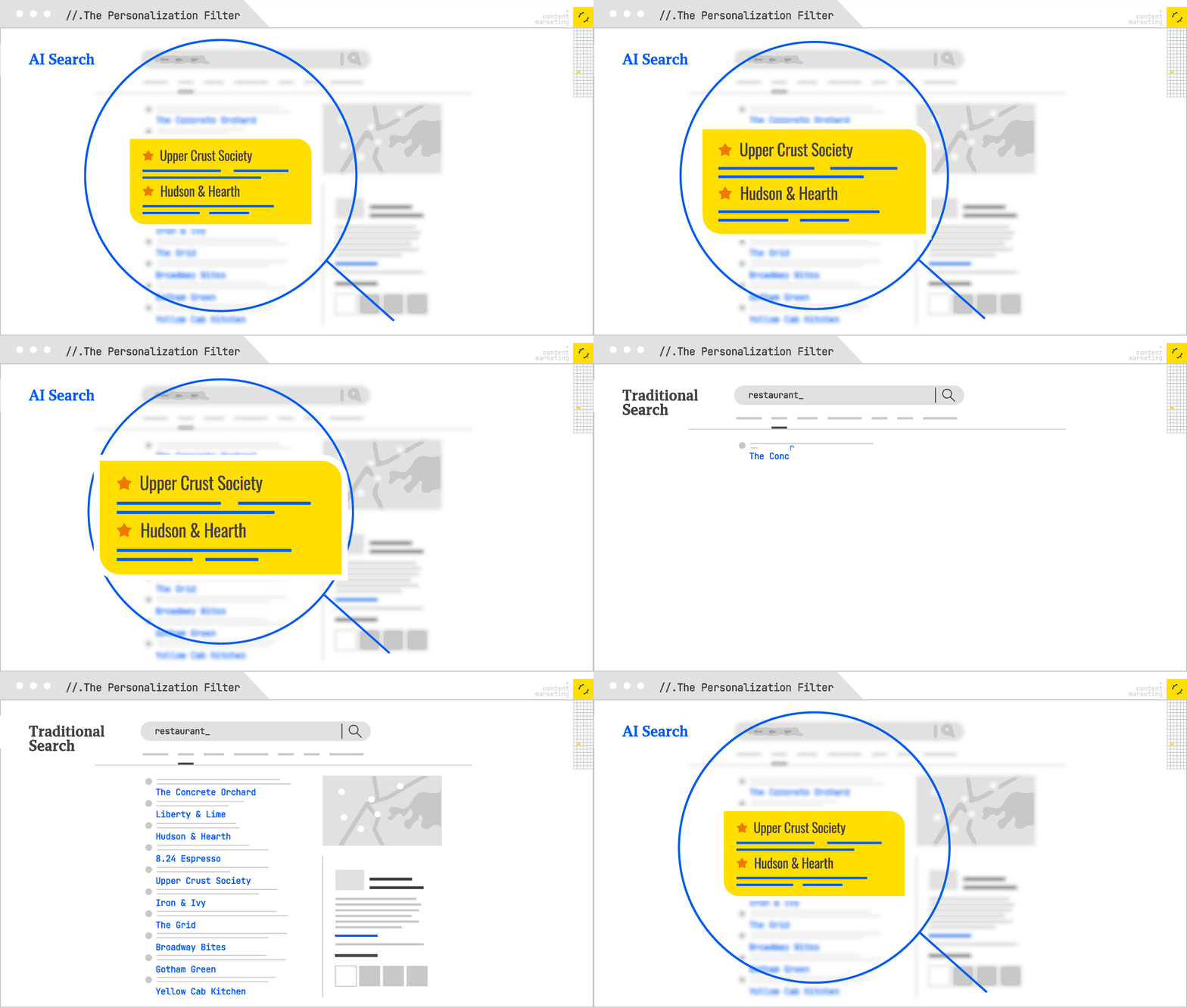
Historically, proximity was the king of local SEO. If you were the closest dry cleaner to the user, you won. Today, personalization is beginning to trump physical distance.
The most significant differentiator in future local AI Search is contextual memory. Recall that unlike traditional search engines that treat queries largely in isolation, advanced LLMs now have agentic capabilities that can remember past interactions, preferences, and loyalty memberships.
Future iterations of the models, such as ChatGPT-6, are expected to focus heavily on improving memory. This will allow for ever more hyper-personalized interactions where the AI maintains context over multiple exchanges.
In an environment where users can switch models instantly if they receive incorrect information, trust is the primary currency. Citations are the receipts that validate that trust.
AI models determine which local businesses to surface based on a probabilistic analysis of four factors: question, context, location, and model. To be visible, a business must have its information corroborated across multiple source types. A 2025 Yext study on 6.9 million citations categorized these sources by the type of information they verify:
If a fact appears only on a business’s website, an AI model views it as less trustworthy. When that same fact is corroborated by third-party reviews or directories, the probability of the business appearing in an AI answer increases.
To optimize for local search today, businesses must focus on how they appear in LLM answers through these methods:
Discovery is becoming a seamless, automated byproduct of trust and historical relevance. So local businesses must stop viewing their digital presence as a series of static storefronts and start treating it as a living, interconnected data ecosystem.
While traditional search methods may be fading, the demand for local expertise is stronger than ever. By optimizing for answers rather than just keywords, and by prioritizing probabilistic relevance over simple rankings, brands can ensure they become the definitive answer.
If your brand isn’t being retrieved, synthesized, and cited in AI Overviews, AI Mode, ChatGPT, or Perplexity, you’re missing from the decisions that matter. Relevance Engineering structures content for clarity, optimizes for retrieval, and measures real impact. Content Resonance turns that visibility into lasting connection.
Schedule a call with iPullRank to own the conversations that drive your market.

The appendix includes everything you need to operationalize the ideas in this manual, downloadable tools, reporting templates, and prompt recipes for GEO testing. You’ll also find a glossary that breaks down technical terms and concepts to keep your team aligned. Use this section as your implementation hub.
//.eBook

The AI Search Manual is your operating manual for being seen in the next iteration of Organic Search where answers are generated, not linked.
Prefer to read in chunks? We’ll send the AI Search Manual as an email series—complete with extra commentary, fresh examples, and early access to new tools. Stay sharp and stay ahead, one email at a time.

We’ll break it up and send it straight to your inbox along with all of the great insights, real-world examples, and early access to new tools we’re testing. It’s the easiest way to keep up without blocking off your whole afternoon.