The AI Search Manual

CHAPTER 21

The Transformation of Ecommerce in AI Search

Ecommerce chapter header

A study from Profound indicates that 58 percent of American shoppers already use AI at least once a week to browse or make purchases. This rapid adoption, occurring only three years after the launch of ChatGPT, just emphasizes the lightning speed of the transition of search toward a zero-click environment, where user behavior dictates a new digital strategy. With AI-driven traffic expected to rise by 520 percent year-over-year, the e-commerce industry must adapt to an industry where search has become a complex, omni-channel journey. 

Google CEO Sundar Pichai said in January 2026 that retailers processing tokens on their API had seen an eleven-fold increase over the prior year, jumping from 8.3 trillion to over 90 trillion tokens. It’s clear that the industry is shifting.

This chapter will detail how e-commerce has evolved over the years, and what AI Search and agentic commerce will mean for its future. 

Multi-surface shopping journey

The Evolution of Ecommerce Search

Since its 2002 launch, Google Shopping has functioned primarily as an advertising platform. Visibility was gated by ad spend: If a brand didn’t bid, they weren’t seen, regardless of product quality. 

Simultaneously, Amazon built its own closed loop, dominating the market by controlling the entire funnel of discovery, reviews, and logistics within a single ecosystem.

Today, we are witnessing an e-commerce renaissance, driven by AI. The search experience has evolved from keyword matching (finding a string of text) to semantic reasoning (understanding user intent and product attributes).

Keyword Matching vs. Semantic Reasoning

Google has pivoted to a multimodal Shopping Graph, utilizing tools like Google Lens and virtual try-ons to understand products visually and contextually.

OpenAI has introduced conversational discovery, which makes shopping feel less like querying a database and more like a consultation. An AI agent can now answer complex prompts like “find an air purifier for a small apartment with pets” by reasoning through specifications rather than just matching keywords.

The Rise of Agentic Commerce

The most radical development in this new era is agentic commerce, a protocol through which AI agents autonomously compare products and complete checkouts on a user’s behalf. This shift marks the rise of the zero-click environment, which removes the human middleman from the research phase.

At the 2026 National Retail Federation conference, Google introduced the Universal Commerce Protocol (UCP), an open standard designed to let systems talk to each other. 

Unlike Amazon’s closed system, the Model Context Protocol (MCP) used by Anthropic and OpenAI acts as an infrastructure-agnostic layer above existing commerce platforms. Through partnerships with Shopify, Walmart, Stripe, and PayPal, ChatGPT facilitates transactions across multiple merchants without owning inventory. 

The model also offers merchants control, via flags like enable_search and enable_checkout, which allow them to decide if they want the AI to facilitate the transaction or just refer the user.

The Protocol Bridge Diagram

Some other implications of agentic commerce:

  • Marketing to Machines: Marketers are no longer just persuading humans, but providing data to third-party agents that act as gatekeepers.
  • High-Intent Conversion: While brand interaction decreases, conversion rates may rise. Users employing agents have already bypassed the consideration phase and are ready to buy.
  • Volatile Visibility: The landscape is unstable. Citations for top websites fluctuate wildly, and search behavior has never been more complex.

OpenAI’s Agentic Commerce Protocol vs. Google’s Universal Commerce Protocol

Both protocols aim to facilitate agentic commerce. However, they differ significantly in their technical architecture, data philosophy, and the level of control they offer merchants.

Here’s where they differ:

Philosophy and Ecosystem Strategy

  • Google’s Universal Commerce Protocol (UCP):
    • Open and Agnostic: UCP is  designed to work across different industry verticals.
    • Interoperability: UCP was explicitly built to be compatible with other existing protocols, such as Agent2Agent, the Agent Payments Protocol, and the Model Context Protocol.
    • Retailer-Centric: Google emphasizes that under UCP, the retailer remains the “merchant of record,” owning and shaping the customer relationship throughout the transaction.
    • Partners: UCP was built in collaboration with major retailers including Shopify, Etsy, Wayfair, Target, and Walmart.


  • OpenAI’s Agentic Commerce Protocol (ACP):
    • Infrastructure Layer: The protocol has been positioned as a conversational layer that sits above existing commerce platforms. It facilitates discovery and transactions across various merchants (like Shopify or Etsy) without owning inventory or managing shipping.
    • Selective Partnership: Unlike Google’s open-ecosystem approach, OpenAI currently operates on a rolling admission basis where merchants must apply to join. The company is manually approving partners to mitigate manipulation by bad actors.
    • The “Anti-Amazon” Model: By connecting disparate merchants through a single AI interface, OpenAI’s model decouples the discovery layer from the inventory layer.

Data Structure: Unified vs. Split Feeds

The most distinct technical difference between the two protocols lies in how each uses product data to power AI reasoning.

  • OpenAI (Unified Schema):
    • Consolidated Data: OpenAI’s specification merges all product information into a single feed. This includes attributes, pricing, inventory, and user-generated content (UGC) like reviews and Q&As.
    • Reasoning Attributes: The Agentic Commerce Protocol introduces relationship_type fields (such as complementary_with and progression_from) that allow merchants to explicitly define logical connections between products (as with a yoga mat and yoga blocks).
    • Rich Media: The protocol explicitly supports video_link and model_3d_link attributes, treating the feed as a multimedia content engine.
  • Google (Split System & UCP Integration):
    • Fragmented Feeds: Google traditionally uses a split-feed system, separating data into a core product feed, inventory feed, and product reviews feed.
    • UCP Functionality: While Google’s Shopping Graph indexes billions of products, UCP specifically focuses on the transactional layer.

Merchant Control and Visibility

  • OpenAI:
    • Explicit Flags: The Agentic Commerce Protocol offers merchants granular control via enable_search and enable_checkout flags. These allow a brand to decide if they want to be visible in discovery but disable the AI’s ability to complete the transaction (perhaps to preserve first-party data capture).
    • Metadata: OpenAI allows unique metadata regarding when an item was created or updated, which can help improve user trust.
  • Google:
    • Dynamic Personalization: UCP allows merchants to recognize returning customers and provide specific offers based on past purchases, or give a personalized new-member price to a first-time customer.
    • Visibility: In Google this is historically tied to ad spend and algorithmic ranking within the Shopping Graph, though UCP aims to streamline the decision phase of shopping.

Feature

OpenAI Agentic Commerce Protocol

Google Universal Commerce Protocol (UCP)

Primary Goal

Create a reasoning layer above commerce platforms

Create an open standard for agent transactions

Data Structure

Unified feed (merges reviews, media, attributes)

Split feeds (core, inventory, reviews are separate)

Unique Attributes

relationship_type (e.g., complementary_with)

Dynamic personalization (loyalty/past orders)

Merchant Control

enable_search / enable_checkout flags

Merchant remains “merchant of record”

Access

Rolling admission/
application-based

Open, agnostic standard

Media Support

Explicit video_link & model_3d_link in feed

Leverages visual embeddings & Shopping Graph

As the industry continues moving toward agentic protocols, the traditional shopping funnel is collapsing. This means brands should focus on translating their inventory into semantically rich, resonant narratives.

Strategy for Achieving Visibility

To maintain visibility, marketers must shift their focus to Relevance Engineering and omnimedia strategies. The following areas are critical for modern ecommerce shops:
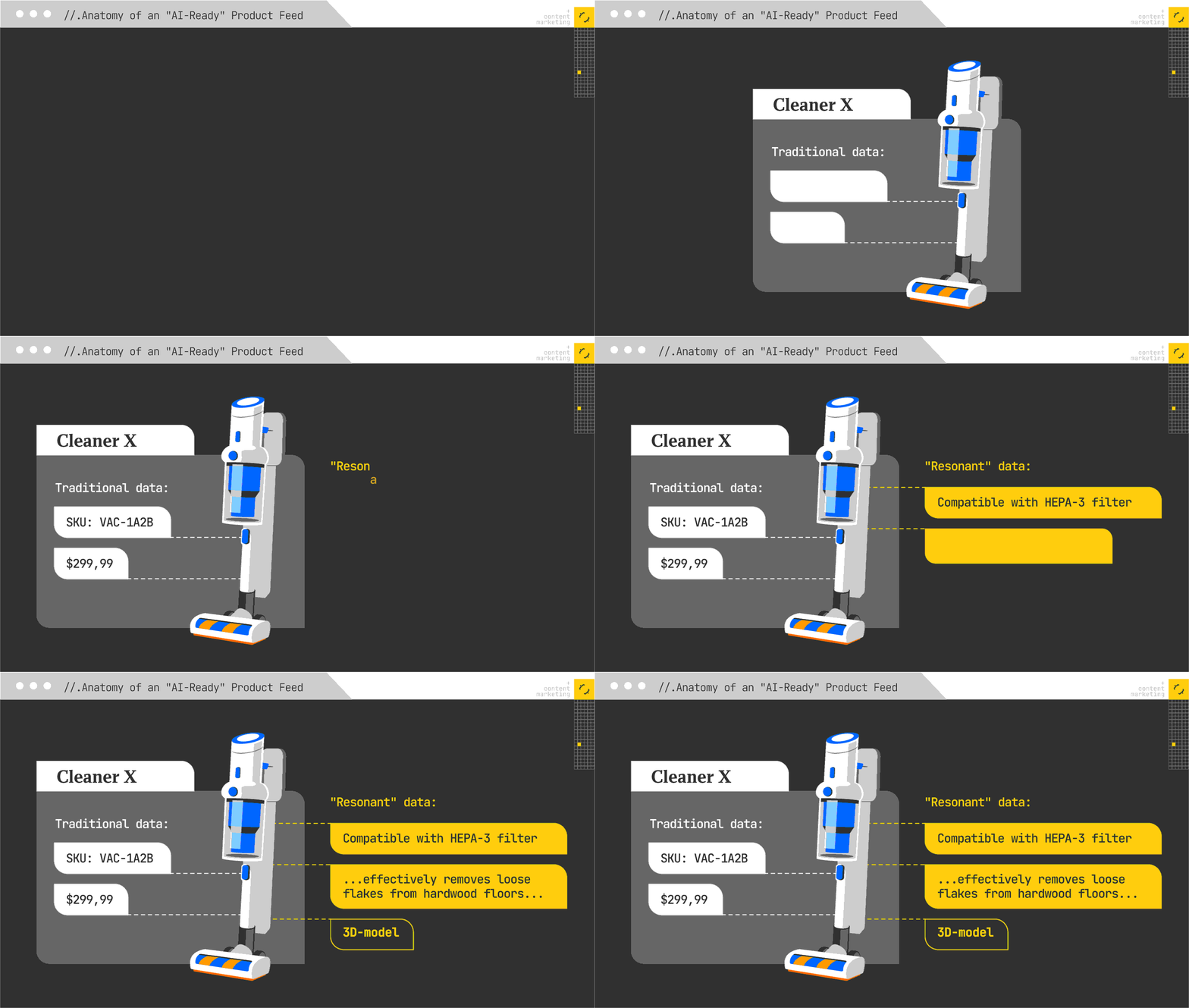
  1. Treat the Product Feed as Content: This feed is now the source of a product’s semantic identity. Marketers must therefore ensure feature completeness, filling out every possible field to ensure they don’t fail the filters of an AI agent.
  2. Develop “Feed Resonance” Through Emotional Architecture: Transactional data (SKU, price) is insufficient for AI models trained on human language. Marketers should instead use resonant descriptions that explain the “why” behind a product. For example, instead of just listing “vacuum insulation,” a good description explains that the insulation “keeps morning coffee hot through your entire commute.”
  3. Optimize for Multimodal Retrieval: AI systems are increasingly extracting meaning from visual embeddings and video. Brands need clean, consistent product photography and should also incorporate 3D models and video links directly into their unified product feeds.
  4. Utilize Relationship Attributes: To help AI understand a brand’s entire ecosystem, marketers should use relationship_type fields. These define how products are complementary to, alternatives for, or progressions from one another, helping AI recommend the right item for a specific stage in a customer’s journey.
  5. Cultivate Contextual and Scenario-Based Reviews: Generic five-star reviews offer little semantic value to AI. Marketers should be soliciting reviews that describe specific use cases, such as how a product performed in a particular environment (such as, “kept ice frozen for 14 hours during a power outage”). This provides the high-trust, authentic language that AI models use to validate product claims.
  6. Ensure Technical Readiness for Agents: Visibility in agentic commerce requires structured behavioral metadata and APIs that allow a site to “speak” to AI agents. Marketers must also proactively apply to join new protocols that require it, such as OpenAI’s Agentic Commerce Protocol, to ensure their products are eligible for automated discovery and checkout.
Anatomy of an "AI-Ready" Product Feed

Visibility in the future of ecommerce depends on creating resonant, semantically rich narratives across every digital touchpoint. You want to ensure that when an AI agent or a human shopper asks a question — whether through a Google search or a ChatGPT consultation — your product is the most contextually relevant answer.

 As Sundar Pichai noted, the goal is to move from a world where users sort through pages of results to one where AI does the hard work of narrowing down exactly what they want.

We don't offer SEO.

We offer
Relevance
Engineering.

If your brand isn’t being retrieved, synthesized, and cited in AI Overviews, AI Mode, ChatGPT, or Perplexity, you’re missing from the decisions that matter. Relevance Engineering structures content for clarity, optimizes for retrieval, and measures real impact. Content Resonance turns that visibility into lasting connection.

Schedule a call with iPullRank to own the conversations that drive your market.

MORE CHAPTERS

APPENDICES

The appendix includes everything you need to operationalize the ideas in this manual, downloadable tools, reporting templates, and prompt recipes for GEO testing. You’ll also find a glossary that breaks down technical terms and concepts to keep your team aligned. Use this section as your implementation hub.

//.eBook

The AI Search Manual

The AI Search Manual is your operating manual for being seen in the next iteration of Organic Search where answers are generated, not linked.

Want digital delivery? Get the AI Search Manual in Your Inbox

Prefer to read in chunks? We’ll send the AI Search Manual as an email series—complete with extra commentary, fresh examples, and early access to new tools. Stay sharp and stay ahead, one email at a time.

Want the AI Search Manual

In Bites-Sized Emails?

We’ll break it up and send it straight to your inbox along with all of the great insights, real-world examples, and early access to new tools we’re testing. It’s the easiest way to keep up without blocking off your whole afternoon.